
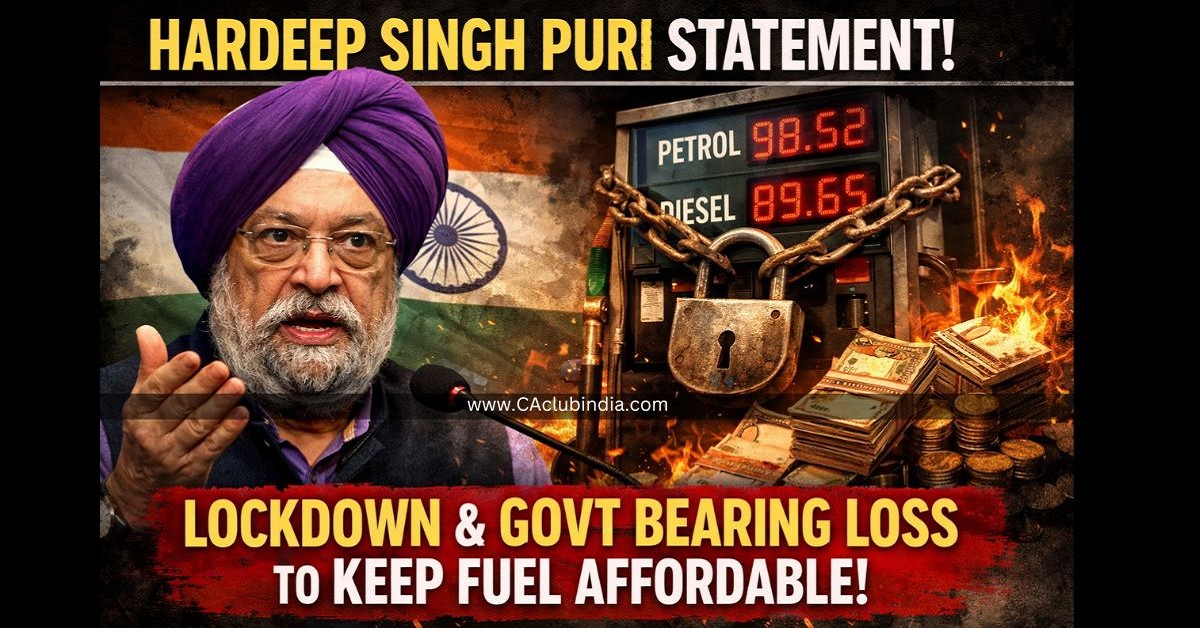
On Friday (27th March 2026), Union Minister for Petroleum and Natural Gas Hardeep Singh Puri said there is NO plan to impose a lockdown in India, which was previously implemented during the pandemic period.
The Minister Hardeep Singh Puri said the rumours of lockdown are "completely false" and misleading.
He criticised the rumours of lockdown in such a situation and said spreading such misleading news is a "irresponsible and harmful. As these rumours can:
- Create panic among people
- Spread confusion
- Disturb normal life
India's Response to the Global Energy Crisis
Current Crude Oil prices
Union Minister highlighted that Crude oil prices surged sharply from $70 to $122 per barrel in one month. The upward trend forced to hike the prices of petrol and diesel across the globe.
Impact
Fuel prices increased worldwide:
| Foreign Nations | Fuel Prices Hike Rate |
| Southeast Asia | 30–50% |
| North America | 30% |
| Europe | 20% |
| Africa | 50% |
But in India, Prime Minister Narendra Modi choose not to fully pass on rising costs to citizens. He accepted huge financial losses.
Estimated losses:
Oil companies were facing losses around:
- Rs 24 per litre on petrol
- Rs 30 per litre on diesel
The government also added an export tax on fuel. If Indian refineries want to sell petrol or diesel to foreign nations, will have to pay extra tax.
Finance Minister Decision
The FM Nirmala Sitharaman announced that due to the West Asia crisis, the excise duty on petrol and diesel for domestic consumption has been reduced by Rs 10 per litre each.
Later, on 27th March 2026 the government reduced excise duties for petrol to:
- Rs 3 per litre on petrol
- Rs 0 on diesel
To balance the situation, the government also added taxes on exports:
- Diesel export tax: Rs 21.5 per litre
- ATF (aircraft fuel) export tax: Rs 29.5 per litre
The government has made this decision by taking a huge hit on its taxation revenues to ensures that petrol and diesel prices doesn't rise too much for the Indian citizen, even when global prices are very high.









 CAclubindia
