
From Swiggy Sales to POS Data: How Tax Authorities Are Tracking B2C Businesses


Quick Summary
Tax authorities are increasingly using data triangulation from various sources, including POS systems, aggregator platforms like Swiggy, utility bills, and banking transactions, to monitor B2C businesses. Recent surveys have uncovered significant suppressed sales, leading to increased scrutiny on sectors like restaurants. Businesses are advised to ensure transparent reporting, reconcile POS data with tax filings, and accurately record all revenues and expenses to maintain compliance.

It looks like the government is moving toward data triangulation across multiple sources (POS, aggregator platforms, utilities, banking transactions, GST filings, and ITRs). For businesses, the safest path forward is transparent reporting and proactive reconciliation before authorities come knocking.

Recently, the Income Tax Department's survey revealed suppressed sales worth Rs 408 crore across restaurants, with 63,000 establishments flagged for review before March 31, 2026. The action on restaurants seems to paint a picture of how tax authorities are tightening compliance in the broader B2C sectors. 
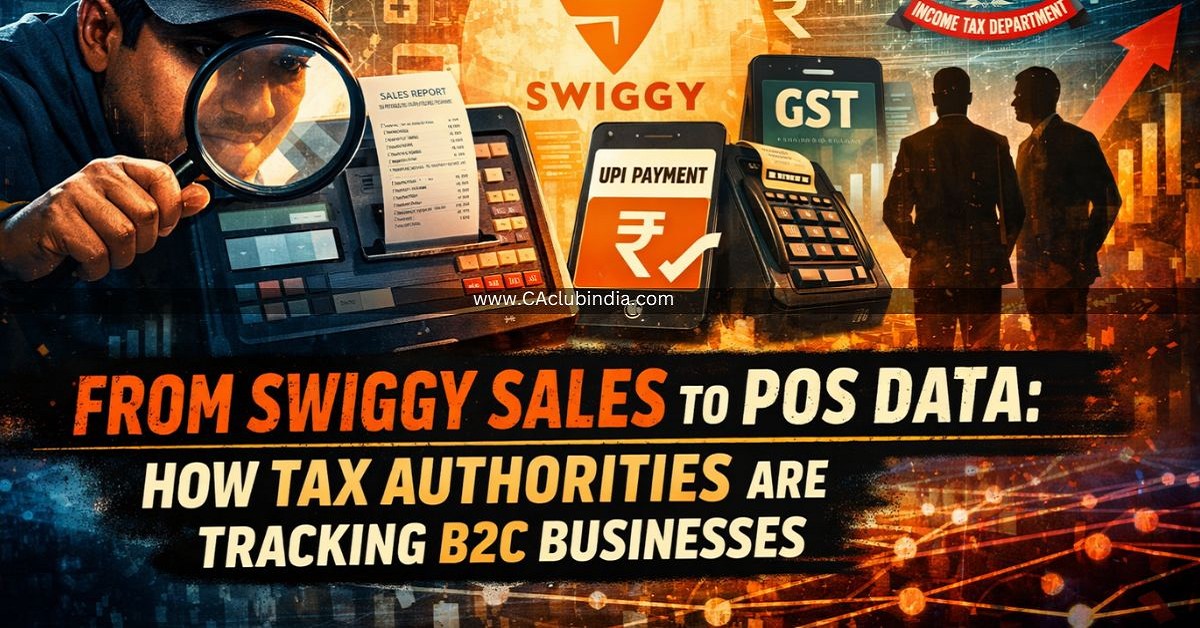
Tax Authorities Track B2C Sales: POS, Swiggy Data and More

The most common irregularities include:

  • Bulk deletion or modification of bills.
  • Not reporting banquet/party bookings.
  • Fake purchase bills from unregistered vendors.
  • Under-reporting aggregator sales (Swiggy/Zomato).
  • Ignoring TDS/TCS and utility consumption data.
  • Input/output mismatches in exempt sectors.

Restaurants and other B2C sectors seem "sensitive" and under close scrutiny now.

Some pointers on the way forward are as follows:

  • Reconciling POS/billing software with accounts and tax filings.
  • Properly recording aggregator revenues.
  • Matching purchases with sales and stock reconciliations.
  • Monitoring inflated expenses against industry averages.
  • Tracking family spending, investments, and SFT (Specified Financial Transactions).
  • New PAN rule from April 1, 2026, under Income Tax Act 2025: Cash withdrawals above Rs 10 lakh per account will be reported as SFT transactions. Hence, cash withdrawals need to be accounted for minutely.
 

The Big picture seems that this isn’t just about restaurants, the net may widen to include:

  • Retail shops, hotels, real estate developers, jewellery, transport/logistics, influencers, and even professionals like doctors/lawyers who rely on cash billing.
  • GST departments (like SGST Karnataka) are already issuing notices to small restaurants about UPI transactions, hinting at deeper integration between GST and Income Tax monitoring.
 

The SAKSHAM NUDGE campaign is now designed to encourage voluntary compliance rather than punitive action, but clearly backed by strong data. Incase applicable, taxpayers may utilise the opportunity to file ITR-U.

FAQ :

Tax authorities are using data triangulation from multiple sources, including POS systems, aggregator platforms (like Swiggy/Zomato), utility bills, banking transactions, GST filings, and Income Tax Returns (ITRs).

Common irregularities include bulk deletion or modification of bills, not reporting banquet/party bookings, fake purchase bills, under-reporting aggregator sales, ignoring TDS/TCS, and input/output mismatches.

Businesses should reconcile POS/billing software with accounts and tax filings, properly record aggregator revenues, match purchases with sales, monitor expenses against industry averages, and track family spending and investments.

From April 1, 2026, cash withdrawals above Rs 10 lakh per account will be reported as Specified Financial Transactions (SFT), requiring minute accounting for such withdrawals.

Restaurants and other B2C sectors like retail shops, hotels, real estate developers, jewellery, transport/logistics, influencers, and professionals such as doctors and lawyers are under close scrutiny.

The SAKSHAM NUDGE campaign is designed to encourage voluntary compliance by tax authorities, supported by strong data analysis.


About the Author

DESIGNATED PARTNER

Mr. Vivek Jalan is a FCA, Qualified LL.M (Constitutional Law) and LL.B. He is the Chairman of The Fiscal Affairs and Taxation Committee of The Bengal Chamber of Commerce and Industry. He is the Convenor on Indirect Taxes of the CII- Economic Affairs and Taxation Committee (ER); He is also a visiting faculty for Indirec ... Read more

Click here to Login and post comments    OR


Related Articles


Loading


Popular Articles


CCI Pro

CCI Articles

submit article


Company
23 July 2026
Semi qualified CA

Garg Bros & Associate CA

New Delhi

CA Inter

View Details
Company
Featured 18 July 2026
CA Articleship

apricus india

Mumbai

CA Inter

View Details
Company
ARTICLESHIP 10 July 2026
Article Assistant

N S Gokhale & Co

Thane

CA Inter

View Details
Company
Featured 16 July 2026
Semi Qualified Company Secretary

Vakilsearch.com

Chennai

CS

View Details
Company
ARTICLESHIP 30 June 2026
Taxation Content Writer Intern

Interactive Media Pvt Ltd.

New Delhi

CA Inter

View Details
Company
14 July 2026
Senior Executive/ Manager

H S SHARMA AND CO

Pune

CA Final

View Details
Company
ARTICLESHIP 16 July 2026
CA Article

Pipara & Co. LLP.

Mumbai

CA Inter

View Details
Company
16 July 2026
CA Inter, CA Intermediate, CA IPCC, CA CPT , CA SemiQualifie

Vakilsearch.com

Chennai

CA Inter

View Details