
Form 26Q is an essential document for reporting Tax Deducted at Source (TDS) on payments unrelated to salaries in India. This form is regulated by Section 200(3) of the Income Tax Act, 1961, and needs to be submitted quarterly by any deductor making certain types of payments.
This form is required under Section 200(3) of the Income Tax Act, 1961, as well as Rule 31A of the Income Tax Rules, 1962.
Applicability
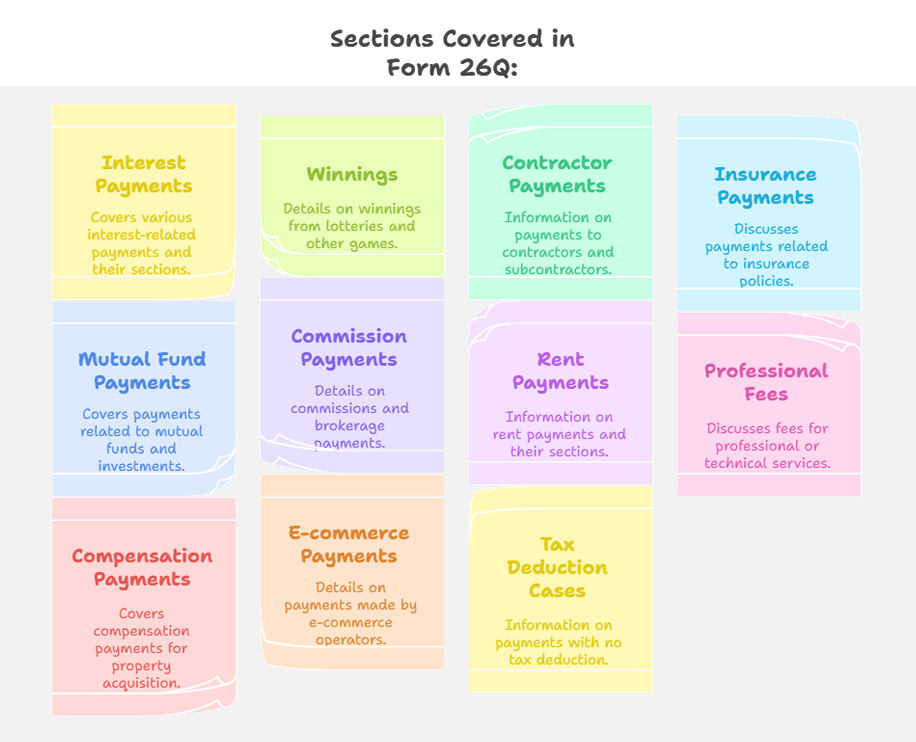
Submitted TDS returns for deductions on non-salary payments across different sections, such as:
Quarterly Filing
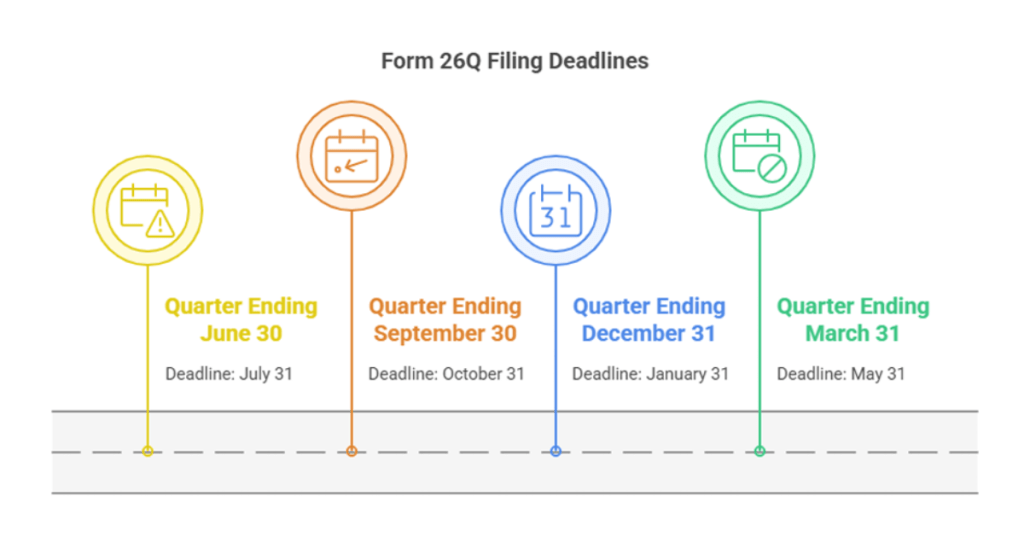
The due dates are:
| Quarter | Period | Due Date |
| Q1 (April-June) | 1 Apr - 30 Jun | 31-Jul |
| Q2 (July-Sept) | 1 Jul - 30 Sep | 31-Oct |
| Q3 (Oct-Dec) | 1 Oct - 31 Dec | 31-Jan |
| Q4 (Jan-Mar) | 1 Jan - 31 Mar | 31-May |
Who Needs to File Form 26Q?
Form 26Q must be filed by:
- Deductors: Any person or organization responsible for making payments subject to TDS, including companies, firms, or individuals.
- Types of Payments: This encompasses payments such as professional fees, rent, interest, commissions, and other specified payments that are subject to TDS regulations.
Downloading Form 26Q from TRACES
- Visit the Official Website: Go to the official NSDL website at https://www.protean-tinpan.com/.
- Navigate to Downloads: Click on the “Downloads” tab and select “ETDS/E-TCS” from the drop-down menu.
- Select Quarterly Returns: Click on “Quarterly Returns” and then choose “Regular.”
- Download Form 26Q: You will be redirected to a new page where you can find Form 26Q listed under the “Form” section. Click on it to download.
By following these steps, you can easily obtain Form 26Q for your TDS filings related to non-salary payments.
Filing Form 26Q
Visit the official Protean website and navigate to the downloads section.
- Select "e-TDS/e-TCS" and then choose "Quarterly Returns" followed by "Regular" to download the TDS utility.
- From the same downloads section, select and download the e-TDS/e-TCS RPU (Return Preparation Utility).
- Extract the downloaded ZIP file and open the RPU tool. Ensure you have Java installed to run the application.
- In the RPU tool, choose Form 26Q from the drop-down list and click "Continue."
- Fill in all necessary information, including details of deductor, deductees, and challan information (such as BSR code, payment date, total amount, etc.).
- After entering all relevant data, click "Save" to save your work. Then click "Create File" to generate the TDS return file.
- Use File Validation Utility (FVU) software to verify the generated file for any errors.
- Log in to the Income Tax e-filing portal using your TAN and password.
- Navigate to “e-file” and select “Income Tax Forms” to upload your verified Form 26Q.
- If applicable, select a payment mode (net banking, debit card, etc.) to pay any TDS due before filing.
Filing Requirements
To file Form 26Q, the following details are necessary:
- Deductor Information: Name, address, and Tax Deduction and Collection Account Number (TAN).
- Deductee Information: Full names, addresses, and Permanent Account Numbers (PAN) of the payees.
- Challan Details: Basic Statistical Return Code (BSR Code), payment date, and total amount paid.
- Nature of Payment: Specification of the type of payment made according to the relevant sections of the Income Tax Act.
Penalties
Failure to file Form 26Q on time can result in various penalties, including:
- Late Filing Fee: A fee under Section 234E may be levied for late submission of TDS returns, which is ₹200 per day until the return is filed.
- Non-filing penalty: As per Section 271H, if Form 26Q is not filed within one year from the due date or is filed incorrectly, a penalty ranging from a minimum of ₹10,000 to a maximum of ₹1,00,000 may be imposed for such non-compliance.
- Interest on Late Payment: Interest may be charged under 220(2) for delayed payment of TDS.
- Penalties for Incorrect Information: Providing incorrect details can lead to further scrutiny and penalties as per tax regulations.
Form 26Q is essential for compliance with India's tax regulations concerning non-salary payments. Timely and accurate filing is crucial to avoid penalties, interest on late payments, and complications during tax assessments. Deductors should maintain detailed records of all TDS-related transactions to ensure proper reporting and fulfil their tax obligations effectively.
You have reached your daily limit of 2 Free Articles
Subscribe to CCI PRO for unlimited access
Why Upgrade to CCI PRO?
- No Ads
- WhatsApp Community
- Daily E-Newsletter
- Unlimited Articles Access
- Profile Visitors
- Link Social Profiles
- Featured Job Posts
- Pro Badge
- Expert GST Guidance
- Unlimited Forum Replies
- Download Content in PDF
Already a PRO member? Login here for an ad-free experience. 07941056694










 CAclubindia
