 Poojitha Raam Vinay
Millions of taxpayers across India have excess tax deducted at source (TDS) from their income - whether from salary, rent, interest, professional fees, or property transactions. The usual solution was to file an ITR and wait months for a refund. A smarter route has always been to apply for a lower or nil TDS certificate in advance.
Under the old Income Tax Act, 1961, this was done via Form 13 under Section 197. But from 1st April 2026, with the Income Tax Act, 2025 coming into force, the game has changed.
Form 128 - the new, restructured declaration form for obtaining a lower or nil tax deduction certificate under Section 395(1) and 395(3) of the Income Tax Act, 2025. Whether you are a salaried individual, business owner, NRI selling property, or a large corporate entity, understanding Form 128 is now essential for smarter tax management in Tax Year 2026-27 and beyond.
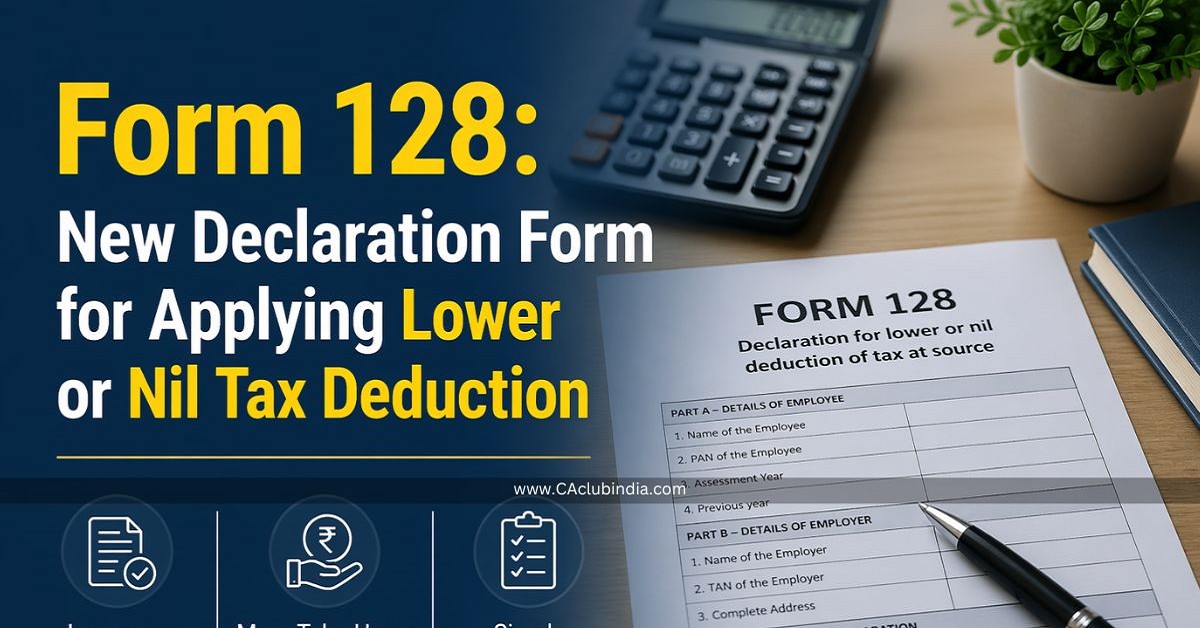
What Is Form 128?
Form 128 is an application filed by a taxpayer to obtain a certificate from the Assessing Officer authorising the payer to deduct or collect tax at source (TDS/TCS) at a lower or nil rate.
In simple terms: if your actual tax liability for a year is lower than the TDS being deducted from your income, you can apply to the Income Tax Department using Form 128. Once approved, your payer (bank, buyer, client, etc.) is legally authorised to deduct TDS at the reduced or zero rate specified in the certificate - instead of the standard rates.
The form is governed by Section 395 of the Income Tax Act, 2025, and Rule 213 of the Income Tax Rules, 2026. It is effective from 1 April 2026, replacing Form 13 under the old Income Tax Act, 1961.
Form 128 vs Form 13
| Feature | Old Form 13 | New Form 128 |
| Governing Act | Income Tax Act, 1961 | Income Tax Act, 2025 |
| Governing Section | Section 197 / 206C(9) | Section 395(1) / 395(3) |
| Governing Rule | Rules 28, 28AA, 28AB, 29, 37G, 37H | Rule 213, Income Tax Rules 2026 |
| Effective From | Prior to 1 April 2026 | 1 April 2026 onwards |
| Applicant Classification | Not categorised | 4 applicant categories |
| Terminology | Assessment Year / Financial Year | Tax Year |
| Filing Mode | Online (TRACES) | Online only (TRACES) |
Note: A certificate issued under Section 197 of the Income Tax Act, 1961 shall remain valid for payments/credits made on or after 1st April, 2026, provided that it is issued for lower/nil deduction of tax in respect of projected receivable for Tax Year 2026-27.
Who Can File Form 128?
Form 128 is applicable to both residents and non-residents seeking reduced tax rates on specified income such as interest, commission, rent, or professional fees.
More specifically, any person whose actual tax liability is lower than the TDS or TCS deducted can file Form 128 - irrespective of whether you are an individual or a company, receiving business income, capital gains or other income.
Form 128 classifies applicants into four categories:
- Registered Non-Profit Organisations - covered under specific provisions
- Specified Entities - as referred to in Section 263(9)(c) of the Income Tax Act, 2025
- Persons Carrying on Business or Profession - companies, firms, LLPs, proprietors
- All Other Persons - salaried individuals, investors, NRIs, retirees, etc.
The category you select determines which parts of the form, annexures, and declarations are applicable to you - reducing unnecessary compliance burden.
Structure of Form 128: What Is Inside?
Form 128 is a well-structured multi-part form. Here is a breakdown:
Main Parts
Part A - Applicant Details
Captures name, PAN, residential status, contact details, address, and designation. Fields have been separated into distinct boxes to eliminate system anomalies.
Part B - Nature of Applicant
You declare whether you are a Non-Profit Organisation, Specified Entity, Business/Professional entity, or other person.
Part C - Income and Tax Details
Estimated income, tax liability, past ITR details, advance tax paid, and TDS/TCS credits available.
Part D - Declaration for Non-Profit Organisations and Specified Entities
Applicable only to registered trusts, societies, and specified entities under Rule 213.
Part E - Declaration for All Other Applicants
This is the declaration section for individuals, businesses, and NRIs.
Verification and Digital Signature
The final section where the applicant signs and submits using DSC or EVC.
Annexures
Annexure-I is applicable for TDS applications where payer details are known. Annexure-II is applicable for TDS applications where the number of payers is likely to exceed 100 and their details are not available at the time of application - in such cases, the certificate is issued in the name of the applicant, who then generates Child Certificates for individual deductors. Annexure-III is applicable for TCS (Tax Collected at Source) applications.
What Are "Child Certificates" and Why Do They Matter?
This is one of the most important new features of Form 128, especially useful for businesses, mutual funds, stock brokers, and large enterprises.
When you use Annexure-II of Form 128 (i.e., when you have more than 100 payers whose details are not yet available), the Income Tax Department issues a master certificate in your name. This master certificate authorises you to receive specified payments at the approved lower rate. From this master certificate, you then generate Child Certificates - one for each payer/deductor who needs to deduct tax on your payments. Each child certificate specifies the exact rate at which that particular payer should deduct TDS.
Multiple child certificates can be generated, provided the total payment amount stays within the limit authorised by the master certificate.
Types of Income Covered Under Form 128
Form 128 can be used to seek lower or nil deduction on a wide range of income types, including:
- Interest income (FD, bank deposits, bonds)
- Rent from property
- Professional fees and technical service charges
- Commission and brokerage
- Contract payments
- Sale of property (especially for NRIs)
- Capital gains from sale of securities or real estate
- TCS (Tax Collected at Source) on purchases and transactions (via Annexure-III)
Documents Required to File Form 128
| Document | Purpose |
| PAN of the applicant | Mandatory - form cannot be submitted without PAN |
| TAN of payer(s) | Required in Annexure-I and III (where payer details are known) |
| Estimated income computation | Shows projected income and actual tax liability for the Tax Year |
| Last 4 years' ITRs | Required if available; if not filed, attach separate income computations |
| Audit reports / financial statements | For businesses, trusts, and entities |
| Advance tax payment details | Challan details of advance tax paid, if any |
| TDS/TCS credit details | From Form 26AS or AIS |
How to File Form 128 on the TRACES Portal: Step-by-Step
Form 128 cannot be filed offline. It must be mandatorily submitted electronically through the TRACES portal.
Here is the complete filing process:
Step 1: Log in to TRACES
Visit www.tdscpc.gov.in and log in as a Taxpayer using your PAN and TRACES credentials.
Step 2: Navigate to Form 128
Go to: TRACES Dashboard → e-File and View → File Forms → Select Form No. 128
Step 3: Select Applicant Category
Choose your applicable category (Non-Profit, Specified Entity, Business/Profession, or Others). This auto-filters the relevant parts and annexures.
Step 4: Fill the Online Form
Enter your income details, payer TAN, nature of income, estimated tax liability, and other required particulars. The new smart form auto-populates several fields from your TRACES profile.
Step 5: Upload Supporting Documents
Upload income computation, ITR copies, financial statements, and any other required supporting documents in the prescribed format.
Step 6: E-Verify and Submit
Verify using a Digital Signature Certificate (DSC) or an Electronic Verification Code (EVC) such as Aadhaar OTP or net banking.
Step 7: Receive Acknowledgement
Upon successful submission, an Acknowledgement Receipt Number (ARN) is generated. The application is then forwarded to your Jurisdictional Assessing Officer (AO).
Step 8: AO Processes and Issues Certificate
The Assessing Officer, on being satisfied that the total income of the payee justifies a lower rate or no deduction, will issue a certificate specifying the rate and its period of validity.
Step 9: Download Your Certificate
Once approved, go to: TRACES Dashboard → Downloads → Lower/Nil Deduction/Collection Certificates. Download and share with your payer.
Time Limit: When Should You File Form 128?
The application for obtaining the certificate in Form No. 128 should be filed with the Income Tax Department as early as possible. The applicant must apply for the certificate well before the date of transaction. Such application cannot be processed once the transaction involving TDS/TCS is completed.
This means:
- For property sales, apply before the sale deed is executed
- For FD interest or rent, apply at the start of the Tax Year or before payment is due
- For professional/contract fees, apply before the client makes the payment
How many times can you file in a year?
There is no statutory limit on the number of times Form No. 128 can be filed in a Tax Year. A taxpayer may file more than one application in Form No. 128.
NRIs and Form 128: Special Provisions
NRIs frequently face high TDS rates on property sale proceeds, rental income, and capital gains. Form 128 offers significant relief:
- Persons buying property from NRIs can apply for lower deduction directly on the Income Tax Portal using a PAN-based facility.
- NRIs can file Form 128 on the TRACES portal by selecting their residential status accordingly.
- Lower TDS certificates under Form 128 are particularly valuable for NRI property sales where buyers are required to deduct TDS at 20–30% on the entire sale value.
FAQs
What is Form 128 in Income Tax?
Form 128 is the new application form under the Income Tax Act, 2025 (Rule 213 of Income Tax Rules, 2026) for obtaining a certificate authorising your payer to deduct TDS or collect TCS at a lower or nil rate. It replaces old Form 13.
Who should file Form 128?
Any resident or non-resident taxpayer whose total tax liability for the year is lower than the TDS/TCS being deducted - whether they have salary, interest, rent, professional fees, capital gains, or other income - can file Form 128.
Is Form 128 mandatory?
No, it is optional. However, it is highly recommended if excess TDS is being deducted and you want to maintain better cash flow without waiting for refunds.
Where is Form 128 filed?
Form 128 must be filed exclusively on the TRACES portal (www.tdscpc.gov.in). There is no offline option and it cannot be submitted on the Income Tax e-filing portal.
How long is the Form 128 certificate valid?
The certificate is valid for the period specified in it by the Assessing Officer, unless withdrawn or modified. It can cover the entire Tax Year or a specific transaction period.
Can I file Form 128 multiple times in a year?
Yes. There is no restriction on the number of times Form 128 can be filed in a single Tax Year.
Can NRIs file Form 128?
Yes, both residents and non-residents can file Form 128.
What is the difference between Form 128 and Form 121?
Form 121 is the new equivalent of old Forms 15G/15H - a self-declaration for nil tax deduction submitted directly to the payer. Form 128, on the other hand, requires approval from the Assessing Officer and results in a formal certificate that is binding on the payer.
Does Form 128 cover TCS as well?
Yes. Annexure-III of Form 128 covers Tax Collected at Source (TCS) transactions.
What if I have more than 100 payers?
If the number of payers exceeds 100 and their details are not available, you use Annexure-II of Form 128. The AO issues a master certificate, from which you generate individual child certificates for each payer on the TRACES portal.











 CAclubindia