
Short answer
If you hold or trade crypto, you must report it in your Income Tax Return. Gains on transfer of a virtual digital asset (VDA) are taxed at a flat 30% (plus surcharge and cess), with no deductions allowed except the cost of acquisition, and a 1% TDS applies on transfers. A fresh August 2026 CBDT guidance note also tightens who has to report crypto transactions to the tax department.
Crypto is one of the most misunderstood items on an Indian tax return. Many small investors and business owners in Kerala assume that because gains are small, or because they only "moved coins between wallets", nothing needs to be declared. That is a costly misunderstanding. Below is a plain explanation of how crypto is taxed in India and what the latest rules mean for you.
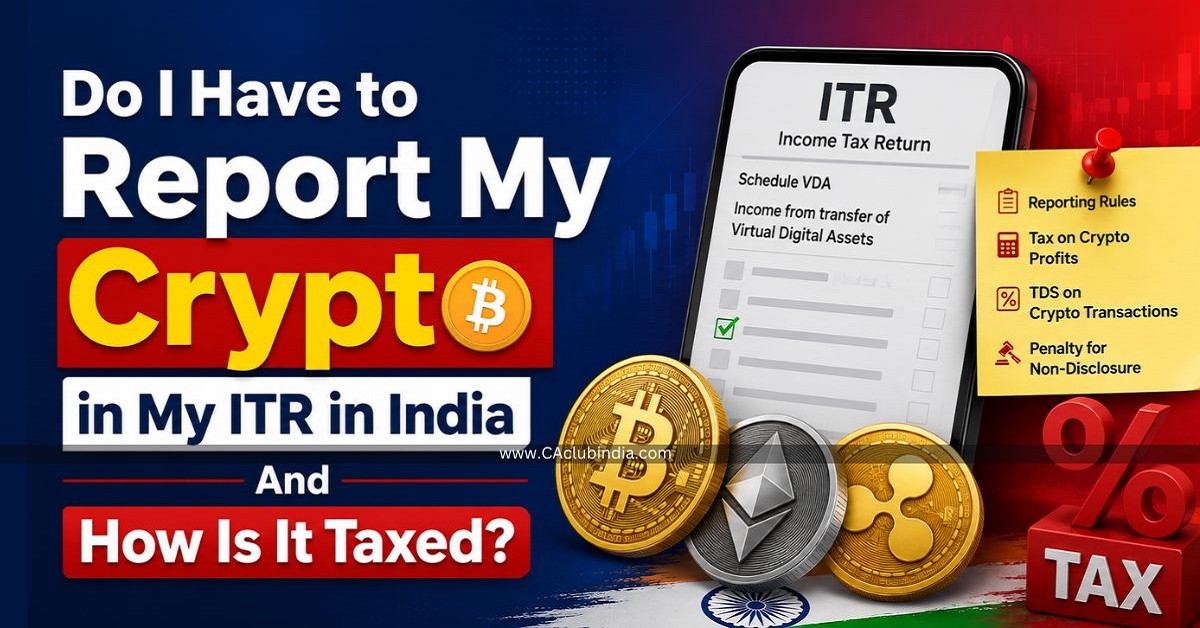
How is crypto taxed in India?
Under the income-tax framework, a virtual digital asset includes cryptocurrencies, crypto tokens and NFTs (Indian currency, foreign currency and central bank digital currency are excluded). Income from the transfer of a VDA is taxed at a flat rate of 30% plus applicable surcharge and cess. Two features make this regime unusually strict: no expense is deductible except the cost of acquisition, and a loss from one VDA cannot be set off against gain from another VDA or against any other income. So if you made a profit on one coin and a loss on another in the same year, you are still taxed on the profit in full.
What about the 1% TDS?
A 1% TDS applies under Section 194S when a payment is made to a resident for the transfer of a VDA. Where the payee is a non-resident, tax is instead deducted under Section 195. There are small thresholds below which TDS is not required: broadly, no TDS if the payment does not exceed Rs. 50,000 for a "specified person" (an individual or HUF with business turnover below Rs. 1 crore, professional receipts below Rs. 50 lakh, or no business/profession income), and Rs. 10,000 for all other payers. On Indian exchanges, this 1% is usually deducted automatically, and it appears in your Form 26AS / AIS - which is precisely why the department can see your trades.
Do I have to report crypto even if I made a loss?
Yes. Reporting is a disclosure obligation, not just a "tax due" trigger. If your trades show up in your Annual Information Statement (AIS) and your return does not, that mismatch is a common reason for notices. You should reconcile every exchange, wallet and P2P transaction against your AIS before filing, and disclose your holdings correctly even in a loss year.
What changed in August 2026?
In August 2026, the CBDT released a Guidance Note on Crypto-Asset Reporting Obligations under Section 509 of the Income-tax Act, 2025 (read with Rules 241 to 244 and Form 167). It is aligned with the OECD's Crypto-Asset Reporting Framework (CARF), a global standard for automatic exchange of crypto transaction information between countries. The reporting duty here falls on Reporting Crypto-Asset Service Providers (RCASPs) - exchanges, brokers, dealers and similar intermediaries - not on the individual investor. But the practical effect for the ordinary user is clear: crypto transactions are becoming far more visible to tax authorities, both in India and across borders. Under-reporting is getting harder, not easier.
What should a Kerala investor or SME do now?
Keep clean records. Maintain a transaction-wise log of every buy, sell, swap and transfer, with dates, amounts, INR values and the exchange used, and retain supporting statements. Reconcile against your AIS and Form 26AS before you file. Compute gains transaction-by-transaction (remember, losses do not offset each other). And if your business accepts crypto or you trade at scale, treat it as a proper accounting head in your books rather than an informal side activity.
Frequently asked questions
Is buying crypto taxable?
Simply buying and holding is not a taxable transfer. Tax arises when you sell, swap or otherwise transfer the asset. But holdings should still be tracked for accurate reporting.
Can I reduce the 30% tax with expenses like internet or advisory fees?
No. Only the cost of acquisition is allowed. No other expenditure or allowance is deductible against VDA gains.
Are gifts of crypto taxed?
A VDA received as a gift can be taxable in the recipient's hands under the normal gift provisions, subject to the usual exemptions (for example, gifts from specified relatives). Value it correctly on the date of receipt.
Does the 1% TDS mean my tax is fully paid?
No. The 1% TDS is only a credit against your final liability. The 30% tax on gains is separate, and you claim the TDS while filing your return.
Crypto reporting sits right at the intersection of accurate bookkeeping and correct ITR filing - which is exactly where errors turn into notices. At Saiph Business Solutions LLP, we help Kerala individuals and SMEs reconcile VDA transactions against the AIS and file returns correctly.
You have reached your daily limit of 2 Free Articles
Subscribe to CCI PRO for unlimited access
Why Upgrade to CCI PRO?
- No Ads
- WhatsApp Community
- Daily E-Newsletter
- Unlimited Articles Access
- Profile Visitors
- Link Social Profiles
- Featured Job Posts
- Pro Badge
- Expert GST Guidance
- Unlimited Forum Replies
- Download Content in PDF
Already a PRO member? Login here for an ad-free experience. 011-411-70713











 CAclubindia
