
1. General Provision [Sec.45(1)]:-
Any profits or gains arising from the transfer of a capital asset effected in the previous year, shall be chargeable to Income-tax under this head in the previous year in which the transfer took place.
2. Special Case [Sec.45(2)]:-
A person who is the owner of a capital asset may convert the same or treat it as stock-in-trade of the business carried on by him. As noted above, the above transaction is a transfer.
As per section 45(2), notwithstanding anything contained in section 45(1), being the charging section, the profits or gains arising from the above conversion or treatment will be chargeable to income-tax as his income of the previous year in which such stock-in-trade is sold or otherwise transferred by him.
The full value of consideration: -
In order to compute the capital gains, the fair market value of the asset on the date of such conversion or treatment shall be deemed to be the full value of the consideration received or accruing as a result of the transfer of the capital asset.
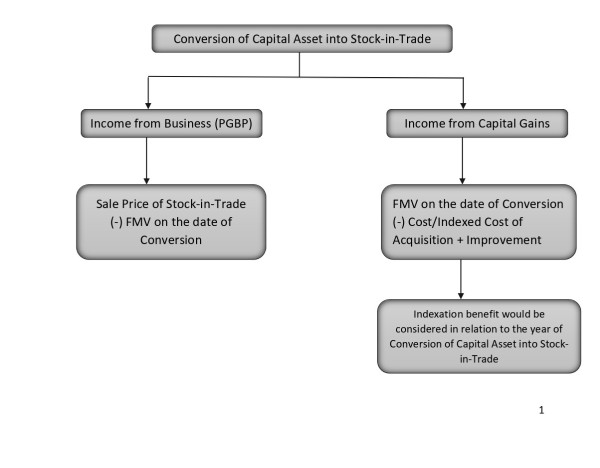
Note: - Both Capital Gains and Business income are chargeable to tax in the year in which stock-in-trade is sold or otherwise transferred.
3. Section 28 has been amended by way of insertion of Clause (via) which reads as follows:-
'The fair market value of inventory as on the date on which it is converted into, or treated as, a capital asset determined in the prescribed manner.”
4. ILLUSTRATION
Mr. converts his capital asset (acquired on June 10, 2003 for Rs.60000/-) into stock-in-trade on March 10, 2019. The fair market value on the date of the above conversion was Rs.550000/-. He subsequently sells the stock-in-trade so converted for Rs.600000/- on June 10, 2019. Examine the tax implication.
Cost Inflation Index - F.Y. 2003-04: 109; F.Y. 2018-19: 280; F.Y. 2019-20: 289.
SOLUTION
Since the capital asset is converted into stock-in-trade during the previous year relevant to the A.Y. 2019-20, it will be a transfer under section 2(47) during the P.Y.2018-19. However, the profits or gains arising from the above conversion will be chargeable to tax during the A.Y. 2020-21, since the stock-in-trade has been sold only on June 10, 2019. For this purpose, the fair market value on the date of such conversion (i.e. 10th March, 2019) will be the full value of consideration.
The capital gains will be computed after deducting the indexed cost of acquisition from the full value of consideration. The cost inflation index for 2003-04 i.e., the year of acquisition is 109 and the index for the year of transfer i.e., 2018-19 is 280. The indexed cost of acquisition is 60000 × 280/109 = Rs.154128/-. Hence, Rs.395872/- (i.e. Rs.550000 – Rs.154128) will be treated as Long-Term capital gains chargeable to tax during the A.Y.2020-21. During the same assessment year, Rs.50000 (Rs.600000 – Rs.550000) will be chargeable to tax as Business profits (PGBP).









 CAclubindia

