
The provisions for Tax Deducted at Source (TDS) under GST, as outlined in Section 51 of the CGST Act, were initially limited to government entities and public sector units (PSUs). However, following the recommendation of the GST Council during its 54th meeting, the CBIC issued Notification No. 25/2024-CT dated 9th October 2024, extending the scope of GST TDS to include the metal scrap sector under its umbrella.
Effective Date
The amendments introduced by Notification No. 25/2024-Central Tax are effective from October 10, 2024. All transactions on or after this date must comply with the updated TDS provisions under GST.

Scope
The amendment includes registered persons receiving metal scrap classified under Chapters 72 to 81 of the Customs Tariff Act, 1975. This ensures that TDS provisions under GST are applicable to a broader range of metal scrap transactions.
TDS Rate
A TDS of 2% is mandated on transactions where the taxable value exceeds Rs 2,50,000.
The rate is broken down as follows:
- Intra-State Transactions: CGST (1%) + SGST (1%) = 2%
- Inter-State Transactions: IGST = 2%
GST Registration & Forms
- GST Registration Form GST REG-07 (Required separate registration).
- Time Period of GST TDS deposit: - The amount deducted as tax shall be paid to the government within 10 days after the end of the month in which such deduction is made.
- GST Return Form GSTR-7 (Filing must be completed by the 10th of the subsequent month).
- GST Certificate Form GSTR-7A (Certificate will be automatically generated), (akin to Form 16A under the Income Tax Act).
Chapters of the Customs Tariff Act, 1975
- Chapter 72: Iron and Steel
- Chapter 73: Articles of Iron and Steel
- Chapter 74: Copper and Articles thereof
- Chapter 75: Nickel and Articles thereof
- Chapter 76: Aluminium and Articles thereof
- Chapter 78: Lead and Articles thereof
- Chapter 79: Zinc and Articles thereof
- Chapter 80: Tin and Articles thereof
- Chapter 81: Other Base Metals; Cermet's; Articles thereof
Consequences of non-compliance of the provisions of TDS under GST
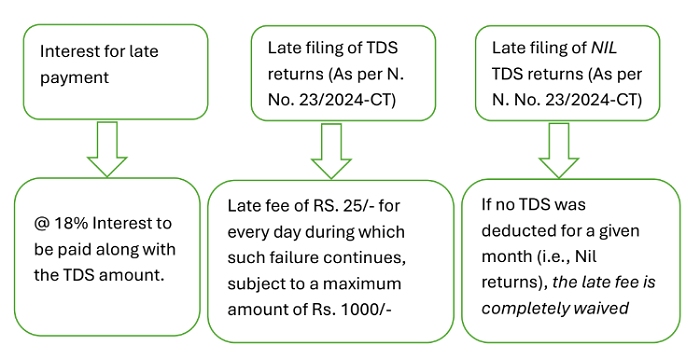
Other Points
- 1The threshold of Rs 2,50,000 applies per transaction. Each transaction must be assessed individually to determine TDS obligations.
- TDS under GST is not applicable to the import of metal scrap from foreign countries.
- Suppliers can offset the TDS credit to pay their GST liabilities or claim refunds.
- Suppliers will receive TDS credits in their cash ledger on a monthly basis.
- Transactions must be B2B i.e. Registered persons purchasing metal scrap from other registered persons.
- To deduct TDS under GST, the value of supply shall be taken as the amount excluding the CGST, SGST/UTGST, IGST and CESS indicated in the invoice i.e., Taxable value.
- GST TDS is not applicable, if Location of Suppliers and place of supply of state are different from the state of recipients.
- TDS is required to be deducted only in such cases where the total value of supply under a contract exceeds Rs. 2.5 lacs. Thus, even if the individual supplies are less than 2.5 lacs if the total value of supplies under a contract is more than 2.5 lacs, TDS must be deducted.
For Example: -Mr. Rahul has entered a contract with Mr Sachin to supply metal scrap worth Rs. 18 lacs in 10 equal lots over the year. In this case, even though each
individual supply is less than Rs. 2.5 lacs, Mr. Sachin is still required to deduct TDS as the contract value exceeds Rs. 2.5 lacs. - URP to RP transactions - RCM would be applicable and the registered person being a recipient would be liable to pay tax under RCM.
- The provisions of GST TDS are also applicable in case of supply of metal scrap by a PSU/Central Govt./State Govt./local authority to another PSU/Central Govt./State Govt./local authority, not being a distinct person.
- The liability for deducting GST TDS arises when the payment is made or credited to the supplier and is not based on the date of purchase or invoice. Therefore, if payment is made on or after 10th October 2024, it would be appropriate to deduct GST TDS.
- As per GST law, "distinct persons" refer to establishments of the same entity (different branches or locations of the same legal entity in different states). These establishments or units are different entities from GST perspective but would be considered as the same legal entity for all other perspectives. In case of purchase of metal scrap from a distinct person, the provisions of GST TDS would not be attracted as they are considered as the same legal entity.









 CAclubindia
