
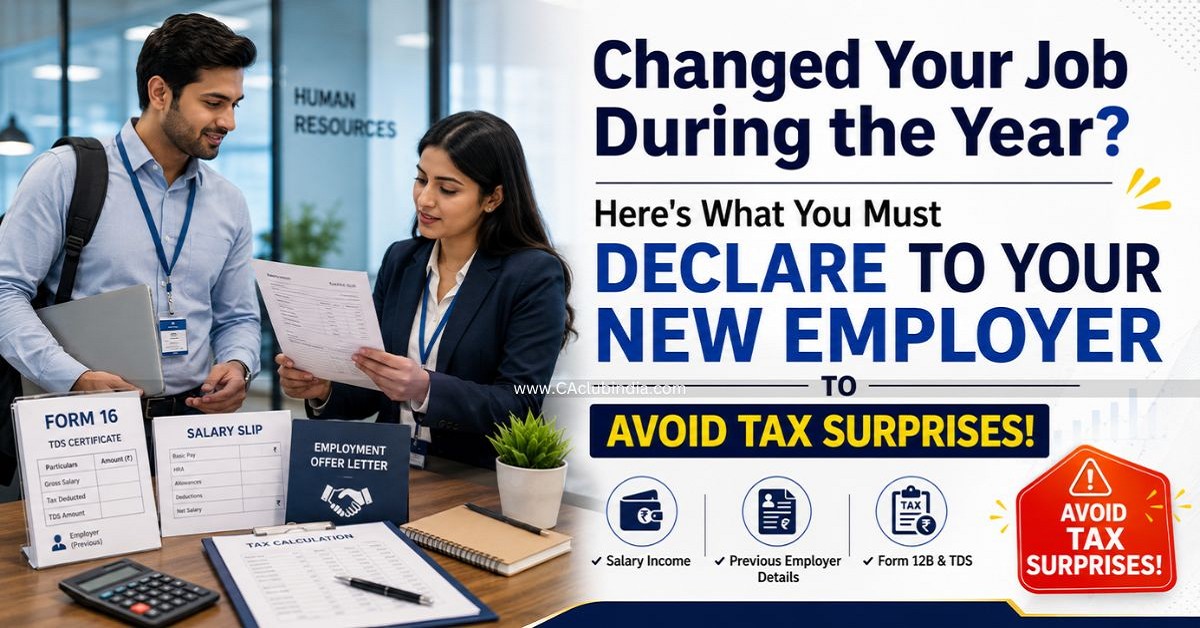
Changing jobs is exciting, but amidst salary negotiations, onboarding, and new responsibilities, one important task often gets overlooked, declaring your previous employment details to your new employer for correct TDS deduction.
Many salaried employees assume that each employer will deduct tax correctly. Unfortunately, that isn't always the case.
As a result, they often discover at the time of filing their Income Tax Return (ITR) that they have to pay additional tax, along with interest under the Income-tax Act.
Why Does This Happen?
When you change jobs during the financial year, your new employer generally does not know:
- Salary earned from your previous employer.
- TDS already deducted.
- Taxable allowances and perquisites received earlier.
- Other income such as bank interest, rental income, capital gains, etc. (unless declared).
If these details are not provided, your new employer computes TDS only on the salary paid by them, leading to short deduction of tax.
What Should You Declare to Your New Employer?
To ensure accurate TDS deduction, you should submit the following information:
1. Salary and TDS from Previous Employer
Provide details from your previous employer's salary slips or Form 16, including:
- Gross salary received
- Exempt allowances
- Professional tax (if applicable)
- TDS already deducted
This enables your new employer to calculate tax on your total annual salary rather than only the salary they pay.
2. Income from Other Sources
Declare income such as:
- Savings bank interest
- Fixed deposit interest
- Family pension
- Dividend income
- Any other taxable income
This helps your employer deduct adequate TDS and reduces the likelihood of tax payable while filing your return.
3. Income from House Property
If you have:
- Rental income, or
- A housing loan resulting in eligible loss from a self-occupied house,
the relevant details should also be submitted so they can be appropriately considered while computing TDS, subject to the provisions of the Income-tax Act.
4. Eligible Deductions and Tax-Saving Investments
Declare deductions that you intend to claim, such as:
- Section 80C investments
- Section 80D medical insurance
- Interest on education loan (Section 80E)
- Donations (where considered by the employer as per applicable rules)
- Other eligible deductions
Submitting these declarations ensures your employer does not deduct excess tax.
What Happens If You Don't Declare?
Suppose:
- You earned ₹8 lakh from your first employer.
- You earn ₹10 lakh from your second employer.
If the second employer considers only ₹10 lakh while deducting TDS, the total tax deducted during the year may be significantly lower than the tax actually payable on your combined salary of ₹18 lakh.
At the time of filing your ITR, you may have to:
- Pay the balance tax from your own pocket.
- Pay interest for short payment of advance tax, wherever applicable under the Income-tax Act.
A situation that could have been avoided with timely disclosure.
A Common Misconception
Many employees believe that once TDS is deducted from salary, nothing further needs to be done.
However, TDS is only a mechanism for tax collection. The ultimate tax liability is determined on your total income for the entire financial year, irrespective of the number of employers you worked for.
Final Thoughts
Changing jobs does not increase your tax liability but failing to disclose complete income details to your new employer can result in insufficient TDS, additional tax outgo, and interest at the time of filing your return.
A few timely declarations during onboarding can save you from unpleasant tax surprises later.
Disclaimer: This article is intended for general educational purposes. Tax implications may vary based on individual facts and applicable provisions of the Income-tax Act. Readers are advised to evaluate their specific circumstances before taking any action.











 CAclubindia
