Many real estate investors follow a simple strategy:
Buy agricultural land at a lower price →
Get DTCP approval →
Develop into a residential layout →
Sell plots at a higher value.
While the model looks straightforward, taxation is not.
The biggest confusion arises here:
- Is the profit treated as Capital Gain or Business Income?
- Which ITR should be filed?
- Does GST apply on plotted land sales?
- What happens when land is converted into stock-in-trade?
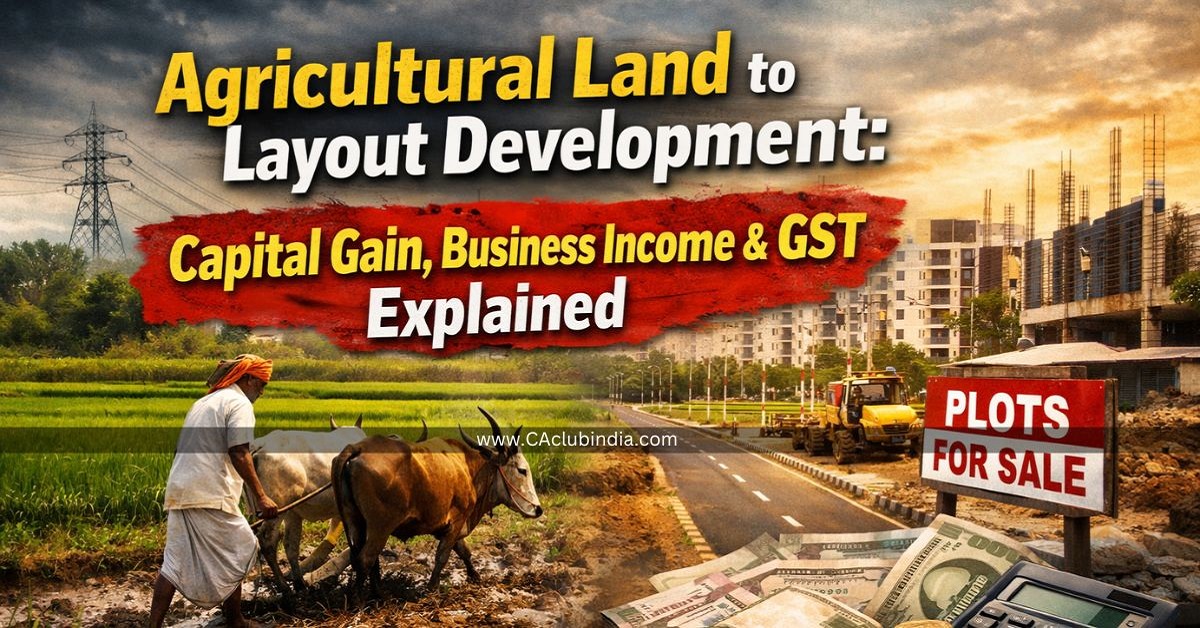
This guide explains everything clearly.
Step 1: Buying Agricultural Land - Initial Tax Position
When agricultural land is purchased:
- It may be treated as a capital asset
- If it qualifies as rural agricultural land, it may not be considered a capital asset under the Income Tax Act
- No GST applies on sale or purchase of agricultural land
At this stage, taxation depends on:
- Whether the land is rural or urban
- Holding period
- Intention of the buyer
If held purely as investment, capital gains may apply at the time of sale.
But things change when development begins.
Step 2: Conversion into Layout - The Turning Point
Once you:
- Apply for land conversion
- Obtain DTCP approval
- Divide land into multiple plots
- Develop roads and infrastructure
- Intend commercial resale
The Income Tax Department may treat the activity as business, not investment.
If agricultural land is converted into stock-in-trade, Section 45(2) of the Income Tax Act applies.
Capital Gain vs Business Income - How Tax Is Calculated
When a capital asset is converted into stock-in-trade, taxation gets divided into two components.
1. Capital Gain Portion
Calculated as:
Fair Market Value (FMV) on conversion date - Original Purchase Cost
This portion is taxed as:
- Long-term capital gain (if held more than 24 months)
- Short-term capital gain (if held less than 24 months)
Tax becomes payable in the year of actual sale.
2. Business Income Portion
Calculated as:
Final Sale Value - FMV on conversion date
This portion is taxed as business income.
Practical Example
Purchase agricultural land = Rs 40 Lakhs
FMV at conversion = Rs 80 Lakhs
Total sale of plots = Rs 1.20 Crore
Capital Gain = Rs 80L - Rs 40L = Rs 40L
Business Income = Rs 1.20Cr - Rs 80L = Rs 40L
Total profit = Rs 80L
But taxed under two different heads.
Which ITR Should Be Filed?
Once the development and sale of plots begin:
- Individuals must file ITR-3
- Firms/LLPs must file business returns
ITR-2 is not applicable once business activity exists.
Proper accounting of:
- Development expenses
- Road formation costs
- Approval charges
- Legal expenses
is essential to compute real profit.
GST on Layout Plots - Applicable or Not?
Under Schedule III of the GST Act:
Sale of land is neither supply of goods nor supply of services.
Therefore:
- Sale of agricultural land - No GST
- Sale of plotted residential land - No GST
- Sale of DTCP approved layout plots - No GST
However, GST may apply if:
- Development charges are collected separately
- Amenities or services are bundled
- Works contract services are provided
Pure land sale remains outside GST.
Registration Value & Banking Impact
When buyers take bank loans:
Registration value must match guideline value or higher
Undervaluation can trigger:
- Section 50C (seller)
- Section 43CA (stock-in-trade cases)
- Section 56(2)(x) (buyer)
Transparent valuation and proper documentation prevent scrutiny issues.
Common Mistakes to Avoid
- Showing entire profit only as capital gain
- Ignoring stock-in-trade conversion implications
- Not obtaining valuation report at conversion stage
- Undervaluing sale consideration
- Poor documentation of development costs
Final Takeaway
Agricultural land for layout development is highly profitable — but tax treatment depends on:
- Intention
- Holding period
- Whether conversion to stock-in-trade happens
- Structuring of the project
Correct planning at the beginning avoids litigation, reassessment, and unnecessary tax burden.
If you are planning to purchase agricultural land for layout development, professional tax structuring should be done before execution.










 CAclubindia