
Overview
In the near future, AI is unlikely to completely replace Chartered Accountants or auditors, but it will substantially transform and automate many aspects of their current responsibilities. The essential qualities that define these professionals, such as professional judgment, ethical reasoning, the interpretation of complex standards, and client advisory, are areas where AI still falls short.
There is a broad consensus that AI will handle routine tasks, shifting the focus for professionals towards higher-value strategic work. As one CA and AI expert succinctly put it, "I don't think AI or any tool will replace an individual. I think a person who understands and knows and uses these tools will replace the one that is not use them."
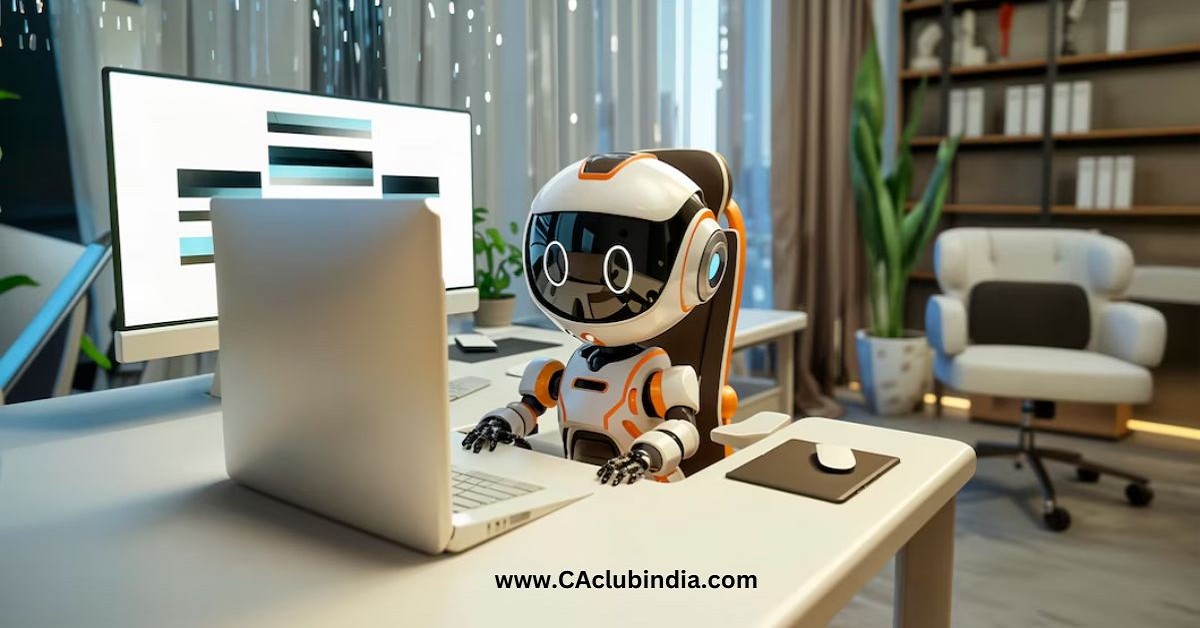
AI's impact
The scope of AI's impact is already visible in its ability to take over repetitive, rule-based tasks. Key areas of automation include:
Accounting Operations
- Data entry, reconciliations, journal-entry processing, and invoice matching.
Audit Procedures
- Routine elements of audits, such as scanning large transaction volumes, flagging anomalies, and performing basic risk screening.
Tax Compliance
- Standard tax-return calculations, basic compliance checks, and certain GST or income-tax-filing workflows.
As a result, the volume of junior-level "grunt work" is likely to shrink, requiring fewer people for these tasks. However, this labour is being redirected rather than completely eliminated, shifting focus to more complex responsibilities.
Despite advances in automation, several critical functions are expected to remain human-centric and continue to require the expertise of CAs and auditors:
Professional Judgment
Forming opinions on materiality, going-concern assessments, complex tax structuring, and final audit determinations.
Interpretation of Standards
Applying new accounting standards, developing accounting policies, and navigating case-specific IFRS, Ind AS, or tax rulings.
Client Advisory and Relationships
Managing client communication, building trust, and providing strategic advice on business improvement, process optimization, and fraud investigation.
Furthermore, regulators and professional bodies consistently emphasize that AI cannot assume the "responsibility" and "accountability" that rest with a qualified professional.
The role of CAs and auditors will evolve into that of an "AI-enabled professional," where tools are used to boost speed, coverage, and focus on high-value tasks. This shift will create a competitive divide: firms embracing AI early will scale efficiently, while others risk falling behind. Consequently, new skills - including data analytics, AI literacy, and communication - will become just as critical as traditional technical expertise.
A Practical Perspective for CA-Aspirants
The rise of AI will streamline routine, manual processes, yet it will not diminish the demand for skilled CAs and auditors. Your distinct value will derive from a robust technical foundation, sound professional judgment, strong communication abilities, and the capacity to harness AI tools to generate faster and more insightful outcomes. In essence, AI is set to reshape the nature of the work, not the necessity of the professionals who perform it. Those who collaborate effectively with AI will be the ones most likely to excel.
You have reached your daily limit of 2 Free Articles
Subscribe to CCI PRO for unlimited access
Why Upgrade to CCI PRO?
- No Ads
- WhatsApp Community
- Daily E-Newsletter
- Unlimited Articles Access
- Profile Visitors
- Link Social Profiles
- Featured Job Posts
- Pro Badge
- Expert GST Guidance
- Unlimited Forum Replies
- Download Content in PDF
Already a PRO member? Login here for an ad-free experience. 011-411-70713











 CAclubindia
