
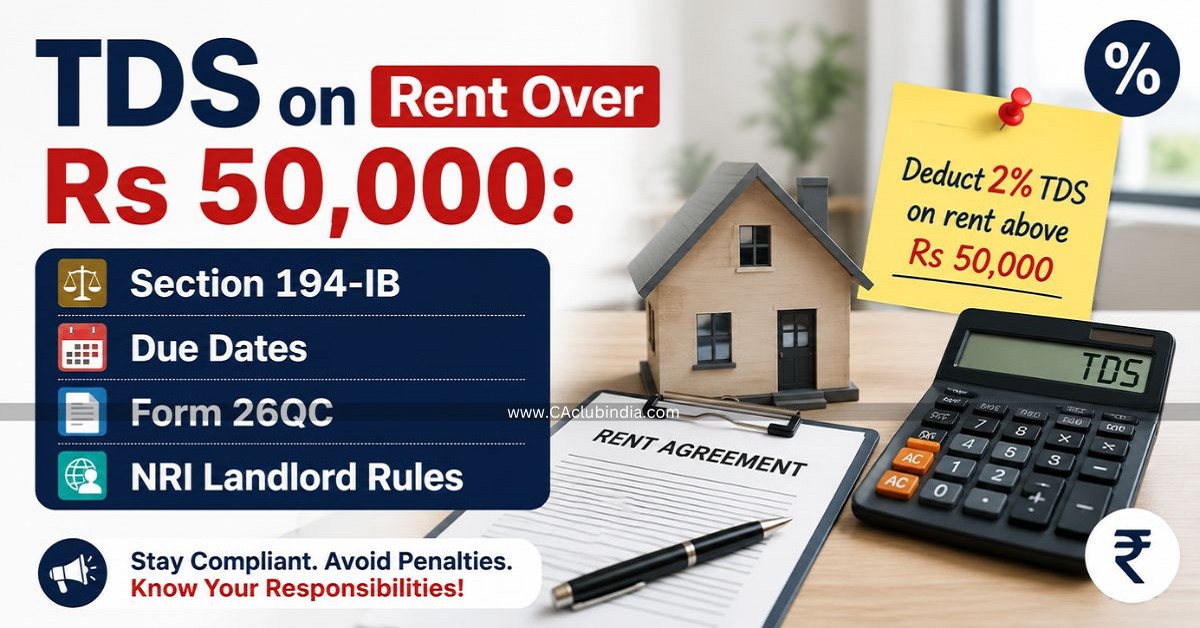
Paying rent above Rs 50,000 per month? Under Section 194-IB of the Income-tax Act, you - the tenant - must deduct TDS at 2% before paying your landlord, even if you are a salaried individual with no business. You do not need a TAN; your PAN and your landlord's PAN are enough. The deduction is made once a year - in March, or in the last month of your tenancy - and reported through Form 26QC, followed by Form 16C issued to the landlord.
This guide covers everything: who must deduct, the current TDS rate, the Rs 50,000 per-landlord rule, Form 26QC and 16C deadlines, penalties, special rules when rent is paid to an NRI, and how the Income Tax Department cross-verifies your HRA claim against TDS filings.
What is Section 194-IB?
Section 194-IB requires individuals and HUFs not liable to tax audit to deduct TDS when monthly rent exceeds Rs 50,000. It was introduced specifically to bring salaried tenants and small taxpayers into the TDS net - people who were paying high rents (and often claiming large HRA exemptions) without any tax trail on the landlord's side.
In simple terms: if you are a salaried employee paying Rs 60,000 rent for your flat, Section 194-IB applies to you , not just to businesses.
What is the TDS rate on rent above Rs 50,000?
The TDS rate under Section 194-IB is 2% of the rent. This was reduced from 5% to 2% with effect from 1 October 2024, so all deductions for FY 2025-26 onwards are at 2%.
Example: Rent of Rs 60,000/month for 12 months = Rs 7,20,000 annual rent. TDS = 2% × Rs 7,20,000 = Rs 14,400, deducted from the March rent payment.
Do tenants need a TAN to deduct TDS on rent?
No. Section 194-IB is designed for individuals, so no TAN (Tax Deduction Account Number) is required. You use:
- Your PAN (as the tenant/deductor), and
- Your landlord's PAN (as the deductee)
Both go into Form 26QC, which works as a combined challan-cum-statement - you pay the TDS and file the return in one step.
When should TDS on rent be deducted?
Unlike business TDS, which is deducted every month, Section 194-IB requires deduction only once a year:
- In March (the last month of the financial year), or
- In the last month of tenancy, if you vacate the property mid-year.
The TDS is calculated on the total rent for the year (or tenancy period) and deducted from that final month's payment.
The Rs 50,000 threshold applies per landlord, not per property
This is where most tenants go wrong. The Rs 50,000/month limit is tested against each landlord (co-owner) separately, not against the total rent for the property.
Example: You pay Rs 80,000/month for a flat jointly owned by two people, and pay Rs 40,000 to each co-owner.
| Recipient | Monthly rent received | Exceeds Rs 50,000? | TDS under 194-IB |
|---|---|---|---|
| Owner 1 | Rs 40,000 | No | Not applicable |
| Owner 2 | Rs 40,000 | No | Not applicable |
Total rent is Rs 80,000, but because no single landlord receives more than Rs 50,000, TDS is not applicable. Keep the rent agreement showing the co-ownership split as proof.
How to comply: Form 26QC and Form 16C
Step 1 - File Form 26QC (challan-cum-statement)
- File and deposit the TDS within 30 days from the end of the month in which tax was deducted. If you deduct in March, the deadline is 30 April.
- File online through the TIN/e-filing portal using your PAN and the landlord's PAN - no TAN needed.
Penalties for delay:
- Late filing fee of Rs 200 per day under Section 234E (capped at the TDS amount)
- Interest at 1% per month for late deduction
- Interest at 1.5% per month for TDS deducted but deposited late
Step 2 - Issue Form 16C (TDS certificate) to your landlord
- Download Form 16C from TRACES and issue it to the landlord within 15 days of filing Form 26QC.
- Delay attracts a penalty of Rs 500 per day.
What if the landlord does not give a PAN?
If the landlord fails to furnish PAN, TDS must be deducted at a higher rate of 20% under Section 206AA. However, the deduction is capped at the rent payable for the last month of the year or tenancy - the law does not require you to pay TDS out of your own pocket beyond that final rent amount.
Rent paid to an NRI landlord? Section 195 applies, not 194-IB
If your landlord is a Non-Resident Indian, the entire framework changes. Section 194-IB does not apply - Section 195 governs instead:
| Particular | Resident landlord (Sec 194-IB) | NRI landlord (Sec 195) |
|---|---|---|
| Threshold | Rs 50,000/month | No threshold - TDS on any rent amount |
| TDS rate | 2% | 30% + surcharge & cess ≈ 31.2% (unless a lower rate applies under DTAA) |
| TAN required? | No | Yes - TAN is mandatory |
| Frequency | Once a year (March / last month) | Deduct and deposit every month |
| Forms | 26QC + 16C | Form 27Q (quarterly) + Form 16A |
Always confirm your landlord's residential status in writing before signing the rent agreement. Deducting 2% when 31.2% was due makes you the assessee-in-default.
How high HRA claims are cross-verified with Form 26QC
If you claim a large HRA exemption in your ITR (typically implying rent above Rs 50,000/month), the Income Tax Department's systems cross-verify your claim against Form 26QC filings. Claiming high HRA with no matching TDS compliance is a system flag and can trigger:
- A notice or intimation asking you to explain the mismatch
- Requests for rent receipts, rent agreement, bank statements, and the landlord's PAN
- Potential disallowance of the HRA exemption plus interest and penalty
If your rent crosses Rs 50,000, TDS compliance is no longer optional housekeeping - it is the evidence trail that protects your HRA claim.
Key takeaways
- Know your landlord's PAN and ownership structure before the year ends - the Rs 50,000 test is per landlord, not per property.
- Deduct 2% TDS in March (or the last month of tenancy) under Section 194-IB.
- File Form 26QC within 30 days from the end of the month of deduction - by 30 April for March deductions.
- Issue Form 16C to your landlord within 15 days of filing Form 26QC.
- NRI landlord? Entirely different rules - Section 195, ~31.2% TDS, monthly deduction, TAN mandatory.
FAQs on TDS on rent above Rs 50,000
Is TDS on rent applicable if I pay exactly Rs 50,000 per month?
No. Section 194-IB applies only when rent exceeds Rs 50,000 per month. At exactly Rs 50,000, no TDS is required.
I moved out in September. When do I deduct TDS?
Deduct in September - the last month of tenancy - on the total rent paid during the year, and file Form 26QC within 30 days from the end of September (i.e., by 30 October).
Can my landlord claim credit for the TDS I deducted?
Yes. The TDS reflects in the landlord's Form 26AS/AIS against their PAN, and they claim it as tax credit in their ITR. Form 16C is their certificate of deduction.
Does Section 194-IB apply to rent paid for commercial property?
Section 194-IB covers rent for any land or building paid by individuals/HUFs not under tax audit. If you are under tax audit, Section 194-I applies instead, with different thresholds and monthly deduction.
What happens if I never deducted TDS but claimed HRA?
You may receive a notice due to the mismatch between your HRA claim and the absence of Form 26QC. You can still file Form 26QC belatedly with interest and late fees - doing it proactively is far better than responding to a notice.
Is TDS required if I pay rent to my parents?
Yes, if the rent exceeds Rs 50,000/month per parent (landlord). The rules apply irrespective of the relationship - and genuine rent payments with TDS compliance actually strengthen an HRA claim involving family arrangements.
You have reached your daily limit of 2 Free Articles
Subscribe to CCI PRO for unlimited access
Why Upgrade to CCI PRO?
- No Ads
- WhatsApp Community
- Daily E-Newsletter
- Unlimited Articles Access
- Profile Visitors
- Link Social Profiles
- Featured Job Posts
- Pro Badge
- Expert GST Guidance
- Unlimited Forum Replies
- Download Content in PDF
Already a PRO member? Login here for an ad-free experience. 07941056694








 CAclubindia
