
A small seller's tax invoice rarely gets read closely, until the buyer's accountant can't match it in GSTR-2B, or a credit claim gets questioned and someone finally checks whether the place of supply was right. Most of those problems trace back to one list: Rule 46 of the CGST Rules, 2017. It sets out what a tax invoice under Section 31 of the CGST Act has to contain.
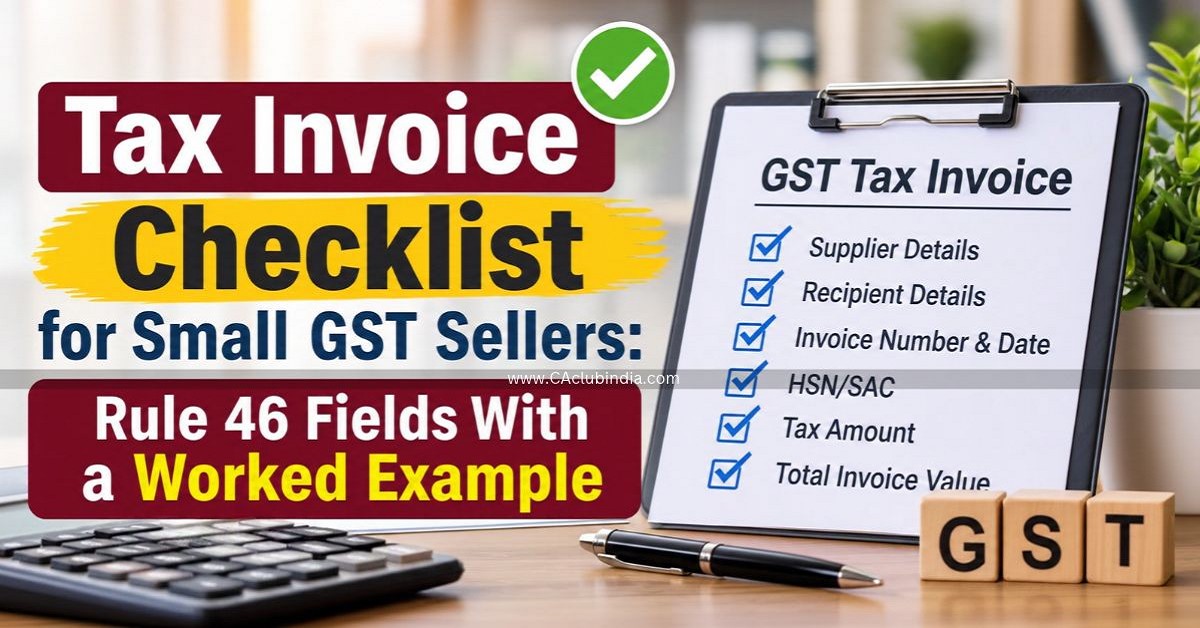
This article goes through that list field by field, in the order a small trader actually fills an invoice. It then builds two complete invoices from scratch, one within a state and one across states, with every rupee of CGST, SGST and IGST worked out. The numbers are illustrative; the rules are quoted from the Rules as they stand on the CBIC tax information portal.
Who this applies to
Rule 46 governs the tax invoice that a registered person issues under Section 31. Two common cases fall outside it:
- Composition taxpayers and suppliers of exempt goods or services issue a bill of supply instead (Section 31(3)(c) of the CGST Act read with Rule 49). The fields differ, and no tax is charged on it.
- Exports and supplies to SEZ units use the same rule but carry a mandatory endorsement and the country of destination (the export proviso to Rule 46).
Everything below assumes an ordinary regular-scheme seller supplying goods within India.
The Rule 46 fields, one at a time
(a) Your name, address and GSTIN. Use the legal or trade name exactly as on your registration certificate. The first two digits of the GSTIN are your State code (27 for Maharashtra, 24 for Gujarat, 29 for Karnataka), and those digits drive the whole CGST/SGST vs IGST decision later.
(b) A consecutive serial number, at most 16 characters, unique for the financial year. You may run one series or several (say, one per branch). Letters, numbers, the hyphen "-" and the slash "/" are allowed, in any combination. A format like PNQ/26-27/0042 is 14 characters and fine. SAHYADRI-CYCLES/2026-27/00042 is too long. Start a fresh, unique sequence each financial year. The serial numbers issued in a tax period are also reported in GSTR-1 (Rule 46(b); Rule 48(3)).
(c) Date of issue. For goods, Section 31(1) requires the invoice before or at the time of removal or delivery. For services, Rule 47 allows up to 30 days from the date of supply (45 days for banks, insurers and NBFCs).
(d) Recipient's name, address and GSTIN (or UIN), if registered. For a B2B sale, the buyer's GSTIN is what lets the invoice flow into their GSTR-2B. A wrong digit here is the most common reason a buyer comes back asking for a fresh invoice.
(e) and (f) Unregistered buyers. If the buyer is unregistered and the taxable value is ₹50,000 or more, the invoice must show the buyer's name and address, the delivery address, and the State name and code. Below ₹50,000 these are needed only if the buyer asks for them to be recorded.
(g) HSN code (SAC for services). Rule 46(g) asks for the code, and the first proviso lets CBIC set how many digits. Notification No. 78/2020-Central Tax (from 1 April 2021) fixes it by aggregate turnover in the preceding financial year: 4 digits up to ₹5 crore, 6 digits above ₹5 crore. A seller at or below ₹5 crore may leave the HSN out on invoices to unregistered persons. In practice, use at least the 4-digit heading, and confirm the rate against the current rate notification for that heading.
(h) Description. Plain words a buyer and an officer would both recognise: "Bicycle, 26-inch, steel frame", not an internal SKU.
(i) Quantity, with unit or UQC. Use a Unique Quantity Code such as NOS, KGS or MTR. GSTR-1's HSN summary asks for the same UQC, so matching it here saves edits later.
(j) Total value and (k) taxable value after discount or abatement. These are two separate fields. The taxable value is what tax is charged on, so a discount shown on the invoice comes off before tax (Section 15(3)(a) of the CGST Act covers discounts given before or at the time of supply and recorded in the invoice).
(l) Rate of tax and (m) amount of tax, shown separately for central tax, State tax, integrated tax, Union territory tax or cess. Write "CGST 2.5% / SGST 2.5%", not just "GST 5%".
(n) Place of supply, with the State name, for inter-State supplies. For goods involving movement, the place of supply is where the movement ends for delivery to the recipient (Section 10(1)(a) of the IGST Act). If that State differs from your own, the supply is inter-State and attracts IGST (Section 7 of the IGST Act). If it's the same State, CGST and SGST apply (Section 8 of the IGST Act; Section 9 of the CGST Act).
(o) Delivery address, if different from the place of supply.
(p) Whether tax is payable on reverse charge. Write "Reverse charge: No" even when the answer is no. An empty space invites the question.
(q) Signature or digital signature of the supplier or an authorised representative. A proviso to Rule 46 dispenses with the signature for an electronic invoice issued under the Information Technology Act, 2000.
(r) and (s) E-invoicing. If your aggregate turnover in any financial year from 2017-18 onwards has exceeded ₹5 crore (Notification No. 10/2023-Central Tax, effective 1 August 2023), B2B invoices must be reported to the Invoice Registration Portal. The printed invoice then carries a QR code with the IRN (clause (r)). A taxpayer above that threshold who is exempt from e-invoicing must print the declaration in clause (s). Most small sellers are below ₹5 crore and can ignore both, but check the turnover test every year, because it looks back at any preceding year.
Copies. For goods, prepare the invoice in triplicate: ORIGINAL FOR RECIPIENT, DUPLICATE FOR TRANSPORTER, TRIPLICATE FOR SUPPLIER. For services, prepare it in duplicate (Rule 48(1) and (2)).
Worked example 1: intra-State sale (CGST + SGST)
Sahyadri Cycles (an illustrative business) is registered in Pune, Maharashtra (GSTIN starting 27). It sells to a registered bicycle-rental business, also in Pune. Bicycles fall under HSN 8712 and bicycle parts under 8714. The GST Council's FAQ on the September 2025 rate changes puts bicycles and their parts at 5% from 22 September 2025, under Notification No. 9/2025-Central Tax (Rate).
1. Bicycle, 26-inch | HSN 8712 | 4 NOS | rate 6,500.00 | value 26,000.00 | discount 1,300.00 (5%) | taxable 24,700.00
2. Tyre and tube sets | HSN 8714 | 20 NOS | rate 350.00 | value 7,000.00 | discount 0.00 | taxable 7,000.00
Total: value 33,000.00 | discount 1,300.00 | taxable 31,700.00
Seller State 27 and place of supply 27 are the same State, so the 5% splits into CGST 2.5% and SGST 2.5%.
- Line 1: 24,700 × 2.5% = ₹617.50 CGST and ₹617.50 SGST
- Line 2: 7,000 × 2.5% = ₹175.00 CGST and ₹175.00 SGST
- Total CGST = 617.50 + 175.00 = ₹792.50; total SGST = ₹792.50
- Total tax = ₹1,585.00. Check: 31,700 × 5% = 1,585.00
- Invoice value = 31,700.00 + 1,585.00 = ₹33,285.00
The ₹1,300 discount was applied before tax because it is shown on the invoice itself. Had it been a post-sale discount, it would need a credit note and the conditions in Section 15(3)(b).
Worked example 2: inter-State sale (IGST)
The same seller ships to a registered dealer in Ahmedabad, Gujarat (GSTIN starting 24). The goods are delivered in Gujarat, so the place of supply is Gujarat (24). That differs from the seller's State (27), so the supply is inter-State and only IGST applies.
1. Bicycle, 26-inch | HSN 8712 | 10 NOS | rate 6,450.00 | taxable 64,500.00 | IGST 5% 3,225.00
2. Tyre and tube sets | HSN 8714 | 37 NOS | rate 349.00 | taxable 12,913.00 | IGST 5% 645.65
Total: taxable 77,413.00 | IGST 3,870.65
- Line 2: 37 × 349 = 12,913.00; × 5% = 645.65
- Total IGST = 3,225.00 + 645.65 = ₹3,870.65. Check: 77,413 × 5% = 3,870.65
- Invoice value = 77,413.00 + 3,870.65 = ₹81,283.65
The invoice must show "Place of supply: Gujarat (24)" (clause (n)). If the dealer asks for delivery at a godown in a different State from its registered address, the delivery address goes in separately (clause (o)), and the place of supply follows where the movement ends.
A quick sanity check: put the same ₹77,413 through example 1's intra-State logic and you get CGST ₹1,935.33 and SGST ₹1,935.33 per half. That is 77,413 × 2.5% = 1,935.325, rounded to the paisa. The two halves add up to ₹3,870.66, one paisa more than the IGST figure, purely from rounding each half separately. That leads to the next point.
Rounding: decide a policy and stick to it
Look at a line with a taxable value of ₹333 at 5%:
- Charged as IGST: 333 × 5% = 16.65
- Charged as CGST + SGST: 333 × 2.5% = 8.325 each, which rounds to 8.33, so 16.66 in total
Neither figure is "wrong", but the buyer's books and yours should agree. Most invoicing software computes tax per line, rounds each component to the paisa, and adds a separate "Round off" line to bring the grand total to the nearest rupee. Section 170 of the CGST Act requires tax, interest and other amounts payable under the Act to be rounded off to the nearest rupee (fifty paise or more goes up, less is ignored). That governs your liability in the return, not the paise on each invoice line, so show paise on the lines and round once at the total. In example 2 that means a round-off of −₹0.65 and a payable figure of ₹81,283.
Five mistakes that cause mismatches later
1. Wrong State code in the place of supply. The tax type flips (IGST vs CGST + SGST), and the buyer can't take credit until it's corrected. Paying the wrong type means claiming a refund of one and paying the other (Section 77 of the CGST Act and Section 19 of the IGST Act deal with this).
2. Serial numbers that restart or repeat within a year, often after switching software mid-year. Clause (b) requires uniqueness for the financial year.
3. Discount shown after tax instead of reducing the taxable value (clause (k)).
4. A missing reverse charge line (clause (p)).
5. An HSN that doesn't support the rate charged. After the September 2025 rate changes, many headings moved slabs. Check each heading against Notification No. 9/2025-Central Tax (Rate) rather than last year's price list.
A simple pre-send check
Before an invoice leaves your shop, run through this list:
1. Is the GSTIN on both sides correct, 15 characters, with the State code you expect?
2. Is the serial number new and within 16 characters?
3. Are HSN and UQC filled on every line?
4. Is any discount shown before tax?
5. Do place of supply and seller State give the tax type you charged?
6. Is reverse charge marked?
7. Is it signed, or e-invoiced, as applicable?
References
- CGST Rules, 2017: Rule 46 (tax invoice), Rule 47 (time limit), Rule 48 (copies and e-invoicing), Rule 49 (bill of supply). Text as published on the CBIC tax information portal (taxinformation.cbic.gov.in).
- CGST Act, 2017: Sections 9, 15(3), 31, 77 and 170.
- IGST Act, 2017: Sections 7, 8, 10 and 19.
- Notification No. 78/2020-Central Tax, dated 15 October 2020 (HSN digits on invoices from 1 April 2021).
- Notification No. 10/2023-Central Tax, dated 10 May 2023 (e-invoicing threshold of ₹5 crore from 1 August 2023).
- Notification No. 9/2025-Central Tax (Rate), dated 17 September 2025, effective 22 September 2025; GST Council FAQ on the rate changes (gstcouncil.gov.in).
This article explains the rules for general information. It isn't professional advice. Check rates for your specific HSN, and your own turnover thresholds, before relying on the examples.











 CAclubindia
