
To prevent the practice of receiving sum of money or the property without consideration or for inadequate consideration, section 56(2)(x) brings to tax any sum of money or the value of any property received by any person without consideration or the value of any property received for inadequate consideration.
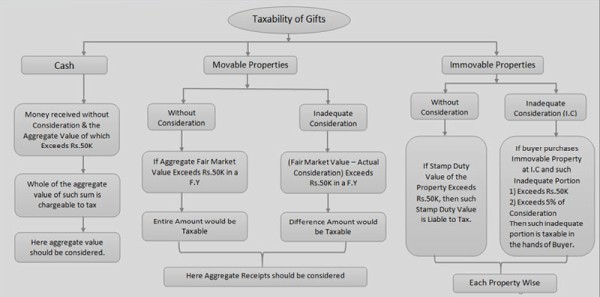
Note:-
• Cash to include all monetary forms like Cheque, Online Transfer, FD, DD or any other form.
• Limit of Rs.50, 000/- should be applied for each of the above 5 categories separately.
• However in case of gifts received from Employer, then Taxableunder the head Salaries- (Cash gift – fully taxable, If gift in kind- fully taxable when value of gift exceeds Rs.5000).
• Immovable Property [Inadequate Consideration]:- If consideration is less than the stamp duty value of the property and the difference between the stamp duty value and consideration is more than the higher of –
(i) ` 50,000 and
(ii) 5% of consideration,
The difference between the stamp duty value and the consideration shall be chargeable to tax in the hands of the assesse as “Income from other sources”.
• Provisions of section 56(2)(x) would apply only to the specified property which is the nature of a capital asset of the recipient and not stock-in- trade, raw material or consumable stores of any business of the recipient. Therefore, only transfer of a specified capital asset, without consideration or for inadequate consideration would attract the provisions of this section.

Exceptions to Sec.56(2)(X):-
Gift clauseshall not apply toany sum of moneyor any property received:-
• from any relative; or
• on the occasion of the marriage of the individual; or
• under a will or by way of inheritance; or
• in contemplation of death of the payer or donor, as the case may be; or
• from any local authority as defined in the Explanation to section 10(20); or
• By any fund or trust or institution or any university or other educational institution or any hospital or other medical institution referred to in Section 10(23C)(iv)/(v)/(vi)/(via).
• Amalgamations, Successions, Demerger which is not a transfer u/s 47
• From or by any trust or institution registered u/s 12AA; or
• From an individual by a trust created or established solely for the benefit of relative of the individual.
Meaning:
1) Property:-
A capital asset of the assesse, namely,-
(a) Immovable property being land or building or both,
(b) Shares and securities,
(c) Jewellery,
(d) Archaeological collections,
(e) Drawings,
(f) Paintings,
(g) Sculptures,
(h)Any work of art or bullion.
2) Relative:-
In case of an individual –
(i) Spouse of the individual;
(ii) Brother or Sister of the individual;
(iii) Brother or Sister of the spouse of the individual;
(iv) Brother or Sister of either of the parents of the individual;
(v) Any lineal ascendant or descendant of the individual;
(vi) Any lineal ascendant or descendant of the spouse of the individual;
(vii) Spouse of any of the persons referred to above.
(b) In case of Hindu Undivided Family, any member thereof.











 CAclubindia
