
1. Introduction - Why Rule 86B Continues to Matter
Rule 86B was introduced with effect from 01.01.2021 vide N. No. 94/2020-CT, dated 22.12.2020, as a revenue-protection measure to address a recurring pattern observed under GST, where certain taxpayers with large outward supplies discharged their entire tax liability through accumulated input tax credit, resulting in negligible cash outflow despite substantial business volumes. The rule, therefore, mandates a minimum cash payment of tax where monthly taxable supplies exceed the prescribed threshold of Rs. 50 lakh, subject to specified safeguards and exemptions. Over time, however, the practical application of this rule has revealed certain industry-specific distortions, particularly in sectors where tax is already paid on a deemed or maximum value. The latest amendment, notified vide Notification No. 20/2025–Central Tax dated 31 December 2025 and effective from 1 February 2026, must be understood against this backdrop.
हवा का रुख समझना भी ज़रूरी है ,
वरना सही नाव भी भटक सकती है।
Understanding the direction of the wind is essential; otherwise, even the right boat may drift astray.
The amendment is not a retreat from discipline, but a recalibration of direction.
2. The Context of the Latest Amendment
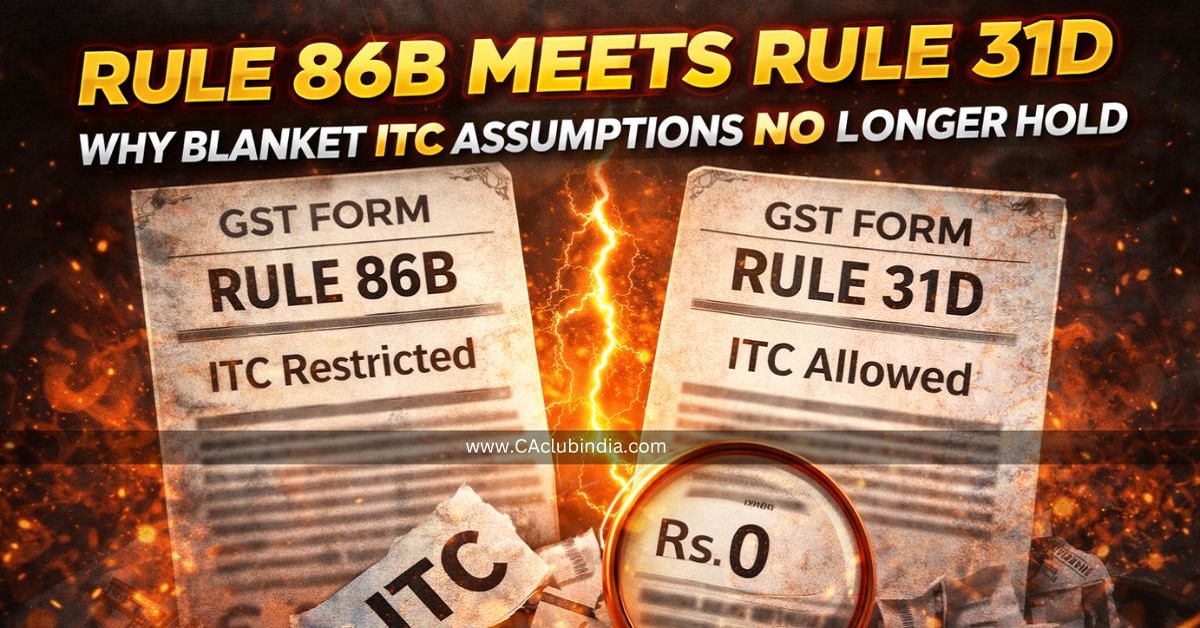
The amendment specifically addresses the interaction between Rule 86B and Rule 31D. Rule 31D prescribes valuation based on the retail sale price (RSP) for certain notified goods, primarily in the tobacco and pan masala sectors. In such cases, GST is paid not on the actual transaction value but on a statutorily deemed value linked to the maximum retail price, which is typically far higher than the trade price at subsequent stages of supply. This structure ensures that a substantial portion of tax is collected upfront, significantly reducing the risk of revenue leakage at the distribution or retail level. Despite this, interpretive disputes continue to arise, with traders dealing in such goods asserting that Rule 86B should not apply to them, whereas tax authorities frequently take the opposite stance. The amendment is intended to bring a clear and definitive statutory resolution to this issue
जहाँ कर पहले ही पूरी ऊँचाई पर वसूल हो चुका हो ,
वहाँ दोबारा सीढ़ी चढ़ाने का औचित्य नहीं।
Where tax has already been collected at its highest point, insisting on another climb serves little purpose.
3. The Amended Text - What Has Been Inserted
With effect from 1 February 2026, clause (f) has been inserted in the proviso to Rule 86B. This new clause now expressly provides that a registered person other than a manufacturer shall be exempted from the provisions of this rule only in respect of goods specified under Rule 31D, on which tax has been paid by the supplier on the basis of the retail sale price. This insertion is concise but carries significant legal and practical consequences.
4. Understanding the Phrase "Registered Person Other Than a Manufacturer"
The amendment's opening words deliberately carve out manufacturers from its scope. A manufacturer, even when dealing in Rule 31D goods, occupies a different position in the tax chain, as the manufacturer is the person who actually pays tax on the RSP basis. This amendment, therefore, focuses squarely on traders, dealers, wholesalers, distributors, and similar intermediaries. For these persons, the exemption from Rule 86B is no longer absolute or assumption-based; it is conditional and limited.
कानून पद नहीं देखता , भूमिका देखता है।
The law does not look at designation; it looks at role.
5. Product-Specific, Not Person-Specific Relief
A crucial feature of the amendment is that the exemption operates only "in respect of goods specified under Rule 31D." This makes the relief product-specific rather than person-centric. A trader may be partially exempt and partially covered by Rule 86B in the same tax period, depending on the nature of goods supplied. This approach aligns the rule with commercial reality and prevents blanket avoidance of cash payment obligations.
हर लेन - देन की अपनी पहचान होती है ,
एक छाया सब पर नहीं पड़ती।
Every transaction carries its own identity; one shadow does not fall upon all.
6. Practical Illustrations
Illustration 1 - Trader Exclusively Dealing in Rule 31D Goods
Aayra Limited is a registered dealer engaged exclusively in the trading of pan masala. In March 2026, Aayra Limited reports taxable outward supplies of ₹1.20 crore. The entire stock is procured from a manufacturer who has discharged GST based on the declared retail sale price, in accordance with Rule 31D. Aayra Limited has sufficient input tax credit accumulated from its purchases.
In this case, although the monthly turnover exceeds the threshold ordinarily attracting Rule 86B, Alpha Traders shall be exempt from the application of the rule for the entire turnover. Since all goods supplied fall within Rule 31D and tax has already been paid on RSP basis at the manufacturing stage, Aayra Limited may discharge its entire output tax liability through input tax credit without any mandatory cash payment.
Illustration 2 - Trader Dealing in Both Rule 31D and Non-Rule 31D Goods
Harpreet Limited is a wholesaler supplying a mix of goods. In April 2026, its taxable outward supplies amount to ₹1.50 crore, comprising ₹80 lakh from the sale of cigarettes (covered under Rule 31D) and ₹70 lakh from the sale of other FMCG products not notified under Rule 31D. GST on cigarettes has been paid by the manufacturer on RSP basis.
In this scenario, the exemption under Rule 86B applies only to the ₹80 lakh turnover from cigarettes. For the remaining ₹70 lakh turnover, Rule 86B applies in full. Accordingly, Harpreet Limited must discharge at least 1% of the GST liability attributable to the non-Rule 31D goods in cash, while it may utilise input tax credit freely for the RSP-based supplies. This illustration highlights the necessity of turnover segregation and careful computation.
Illustration 3 - Manufacturer Supplying Rule 31D Goods
Kirti Ltd. is engaged in the manufacture of pan masala , a notified commodity for which the value of supply is determined on the basis of retail sale price under Rule 31D of the CGST Rules, 2017 . During the tax period of May 2026 , Kirti Ltd. reports a taxable turnover of ₹5 crore , thereby crossing the monetary threshold prescribed under Rule 86B . Being a manufacturer , Kirti Ltd. does not fall within the scope of the exemption inserted with effect from 1 February 2026 , which exempts only a "registered person other than a manufacturer" from the operation of Rule 86B. Consequently, the said amendment does not dilute or relax the applicability of Rule 86B in its case .
Accordingly, Kirti Ltd. continues to be governed by the general framework of Rule 86B , and in the absence of satisfaction of any of the specified exceptions provided under the rule (such as payment of income tax beyond the prescribed limits or accumulation of specified refunds), it is mandatorily required to discharge at least 1% of its output tax liability in cash , notwithstanding the availability of sufficient balance in its electronic credit ledger.
जहाँ ज़िम्मेदारी पहले आती है ,
वहाँ छूट बाद में।
Where responsibility comes first, exemption follows later.
7. Compliance Implications for Traders
Post-amendment, traders must adopt a more nuanced compliance approach. Turnover must be classified between Rule 31D goods and other goods, and the source of tax payment- specifically, whether tax has been paid on RSP basis by the supplier- must be demonstrable through invoices and supporting documentation. Any failure to establish this linkage may invite denial of exemption and potential disputes during audit or scrutiny.
8. Likely Departmental Perspective
From the departmental standpoint, the amendment strengthens the ability to challenge blanket claims of exemption from Rule 86B. Officers are now statutorily empowered to apply the rule selectively and insist on minimum cash payment for non-RSP goods, even where the taxpayer predominantly deals in Rule 31D products. This reduces interpretational ambiguity and litigation.
9. Harmonisation with the Objective of GST
The amendment reflects a regulated approach to compliance. It acknowledges that, where tax is already collected on a maximum deemed value, insisting on cash payment serves little purpose. At the same time, it preserves the discipline of Rule 86B for other supplies where the risk of ITC-led tax avoidance remains.
न संतुलन टूटे , न अनुशासन ढीला पड़े -
यही परिपक्व कानून की पहचान है।
Neither balance should break nor discipline weaken- that is the mark of mature legislation.
10. Pre‑Amendment vs Post‑Amendment - A Comparative Snapshot
Before 1 February 2026, Rule 86B did not explicitly clarify how traders dealing in goods valued under Rule 31D were to be treated. This absence of statutory clarity led many registered persons other than manufacturers to claim a broad exemption from the cash‑payment restriction, arguing that once tax was paid on a deemed retail sale price, further insistence on cash payment served no purpose. The Department, on the other hand, often viewed such claims with scepticism, resulting in inconsistent practices, audit objections, and avoidable litigation.
Post amendment, the position stands decisively clarified. From 1 February 2026 onwards, traders and other non-manufacturers are exempt from Rule 86B only in respect of those goods which are specifically covered under Rule 31D and only where tax has actually been paid by the supplier on the basis of the retail sale price. For all other goods, the minimum cash payment requirement under Rule 86B continues to apply in full. Thus, what was earlier a matter of interpretation has now become a matter of statutory compliance, shifting the exemption from a person-based assumption to a product-wise, condition-driven relief.
11. Departmental Objection vs Taxpayer Defence - The Emerging Debate
From a departmental perspective, the amendment reinforces the original intent of Rule 86B as an anti-evasion measure. Officers may object where a trader seeks to discharge the entire tax liability through input tax credit despite dealing substantially in non‑Rule 31D goods, contending that the legislature has consciously confined the exemption to a narrow class of supplies. The Department may further insist on documentary proof establishing that tax on Rule 31D goods has indeed been paid on RSP basis at the supplier's end, failing which the exemption may be denied.
From the taxpayer's standpoint, the defence lies in strict adherence to the relevant statutes. A trader who maintains clear segregation of turnover between Rule 31D and non-Rule 31D goods, and who is able to demonstrate through valid tax invoices that GST has been paid on RSP basis for the notified goods, can legitimately contend that the cash‑payment restriction cannot be mechanically extended beyond its intended scope. The amendment itself supports the proposition that where tax has already been collected upfront on a maximum deemed value, further cash payment does not advance the revenue's interest.
12. Frequently Asked Questions (FAQs)
FAQ1. Does the amendment remove the exemption from Rule 86B for all traders?
Ans 1. No. The exemption continues, but only for supplies of goods specified under Rule 31D where tax has been paid on the basis of retail sale price. For other goods, Rule 86B applies.
FAQ2. Is a manufacturer affected by this amendment?
Ans 2. No. The amendment expressly applies to registered persons other than manufacturers. The position of manufacturers remains unchanged.
FAQ3. If a trader deals exclusively in Rule 31D goods, is Rule 86B applicable?
Ans 3. No. Where all outward supplies consist of Rule 31D goods and tax has been paid on RSP basis, the trader is fully exempt from Rule 86B.
FAQ4. What if a trader deals in both Rule 31D and other goods?
Ans 4. In such cases, the exemption applies only to Rule 31D goods. Rule 86B applies to the remaining turnover and requires a minimum cash payment for that portion.
FAQ5. What documentation is critical post-amendment?
Ans 5. Tax invoices evidencing the supplier's RSP-based tax payment, along with proper turnover segregation, will be crucial to defend exemption claims.
13. Concluding Thoughts
The amendment to Rule 86B, effective from 1 February 2026, reflects a mature evolution of the GST framework. It neither weakens the discipline of minimum cash payment nor ignores commercial realities where tax is already collected upfront on a deemed maximum value. By drawing a clear distinction between manufacturers and traders, and by limiting exemption strictly to Rule 31D goods, the law restores balance between revenue protection and business practicality.
For professionals and businesses, the message is both cautionary and constructive. Compliance under GST is no longer about broad assumptions but about precision, documentation, and statutory alignment. Those who understand the spirit of the law and structure their compliance accordingly will find that GST, even in its rigour, rewards clarity and discipline.
In the realm of taxation, as in life, rules should not be perceived as obstacles but rather as guiding guardrails. When properly comprehended, they do not hinder progress; instead, they guarantee that the journey reaches its intended destination with certainty and integrity.
नियम राह रोकते नहीं ,
सही दिशा दिखाते हैं।
Rules do not obstruct the journey; they show the correct path.
Those who internalise this philosophy will find that even the rigour of GST, when properly understood, functions as a framework of certainty rather than constraint.











 CAclubindia
