
Credit for tax deducted at source is granted by the Centralised Processing Centre (CPC) strictly on the basis of the entries appearing in Form 26AS, which in turn is populated from the TDS statements filed by deductors. Where the credit claimed in the return of income exceeds the credit available as per Form 26AS, the intimation under section 143(1) restricts the credit to the figure appearing in Form 26AS, resulting either in a reduced refund or in a demand. TDS mismatch therefore remains one of the most frequent causes of blocked refunds and avoidable demands, and reconciliation of TDS credits prior to filing assumes considerable importance, particularly with the non-audit return filing due date for AY 2026-27 falling on 31 August 2026.
It is clarified at the outset that although the Income-tax Act, 2025 has come into force with effect from 1 April 2026, the return for AY 2026-27 pertains to income of FY 2025-26 and continues to be governed by the Income-tax Act, 1961. Section references in this article are accordingly to the 1961 Act, with the corresponding provisions of the 2025 Act noted separately for transactions on or after 1 April 2026.
1. The reconciliation process
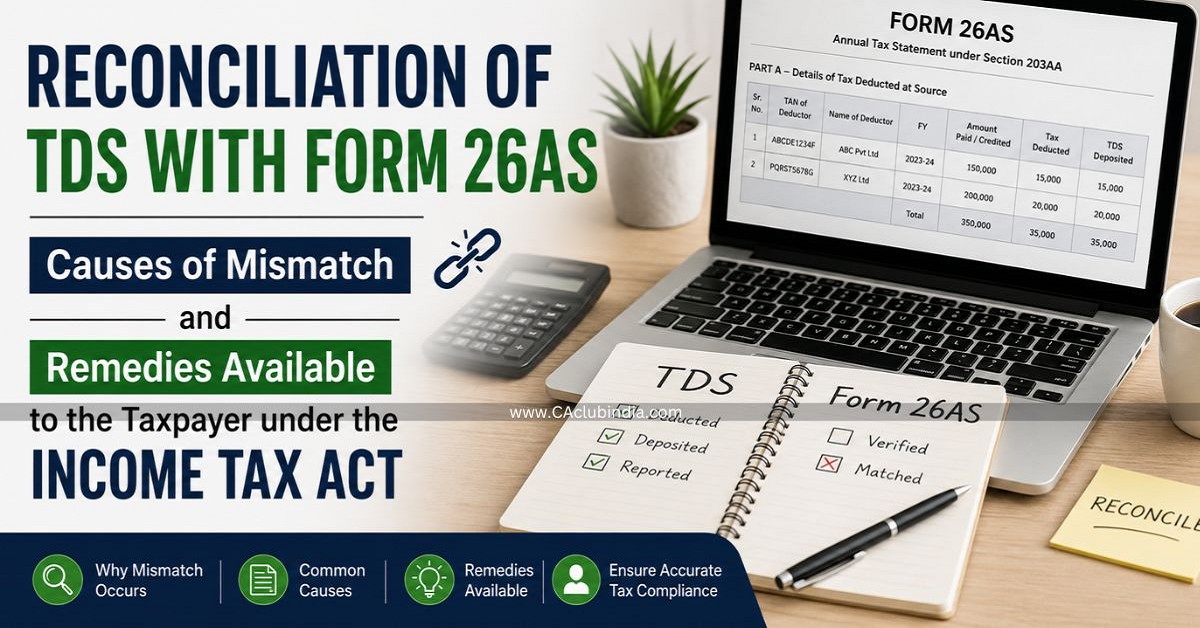
Reconciliation of TDS is a three-way verification between (i) the taxpayer's own records — books of account, invoices, bank statements evidencing receipts net of tax, and Forms 16/16A issued by deductors; (ii) Form 26AS, being the annual information statement referred to in section 285BB; and (iii) the Annual Information Statement (AIS) and Taxpayer Information Summary (TIS) available on the e-filing portal.
The recommended sequence is as follows.
Step 1 - Compilation from own records. A deductor-wise statement should be prepared from the books, capturing the deductor's name and TAN, the section under which tax was deducted, the amount of income, the amount of TDS and the quarter of deduction. In the case of business receipts, every entry where the credit to the party account falls short of the invoice value indicates deduction of tax at source, irrespective of whether Form 16A has been received.
Step 2 - Download of Form 26AS. Form 26AS should be downloaded through the e-filing portal (via TRACES) for the complete financial year, after the due date for the deductors' fourth-quarter statements (31 May) has elapsed. A download made earlier will not reflect Q4 credits, which are frequently the most significant.
Step 3 - Line-wise matching. For each deductor, three parameters must tally: the TAN, the amount of income reported and the amount of TDS. An entry bearing booking status "F" (final) indicates that the deductor's statement has matched with the corresponding challan and the credit stands confirmed. Entries with provisional or unmatched status remain susceptible to change.
Step 4 - Cross-verification with AIS. The AIS may contain information not yet reflected in Form 26AS, and vice versa. While Form 26AS remains the basis on which CPC grants TDS credit, an AIS entry serves as corroborative evidence that the deductor has reported the transaction.
Entries that fail to reconcile constitute the exception list, and the remedies discussed below apply to that list.
2. Common causes of mismatch
The causes of non-reflection or short-reflection of TDS in Form 26AS generally fall within the following categories, and the appropriate remedy depends on the category involved.
| Cause of mismatch | Nature of the default | Party competent to rectify |
|---|---|---|
| Incorrect PAN quoted by the deductor | TDS deposited, but credited to another PAN or reported against "PAN not available" | Deductor, through a correction statement |
| TDS statement not filed | Tax deducted and deposited, but the quarterly statement not furnished | Deductor, by filing the statement |
| Incorrect assessment year or section | Credit reflected in the wrong year or under the wrong section owing to challan or statement errors | Deductor, through statement or challan correction |
| Short reporting of amounts | Statement filed with understated income or TDS figures | Deductor, through a correction statement |
| Tax deducted but not deposited | Deduction effected from the payment, but the amount not remitted to the Central Government | Department, by proceeding against the deductor; the deductee is protected by section 205 |
| Timing mismatch | Income offered on accrual in an earlier year; TDS deducted on payment in a subsequent year | Taxpayer, through Form 71 under section 155(20), read with Rule 37BA |
It will be observed that in the majority of cases the correction lies exclusively within the deductor's control, which explains why the first remedy is directed at the deductor.
3. Remedy I: Correction statement by the deductor
The taxpayer should address a written communication to the deductor — preferably by email, so as to create a record — identifying the payment, the deduction, the PAN and the discrepancy, and requesting that a correction statement be filed on TRACES for the relevant quarter. Upon processing of the corrected statement, Form 26AS is updated automatically, ordinarily within seven to ten days.
Deductors are considerably more responsive when their own statutory exposure is brought to their notice. A deductor in default attracts the following consequences: treatment as an assessee-in-default under section 201(1); interest under section 201(1A) at 1.5% per month from the date of deduction to the date of deposit; late filing fee under section 234E; penalty under section 271H; disallowance of 30% of the corresponding expenditure under section 40(a)(ia) in the deductor's own computation; and, in cases of deduction without deposit, prosecution under section 276B. A communication setting out these consequences is generally sufficient to secure compliance.
4. Remedy II: Claim of credit in the return and response to the section 143(1) adjustment
Where the filing deadline is imminent and the deductor has not rectified the record, the taxpayer holding credible proof of deduction — Form 16/16A, the underlying contract, invoices and bank statements evidencing receipt net of tax — is entitled to claim the credit in the return. Section 199 read with Rule 37BA of the Income-tax Rules, 1962 entitles the deductee to credit for tax deducted, and courts have consistently held that non-reflection in Form 26AS cannot mechanically defeat a credit that is otherwise established on evidence. The TDS schedule of the return should be completed with the deductor's TAN and the actual amounts as per the taxpayer's records.
CPC will, in all likelihood, restrict the credit to the Form 26AS figure in the intimation under section 143(1). The taxpayer should thereupon respond through the e-filing portal: a rectification application under section 154 (tax credit mismatch) may be filed once the deductor's correction statement is processed, or a response to the outstanding demand may be submitted with supporting evidence. Where the correction materialises after processing, the section 154 route ordinarily resolves the matter without further escalation.
It must be emphasised that the corresponding income cannot be omitted from the return merely because the TDS credit is unavailable. Income is chargeable on accrual or receipt in accordance with the method of accounting regularly employed, irrespective of the deductor's reporting. Omission of both the income and the credit exposes the taxpayer to a larger difficulty when the deductor subsequently files the statement and the AIS reflects unreported income.
5. Remedy III: Form 71 under section 155(20) for timing mismatches
Section 155(20), inserted by the Finance Act, 2023 with effect from 1 October 2023, addresses a difficulty of long standing. The typical fact pattern is one where income (for instance, interest or professional fees) has been offered on accrual basis in an earlier assessment year, while the payer deducts tax only in a subsequent financial year at the time of actual payment. The TDS then appears in Form 26AS of a year in which the income is not assessable, and since Rule 37BA(1) links credit to the year of assessability of the income, the credit remains unutilisable in either year.
Under section 155(20), the Assessing Officer is empowered to amend the assessment order or intimation of the earlier year — the year in which the income was included in the return filed under section 139 — and allow credit for the tax so deducted. The application is to be made electronically in Form No. 71, prescribed under Rule 134 (Notification No. 73/2023 dated 30.08.2023), verified by digital signature or electronic verification code, and is routed through the Principal DGIT (Systems) to the jurisdictional Assessing Officer.
The limitation period is two years from the end of the financial year in which the tax was deducted at source. Accordingly, in respect of TDS deducted during FY 2025-26, Form 71 may be furnished up to 31 March 2028. The form requires particulars of the deduction — date, section, rate, date of deposit, and the deductor's TAN and PAN — together with a declaration that credit for the same deduction has not been and will not be claimed in any other assessment year. Form 16A, the earlier year's return evidencing inclusion of the income, and challan particulars should be retained in support.
It should be noted that Form 71 remedies only the mismatch in the year of credit. It does not cure a case where the deductor has failed to report or deposit the tax altogether; such cases fall under Remedies I and IV.
6. Remedy IV: The bar under section 205 where tax is deducted but not deposited
The most serious category is that in which the deductor has deducted tax from the payment but failed to remit it to the Central Government. The departmental practice of keeping such demands alive against the deductee and adjusting refunds against them has been decisively disapproved by the courts.
Section 205 provides that where tax is deductible at source, the assessee shall not be called upon to pay the tax himself to the extent to which tax has been deducted from his income. In Sanjay Sudan v. ACIT (2023) 452 ITR 107 (Del), the Delhi High Court held that this statutory bar extends not only to direct recovery but equally to indirect recovery: the demand attributable to tax withheld by the deductor can neither be enforced against the deductee nor adjusted against refunds of any assessment year. The Revenue's contention that credit under section 199 is available only upon actual receipt of the tax in the Government account was expressly rejected, the Court holding that the remedy for non-deposit lies against the deductor under sections 201 and 226 and not against the person from whose income the tax has already been deducted. The ratio has been followed by the same High Court in Chintan Bindra v. DCIT and Vishesh Khanna v. DCIT (2023), and has been applied by benches of the Tribunal even where the deductor is under liquidation and recovery from it is impracticable.
A taxpayer confronted with such a demand should, therefore: (i) submit a response to the outstanding demand on the e-filing portal; (ii) enclose Form 16/16A, salary slips or invoices, and bank statements evidencing receipt net of tax; (iii) place reliance on section 205 and the decisions cited above; and (iv) specifically request that no adjustment of refund be made under section 245. Where the demand is nonetheless persisted with, escalation through e-Nivaran, representation before the jurisdictional Principal Commissioner and, ultimately, writ proceedings remain available, and the settled position of law strongly favours the deductee.
The scope of section 205 should, however, be correctly understood. The provision bars recovery from the deductee; whether CPC will affirmatively grant credit in processing for an amount not appearing in Form 26AS is a distinct question, and documentary proof of deduction remains the foundation of the taxpayer's case in every scenario.
7. Position under the Income-tax Act, 2025
For payments or credits on or after 1 April 2026 (Tax Year 2026-27 onwards), the TDS machinery stands migrated to the new Act. The provisions of sections 192 to 194T of the 1961 Act are consolidated into section 392 (salary) and section 393 (other payments) of the Income-tax Act, 2025; quarterly statements are replaced by Form 138 (salary) and Form 140 (non-salary); section 396 corresponds to erstwhile section 198 (tax deducted is income received); and the bar against direct demand on the assessee, corresponding to section 205, is now contained in section 401. The substantive protections and the reconciliation discipline described in this article therefore continue unchanged in the new regime; only the statutory references stand renumbered.
8. Conclusion
TDS reconciliation should be treated as a periodic compliance function rather than a year-end exercise. A quarterly verification against Form 26AS, undertaken shortly after each statement due date, permits mismatches to be resolved by a single communication to the deductor. The same mismatch, discovered only upon receipt of an intimation under section 143(1), entails a rectification cycle, a withheld refund, possible loss of interest under section 244A and, on occasion, litigation. The statutory framework — Rule 37BA, section 155(20) read with Rule 134 and Form 71, and the jurisprudence under section 205 — now provides the taxpayer with an effective remedy for every category of mismatch. Each of those remedies, however, is contingent upon the taxpayer's ability to establish the fact of deduction through Forms 16/16A, invoices and bank records; the maintenance of that evidentiary trail is accordingly the first and most important safeguard.
Disclaimer: The contents of this article are for general informational purposes only and do not constitute professional advice. Readers are advised to consult a qualified professional before acting on any information contained herein. The author accepts no liability for any loss or damage arising from reliance on this article. The views expressed are personal.











 CAclubindia
