
When Law Learns to Ignore the Shine
Every mature tax system is scrutinised not through intricate transactions but by seemingly straightforward items that challenge instinct rather than interpretation. Few elements have consistently tested the intellectual rigour of GST authorities and professionals as enduringly as premium presentation boxes - velvet-lined jewellery cases, embossed festive hampers, rigid designer cartons, moulded trays, and luxury packaging that appear vastly removed from the conventional realm of taxation.
These boxes convey an immediate visual impression of generosity. They appear indulgent and evoke a celebratory atmosphere. As GST audits are conducted by human inspectors before they are assessed against statutory provisions, perception often trumps the underlying principle. The inevitable consequence is suspicion: Is this a gift? Is this free? Should the Input Tax Credit (ITC) be denied?
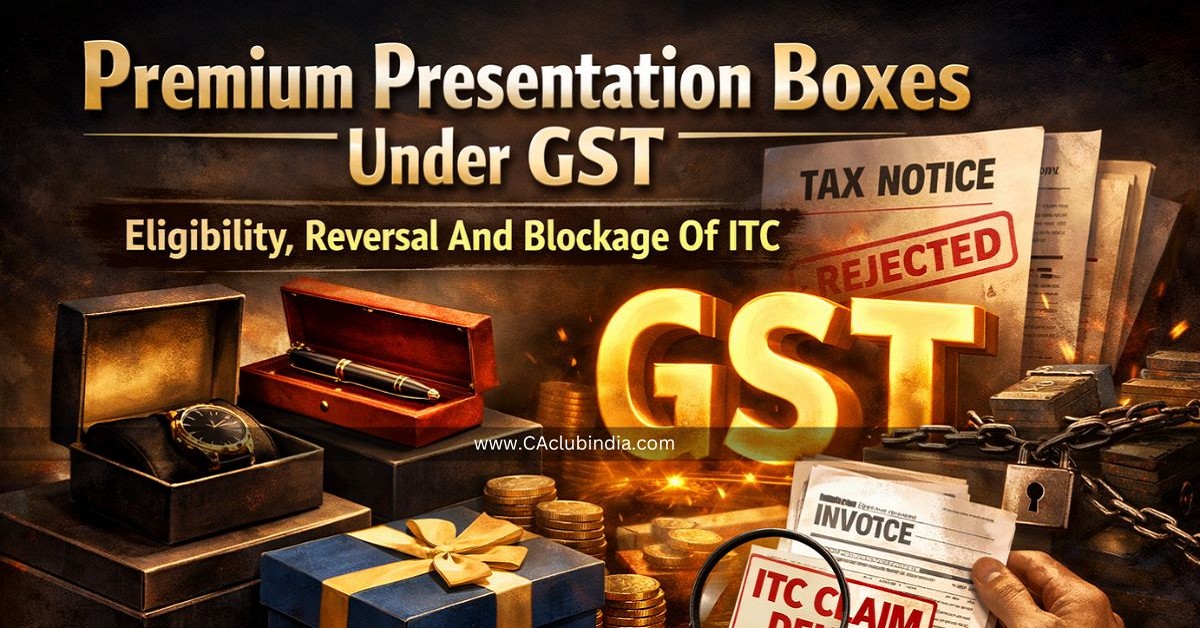
Nevertheless, the GST law is never intended to operate based on superficial appearances. It has been enacted to function on principles of valuation, consideration, and economic flow. Once valuation is appropriately comprehended, the significance of the box's shine diminishes.
" रूप अक्सर भ्रम रचता है , और कानून भ्रम से नहीं चलता। "
[Appearance often creates illusion, but law does not move on illusion].
This article examines why premium presentation boxes repeatedly become audit flashpoints and why, when GST is read as a coherent value-based statute, Input Tax Credit on such boxes is not an exception, but the natural consequence of tax already having been paid.
Why Premium Packaging Creates GST Anxiety - Perception versus Commercial Reality
The controversy over ITC on premium presentation boxes does not arise from ambiguity in the CGST Act. It arises from discomfort. Traditional tax thinking is comfortable with plain cardboard cartons and utilitarian packing. Luxury packaging, however, unsettles that comfort. It does not look like an input. It looks like an indulgence.
But modern commerce has moved far beyond the idea that packaging merely protects goods in transit. Packaging today is part of the product itself. It influences brand positioning, pricing power, consumer choice, and market perception. Businesses invest in it deliberately, and consumers pay for it—albeit indirectly.
When a festive hamper sells for ₹5,000 instead of ₹3,800 because it is housed in a rigid, reusable premium box, the market has already recognised the value of that box. To treat it as "free" merely because it is not separately invoiced is to deny economic reality. GST, as a destination-based consumption tax, has been specifically designed to give priority to commercial substance over visual classification.
" व्यापार की सच्चाई को नज़रअंदाज़ कर , कानून कभी टिक नहीं सकता। "
[A law that ignores commercial reality cannot sustain itself.]
Why the 'Gift' Block Is Far Narrower Than It Appears- Section 17(5)(h)
Section 17(5)(h) of the CGST Act, 2017 blocks ITC on goods "disposed of by way of gift or free samples." This provision is often invoked reflexively in audit proceedings involving premium packaging, but rarely applied with the precision it demands.
The word 'gift' is not defined under the GST Acts, Rules, or both. In such cases, settled legal meaning must prevail. Under the Transfer of Property Act, 1882, a gift is a voluntary transfer without consideration. This principle cannot be diluted merely because the GST law is silent on the definition. Silence does not widen scope; it narrows it to established meaning.
This has an important consequence: the burden of proof lies on the department to establish that the goods were supplied independently, gratuitously, and without any recovery of value. Visual luxury does not meet this burden. Promotional intent does not meet this burden. Absence of a separate line item does not meet this burden.
Blocking provisions must be interpreted strictly. In Commissioner of Customs (Imports), Mumbai v M/s Dilip Kumar and Company & Others, reported as 2018-TIOL-302-SC-CUS-CB: 2018(7) TMI 1826, dated 30.07.2018, the Supreme Court has clearly held that in case of ambiguity in a charging provision, the benefit must necessarily go in favour of the subject/assessee.
Section 17(5)(h) is not a moral commentary on elegance or branding. It is a fiscal safeguard against tax leakage where value genuinely exists the system.
" जहाँ प्रतिफल समाप्त होता है , वहीं कर और क्रेडिट दोनों रुकते हैं। "
Where consideration ends, tax and credit must both stop.
Valuation under Section 15 Resolves the Entire Debate
The real resolution of the controversy lies not in Section 17, but in Section 15 of the CGST Act. Section 15 does not merely prescribe how value is calculated; it reveals how GST understands transactions. It recognises that business pricing is holistic, not itemised to satisfy audit convenience.
Section 15(2)(c) explicitly includes incidental expenses, including packing charged by the supplier to the recipient, within the value of the supply. GST law therefore accepts that packaging, whether plain or premium is part of the taxable value when supplied in the ordinary course of business. The law does not require artificial dissection of a transaction into visible and invisible components.
Once GST is paid on the transaction value, the law presumes that all contributing inputs have been taxed along the chain. The argument that " the box was not charged separately" is therefore legally irrelevant. GST taxes the supply, not the invoice format.
Courts have consistently upheld this substance-over-form approach. Pre-GST decisions under the CENVAT Credit Rules recognised that inputs enhancing marketability do not lose their business nexus merely because they appear luxurious. The Bombay High Court in Nestlé India Ltd. reaffirmed this principle under GST, holding that economic substance must prevail over artificial segregation.
" मूल्य कभी चुप नहीं रहता , वह कीमत में स्वयं बोलता है। "
[Value never remains silent; it speaks through price]
Composite Supply and the Impossibility of Isolating Premium Packaging
Once the valuation is accepted, the theory of composite supply follows naturally. Premium presentation boxes are not supplied independently in the ordinary course of business. They are bundled, expected, and inseparable from the principal supply, be it sweets, jewellery, garments, or luxury goods.
Section 2(30) of the CGST Act has defined the term "composite supply" as follows:
(30) "composite supply" means a supply made by a taxable person to a recipient consisting of two or more taxable supplies of goods or services or both, or any combination thereof, which are naturally bundled and supplied in conjunction with each other in the ordinary course of business, one of which is a principal supply:
Illustration: Where goods are packed and transported with insurance, the supply of goods, packing materials, transport and insurance is a composite supply and the supply of goods is a principal supply .
Thus, Section 2(30) of the CGST Act defines composite supply precisely to capture such realities.
Further, Section 2(90) of the CGST Act has defined the term "principal supply" as under:
(90) "principal supply" means the supply of goods or services which constitutes the predominant element of a composite supply and to which any other supply forming part of that composite supply is ancillary;
The principal supply governs the tax rate, and everything that naturally accompanies it shares the same tax destiny. To tax the final supply while denying ITC on packaging is to fracture the composite chain mid-stream.
GST neutrality demands internal consistency. What moves together commercially must move together fiscally. Otherwise, cascading taxation re-enters through the back door, defeating the very philosophy of GST.
" जो व्यापार में साथ चलता है , वही कर व्यवस्था में भी साथ चलता है। "
[What moves together in trade must move together in tax.]
Why Disputes Persist Despite Legal Clarity
Judicial pronouncements under GST reveal a consistent pattern. Where goods are genuinely distributed free—without recovery and without output tax, ITC has rightly been denied, as seen in Biostadt India Ltd. and Sanofi India Ltd. These cases do not oppose ITC on premium packaging; they merely define the boundary where valuation disappears. Conversely, rulings such as Dwarikesh Sugar Industries Ltd. and Asvini Fisheries recognise that packaging integral to taxable supplies remains within the ITC chain. CBIC Circular No. 92/11/2019-GST (07.03.2019) reinforces this position by clarifying that once value is factored into pricing and GST is paid, promotional items cease to be "gifts".
Why, then, do disputes persist? Because audits often rely on visual inference rather than valuation analysis. Luxury triggers suspicion, but suspicion is not evidence. GST law demands economic linkage, pricing logic, and tax payment—not aesthetic judgment. The solution lies not in post-audit explanations but in valuation coherence: consistent pricing policies, comparable SKUs, documented MRPs, and seamless tax payments.
" तथ्य बोलते हैं , तो अनुमान स्वतः चुप हो जाते हैं। "
[When facts speak, assumptions fall silent.]
ITC Eligibility on Premium Packaging - Four Independent Use-Based Situations
A recurring misconception in GST practice is that premium or decorative packaging automatically attracts denial of input tax credit. Such an approach is legally unsustainable. The CGST Act does not examine the aesthetic character of an input; it examines its functional use. When premium packaging is analysed through the lens of Sections 16 and 17 of the CGST Act, read with Rule 42 of the CGST Rules, 2017, four independent and mutually exclusive situations emerge, each carrying a distinct ITC consequence.
(a) Premium packaging used in making taxable outward supplies
Where premium packaging is used in the course or furtherance of business for making a taxable outward supply, input tax credit on such packaging is fully admissible under Section 16 of the CGST Act. The law does not impose any condition linking ITC eligibility to the value of the outward supply. Whether the outward supply is of modest value or high value is wholly irrelevant. Once it is established that the premium packaging forms part of the taxable supply chain and is not given away independently, the credit cannot be denied merely because the packaging is luxurious, decorative, or disproportionately expensive. GST law does not apply a value-based morality test to business inputs; it only tests their nexus with taxable supplies.
(b) Premium packaging used exclusively for exempt supplies
Where premium packaging is used exclusively in making exempt outward supplies, input tax credit becomes ineligible by operation of Section 17(2) of the CGST Act. This denial is automatic and absolute. Even if such premium packaging is commercially necessary, industry-driven, or adopted for competitive positioning, the statutory bar under Section 17(2) remains unaltered. Commercial expediency cannot override legislative exclusion. In such cases, ITC does not arise at all, and there is no question of proportionate reversal.
(c) Premium packaging commonly used for taxable and exempt supplies
In situations where premium packaging is commonly used for both taxable and exempt outward supplies, the credit does not become entirely ineligible. Instead, the law mandates proportionate reversal of ITC attributable to exempt supplies in accordance with Section 17(2) read with Rule 42 of the CGST Rules, 2017. Importantly, Rule 42 does not operate as a denial provision but as a computational mechanism. Premium packaging does not lose its character as a business input merely because it is commonly used. The reversal is mathematical, objective, and periodic, ensuring that credit attributable solely to exempt supplies is neutralised, while the balance of credit relating to taxable supplies remains available.
(d) Premium packaging given independently as a gift
A materially different consequence arises where premium packaging is not used to make an outward supply at all, but is given independently as a gift, without consideration. In such cases, input tax credit is expressly blocked under Section 17(5)(h) of the CGST Act. Once premium packaging crosses the line from being a facilitative business input to a gratuitous transfer, the statute imposes a hard stop on credit eligibility. This remains true even if the taxpayer otherwise makes taxable supplies or pays GST on related goods. Section 17(5)(h), being a non obstante provision, overrides the general entitlement under Section 16.
Practical Clarifications through Frequently Asked Questions (FAQS)
FAQ 1: Does premium packaging automatically qualify as a gift?
Reply 1: No. A gift requires the absence of consideration. Embedded valuation defeats this claim.
FAQ 2: Is separate invoicing necessary for ITC eligibility?
Reply 2: No. Section 15 recognises bundled valuation.
FAQ 3: Does reusability of boxes affect ITC?
Reply 3: No. Business use and valuation are decisive.
FAQ 4: What if boxes are distributed independently, without charging customers?
Reply 4: ITC will be blocked under Section 17(5)(h).
FAQ 5: Does promotional intent bar ITC?
Reply 5: No. Promotion is a recognised business activity.
FAQ 6: Can an audit deny ITC merely because the packaging looks luxurious?
Reply 6: No. Appearance has no statutory relevance.
FAQ 7: Are festive hampers composite supplies?
Reply 7: Yes, when supplied as a single commercial unit.
FAQ 8 Is pre-GST jurisprudence relevant?
Reply 8: Yes, as persuasive guidance where principles align.
FAQ 9: Does Section 17(5)(h) apply automatically?
Reply 9: No. It applies only when the value genuinely exists in the tax chain.
FAQ 10: What is the strongest defence in practice?
Reply 10: Clear valuation logic supported by pricing and tax records.
When GST Learns to Look Beyond the Box
At its core, GST has never intended to be a tax on appearances. It has been conceived as a tax on economic flows, a system designed to trace value as it moves from input to output, from supplier to consumer, without distortion or interruption. Every provision of the CGST Act, when read harmoniously, points to this singular objective. Input Tax Credit is not a concession granted by the State; it is a structural right embedded in the architecture of GST to prevent tax cascading.
Section 17(5)(h) must be understood in this light. It is not a blunt instrument meant to strike down credit wherever something looks free or generous. It is a carefully calibrated safety valve, intended to operate only when value genuinely exists the tax chain— when goods are lost, destroyed, written off, or truly gifted without any economic recovery. To apply this provision merely because a presentation box appears premium is to confuse visual generosity with legal gratuity , and in doing so, to dilute the discipline of valuation that underpins GST.
The moment value is recognised in pricing; the legal character of the transaction changes irreversibly. When GST is paid on a consolidated transaction value that consciously factors in premium packaging, the law cannot later pretend that such packaging was "free". Credit, in such circumstances, is not a favour—it is a logical corollary . To deny ITC after collecting tax on the same value is not revenue protection; it is an internal contradiction.
" जहाँ कर लिया गया है , वहाँ क्रेडिट से इनकार अन्याय है। "
[Where tax has been collected, denial of credit is an injustice.
This debate also carries a broader lesson for GST administration and practice. The strength of GST lies not in aggressive reversals, but in conceptual consistency . A tax system earns legitimacy when its principles apply uniformly, regardless of whether a transaction appears modest or luxurious. When audit decisions begin to turn on aesthetics rather than economics, uncertainty replaces certainty, and discretion overshadows law.
For practitioners, the message is equally clear. The strongest defence under GST is not argumentative brilliance after a show-cause notice, but coherence before scrutiny begins . Pricing policies, valuation logic, consistent invoicing practices, and documented commercial rationale together tell a single, credible story. When value, tax, and credit move in unison, the law listens patiently—and often agrees.
" मूल्य , कर और क्रेडिट — तीनों साथ हों , तो व्यवस्था संतुलित रहती है। "
[When value, tax, and credit move together, the system remains balanced.
Ultimately, the controversy over premium presentation boxes is not about boxes at all. It is about how GST sees the world. If GST looks only at surfaces, it risks becoming arbitrary. If it looks at flow, it fulfils its promise as a modern, principled consumption tax.
When the law finally learns to look beyond the velvet lining and the gilded exterior—when it fixes its gaze instead on the steady current of value beneath, GST achieves its highest purpose. Not merely as a mechanism for revenue collection, but as a fair, rational, and intellectually honest tax system that honours substance over shadow, valuation over visual appeal, and principle over perception. In that vision of GST, every premium presentation box that has been properly valued and taxed finds its rightful place—not in the scrapheap of suspicion, but firmly within the seamless chain of credit that defines the very soul of GST.











 CAclubindia
