
If you're a CA student or a freshly qualified Chartered Accountant, you've probably asked this question at least once; "Should I go for statutory audit, internal audit, or forensic audit?" It's one of the most common confusions during articleship and even after qualifying.
The truth is, there's no one-size-fits-all answer. Each of these audit careers in India offers something different, different work, different growth, and a different lifestyle. Let's break it down in the simplest way possible, like we're explaining it to a CA student sitting across the table.
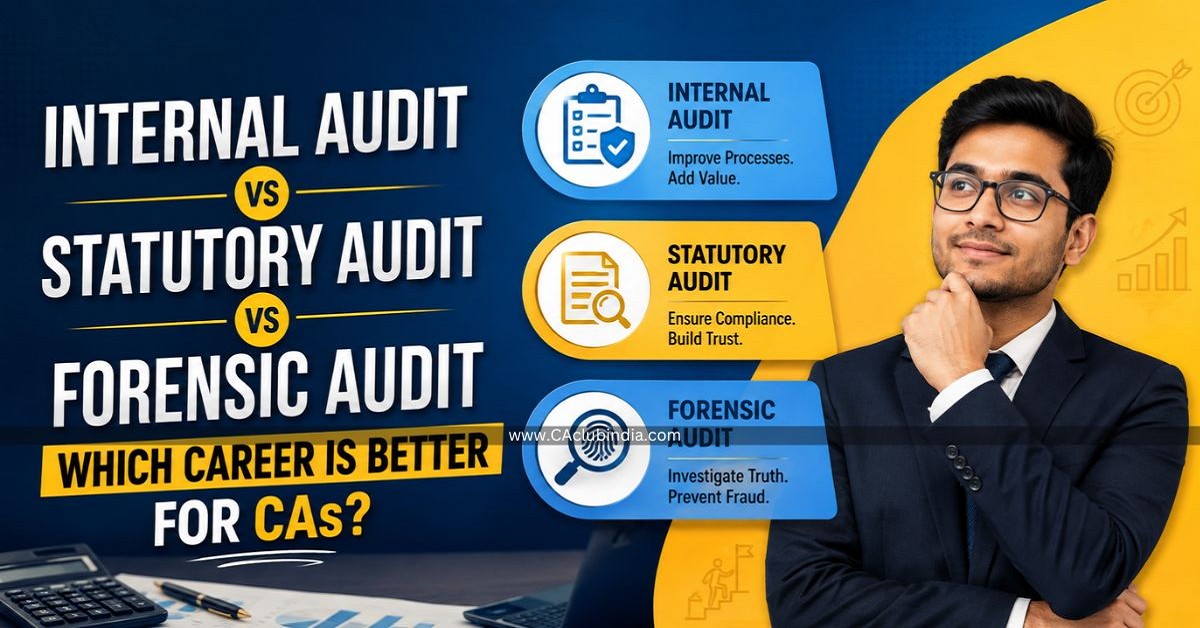
What Do These Audits Actually Mean?
Statutory Audit - The Legal Checkpoint
A statutory audit is a mandatory audit required under the Companies Act, 2013. Every registered company in India, once it crosses certain thresholds, must get its books checked by an independent, practising Chartered Accountant. Think of it as the annual health check-up that every company is legally bound to do.
The statutory auditor checks whether the balance sheet, profit and loss account, and cash flow statement give a "true and fair view." This audit is done once a year and follows strict accounting standards.
Internal Audit - The Ongoing Health Monitor
Unlike statutory audit, internal audit is not always compulsory though it is mandatory for listed companies and larger private companies under Section 138. Internal audit happens throughout the year, not just once. It focuses on risk management, internal controls, and whether business processes are running efficiently.
An internal auditor doesn't just look at numbers, they look at how the business actually functions. This role can be done by a CA, CMA, CS, or even a qualified in-house employee, which makes it more flexible than statutory audit.
Forensic Audit - The Detective Work
Forensic audit is the odd one out, it's not routine at all. It's called in only when there's a suspicion of fraud, financial misstatement, or misappropriation of funds. Forensic auditors dig deep into transactions, almost like financial detectives, and their findings can even be used as evidence in court.
A great real-world example that every CA student should know is the Satyam scandal of 2009. The company's statutory audits looked clean for years, yet massive fraud was happening behind the scenes. It was only deeper investigation the kind forensic audit specialises in that exposed the truth. This case is exactly why forensic audit has become such an important field in India today.
Key Differences at a Glance
- Nature: Statutory audit is compliance-driven; internal audit is management-driven; forensic audit is investigation-driven
- Frequency: Statutory audit is annual; internal audit is continuous; forensic audit happens only when needed
- Who appoints: Statutory auditor is appointed by shareholders; internal auditor by the board; forensic auditor usually by the board, regulators like SEBI/RBI, or courts
- Purpose: True and fair financial view vs risk and efficiency improvement vs fraud detection and legal evidence
Which One Should You Choose As a CA?
This depends a lot on your personality and interest, not just on salary numbers.
- If you enjoy structure, accounting standards, and building strong fundamentals, statutory audit is a solid starting point, it's still considered the backbone of CA articleship training.
- If you like understanding how a business actually runs, enjoy talking to different departments, and want variety in your day-to-day work, internal audit could suit you better.
- If you're someone who enjoys solving puzzles, reading between the lines, and doesn't mind irregular hours, forensic audit can be an exciting and high-growth path.
Salary and Growth Scenario in India
Forensic audit has been getting a lot of attention lately because of rising financial crime cases and stricter regulations. Big 4 firms, banks, RBI, SEBI, and even the Serious Fraud Investigation Office (SFIO) are actively hiring forensic professionals. Entry-level forensic auditors in Big 4 firms can expect packages roughly in the 8–12 LPA range, which can grow significantly with 5-6 years of experience.
Statutory and internal audit, on the other hand, offer more stable and predictable growth, especially if you're aiming to eventually start your own practice or move into a CFO-track role in the industry.
A Word on Upskilling
Whichever path you choose, certifications help you stand out. For statutory and internal audit, staying updated with Companies Act amendments and Ind-AS is important. For forensic audit, courses like ICAI's FAFD are highly valued, and structured programs like the Master Class on Forensic Audit by CA Tushar Makkar are also worth exploring if you want practical, real-case-based learning in this niche field.
Final Thoughts
There's no "better" audit career only the one that fits you better. Statutory audit builds your foundation, internal audit gives you business exposure, and forensic audit offers investigative thrill with growing demand. Many successful CAs in India have even worked across all three at different stages of their career, picking up skills that complement each other.
Take your time, try to get exposure to more than one type during articleship if possible, and choose the path that keeps you genuinely interested because a career you enjoy is always easier to grow in.











 CAclubindia
