
House Rent Allowance (HRA) is one of the most searched tax-saving components every ITR season - and for good reason. If you're a salaried employee under the old tax regime, calculating your HRA exemption correctly can save you thousands of rupees in tax. This guide breaks down the exact formula, the current metro city list, worked examples, and the documentation you need to claim HRA for AY 2026-27 (income earned in FY 2025-26).
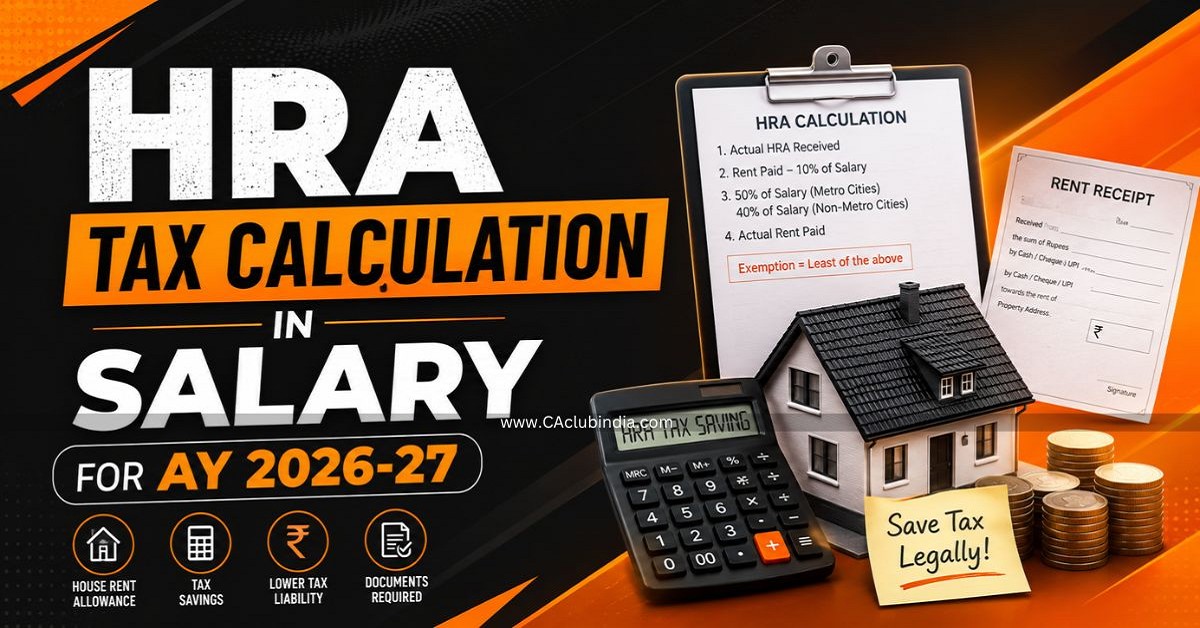
HRA and Who can Claim It?
House Rent Allowance (HRA) is a component of your salary paid by your employer to help you meet the cost of rented accommodation. While the full HRA amount is added to your salary, a part of it is exempt from tax under Section 10(13A) of the Income Tax Act, 1961, read with Rule 2A of the Income Tax Rules.
To claim the HRA exemption, three conditions must be satisfied together:
- You must be a salaried employee and HRA must be a part of your salary structure.
- You must actually be living in rented accommodation.
- You must actually be paying rent for that accommodation during the relevant financial year.
If you own the house you live in, you cannot claim HRA exemption, even if HRA appears in your salary slip. Self-employed individuals and business owners cannot claim HRA under Section 10(13A) at all - they may instead explore a deduction under Section 80GG, subject to its own conditions and limits.
HRA Exemption Formula
The exempt portion of HRA is the lowest of the following three amounts. Any HRA received over and above this exempt amount is fully taxable as part of your salary income.
HRA Exemption = Least of:
- Actual HRA received
- Rent paid minus 10% of (Basic Salary + Dearness Allowance)
- 50% of (Basic Salary + DA) for metro cities, or 40% for non-metro cities
Metro vs Non-Metro City Classification for AY 2026-27
| Category | Cities | Exemption Rate |
| Metro | Delhi, Mumbai, Kolkata, Chennai | 50% of Basic + DA |
| Non-metro | All other cities, including Bengaluru, Hyderabad, Pune, Ahmedabad, and every other Indian city or town | 40% of Basic + DA |
Important clarification
You may have seen articles claiming that Bengaluru, Hyderabad, Pune, and Ahmedabad now qualify for the 50% HRA rate. This is not applicable for AY 2026-27. The Income Tax Rules, 2026, which expand the 50% list to eight cities, take effect only from 1 April 2026 - i.e., from FY 2026-27 (AY 2027-28) onwards. For the return you are filing now (FY 2025-26 / AY 2026-27), the older four-city classification applies.
The classification depends on where the rented accommodation is actually located, not on where your employer's registered office is.
Step-by-Step Calculation
- Note your Basic Salary + DA for the relevant period (annual, or month-wise if salary/rent changed during the year).
- Note actual HRA received from your salary slips or Form 16.
- Note actual rent paid during the year, supported by receipts or bank transfers.
- Compute all three limbs of the formula above.
- Take the lowest value - that is your exempt HRA.
- Subtract the exempt HRA from actual HRA received - the balance is added to your taxable salary.
If your basic salary, HRA, or rent changed during the year (for example, due to an increment or a house shift), the exemption must be computed separately for each period and then added together - not calculated on the annual average.
Worked Examples
Example 1: Metro city employee
Ms. Anjali works in Mumbai. Her annual Basic Salary + DA is Rs 6,00,000. She receives HRA of Rs 3,00,000 per year and pays rent of Rs 2,80,000 per year.
- Actual HRA received = Rs 3,00,000
- Rent paid − 10% of salary = Rs 2,80,000 − Rs 60,000 = Rs 2,20,000
- 50% of salary (metro) = Rs 3,00,000
Exempt HRA = Rs 2,20,000 (the lowest of the three). The remaining Rs 80,000 is taxable as salary.
Example 2: Non-metro city employee (Bengaluru)
Mr. Rahul works in Bengaluru. His annual Basic Salary + DA is Rs 8,00,000. He receives HRA of Rs 3,20,000 per year and pays rent of Rs 3,00,000 per year.
- Actual HRA received = Rs 3,20,000
- Rent paid − 10% of salary = Rs 3,00,000 − Rs 80,000 = Rs 2,20,000
- 40% of salary (non-metro) = Rs 3,20,000
Exempt HRA = Rs 2,20,000. The remaining Rs 1,00,000 is added to taxable salary. Note that Bengaluru still falls under the 40% non-metro rate for AY 2026-27.
HRA: Old Regime vs New Regime
HRA exemption under Section 10(13A) is available only under the old tax regime. If you opt for the new tax regime (the default regime under Section 115BAC), the entire HRA you receive is fully taxable, regardless of how much rent you actually pay.
Broadly, employees paying substantial rent, along with claiming other deductions such as Section 80C investments or home loan interest, tend to find the old regime more tax-efficient. Those with limited rent outflow and few other deductions often find the new regime's lower slab rates more beneficial. It's worth running both computations before deciding which regime to opt for while filing your return.
Documents Required to Claim HRA
- Rent receipts for each month, signed by the landlord - mandatory if monthly rent exceeds Rs 3,000.
- Landlord's PAN - mandatory if total annual rent exceeds Rs 1,00,000.
- Rental agreement, where available, as supporting evidence of a genuine tenancy.
- Proof of payment, ideally through bank transfer, especially important where rent is paid to relatives or parents.
These documents don't need to be submitted along with your ITR, but they must be furnished to your employer for accurate TDS deduction, and retained in case the Income Tax Department raises a query or scrutiny notice.
Common Mistakes to Avoid
- Claiming HRA without actually paying rent - this is a red flag that can attract scrutiny and penalty.
- Ignoring mid-year changes in salary, rent, or city, and applying a flat annual calculation instead of period-wise computation.
- Not collecting the landlord's PAN when annual rent crosses Rs 1 lakh, leading to disallowance by the employer.
- Applying the 50% rate to Bengaluru, Hyderabad, Pune, or Ahmedabad for AY 2026-27 - this expansion only applies from FY 2026-27 onwards.
- Claiming HRA under the new tax regime - it simply isn't allowed.
- No genuine rental arrangement when paying rent to a family member, which can lead to the claim being disallowed on scrutiny.
FAQs
What is the HRA exemption formula for AY 2026-27?
The exemption is the lowest of: actual HRA received, rent paid minus 10% of Basic Salary + DA, and 50% (metro) or 40% (non-metro) of Basic Salary + DA.
Which cities qualify for 50% HRA exemption in AY 2026-27?
Only Delhi, Mumbai, Kolkata, and Chennai qualify for the 50% rate for AY 2026-27. Bengaluru, Hyderabad, Pune, and Ahmedabad remain at the 40% non-metro rate for this assessment year; their move to 50% applies from FY 2026-27 (AY 2027-28) onwards.
Can I claim HRA under the new tax regime?
No. HRA exemption is available only under the old tax regime. Under the new regime, the full HRA received is taxable.
Is a landlord's PAN mandatory for claiming HRA?
Yes, if annual rent exceeds Rs 1 lakh. Without it, the employer may disallow the exemption while computing TDS on salary.
Can I claim HRA if I pay rent to my parents?
Yes, provided the arrangement is genuine, rent is actually paid (preferably via bank transfer), and the parent declares it as rental income in their own return.










 CAclubindia
