
Taxpayers often face a higher tax burden when they receive salary arrears or advance payments in a single financial year. Consequently, this lump-sum income can push an individual into a higher tax bracket than intended. To address this, the Income Tax Act provides a specific mechanism for relief under Section 89(1).
For the Financial Year 2026-27, a significant change has occurred. The government introduced the Income Tax Rules, 2026, which replaced the traditional Form 10E with a new form, Form 39. While the core calculation logic remains similar, you must now use this updated form to claim your tax benefits.
How the Automatic Relief Calculation Works
The relief mechanism effectively "spreads" the arrears back to the years they actually belong to. This process ensures you only pay the tax you would have paid if the money arrived on time.
- Calculate Current Tax with Arrears: First, determine your total tax liability for FY 2026-27, including the full arrear amount.
- Calculate Current Tax without Arrears: Next, calculate the tax for the same year by excluding the arrears amount.
- Find the Difference (A): Subtract the second result from the first to see the "extra" tax the arrears added this year.
- Calculate Past Year Tax with Arrears: Then, go back to the year the arrears pertain to and calculate the tax as if you had received them then.
- Calculate Past Year Tax without Arrears: Similarly, find the tax you originally paid (or should have paid) for that past year without those arrears.
- Find the Difference (B): This shows the extra tax you would have paid in the past.
- Final Relief: Your relief amount is the difference between Difference (A) and Difference (B).
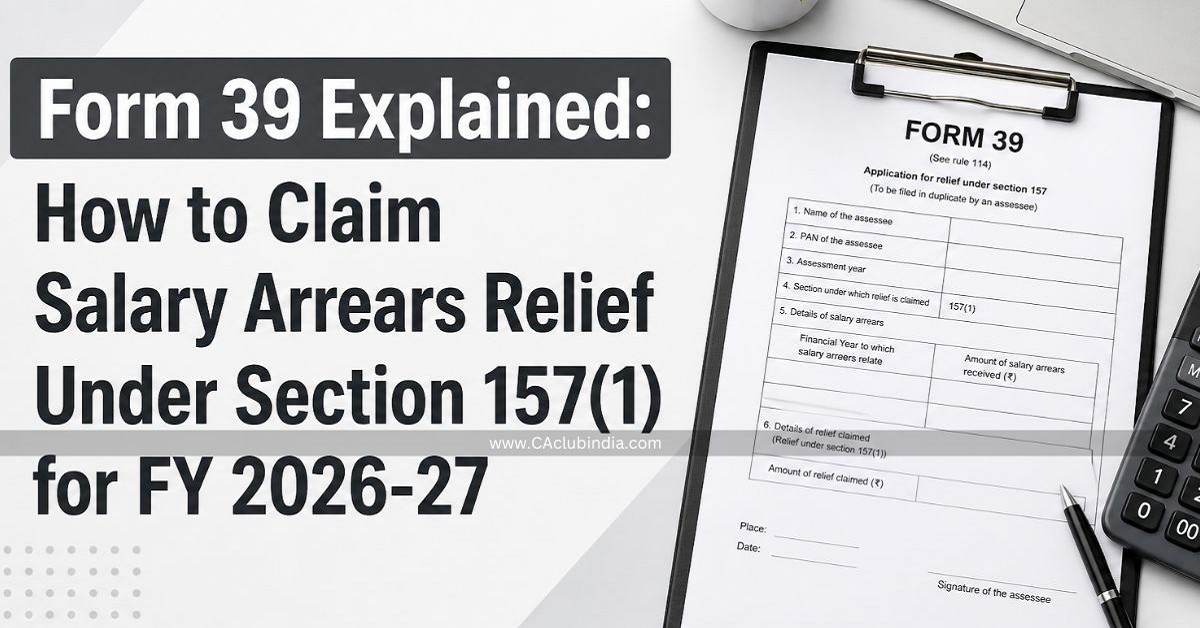
Summary of Form 39 (Format of Form 10E) for FY 2026-27
The following table outlines the structure of the new automated calculator format within Form 39.
| Feature | Description for FY 2026-27 |
| Form Number | Form 39 (Replaces Form 10E starting FY 2026-27) |
| Governing Act | Relief under Section 157(1) of the Income-tax Act, 2025 (Previously Section 89) |
| Annexure I | Details of Salary or Family Pension received in arrears or advance |
| Annexure II / IIA | Details regarding Gratuity payments for past services |
| Annexure III | Compensation received on termination of employment |
| Annexure IV | Commuted pension details |
| Submission Mode | Strictly Online via the Income Tax e-Filing Portal |
| Deadline | Must be filed before submitting the ITR for FY 2026-27 |
Critical Requirements for Success
- Mandatory Filing: You cannot claim Section 89(1) relief in your ITR without first submitting Form 39 online. If you skip this, the department will likely disallow the relief and issue a notice.
- Accurate Data: Ensure you match the "Total Income" of previous years exactly with your filed tax statements for those years. Any discrepancy may lead to rejection.
- Verification: After filling the form, you must e-verify it using Aadhaar OTP or EVC to complete the submission.
To claim tax arrears relief under Section 157(1) of the new Income Tax Act, 2025 (which replaces the old Section 89) for FY 2026-27, you must file the new Form 39. This form officially replaces Form 10E and features auto-populated data and real-time validation to simplify your filing. [ 1, 2, 3 ]
Step-by-Step Guide to Filing Form 39
Before starting, gather your salary arrears breakup from your employer and your previous years' Income Tax Returns (ITR). [ 1 , 2 ]
- Access the Portal: Log in to the Income Tax e-Filing Portal using your PAN and password.
- Locate the Form: Navigate to 'e-File' > 'Income Tax Forms' > 'File Income Tax Forms' .
- Select Form 39: Search for and select Form 39 (ensure you choose Assessment Year 2027-28 for income received in FY 2026-27).
- Complete Part A (Personal Information) : Verify your auto-populated details like name, PAN, and residential status. Confirm these details to proceed.
- Fill Part B (Computation of Relief) :
- Select Annexure: Choose Annexure I for salary arrears.
- Enter Current Year Data: Input your total income for FY 2026-27, both including and excluding the arrears.
- Enter Past Year Data: Add rows for each previous year the arrears relate to. Enter the total income originally reported for those years and the portion of arrears belonging to them.
- Review Auto-Calculated Relief: The system will automatically use structured formulas to calculate your relief amount in Column 8/9. Cross-check this with your manual calculation.
- Preview and Submit: Review the entire form for accuracy. Click 'Preview' and then 'Proceed to e-Verify.'
- Verification: Complete the process using Aadhaar OTP or digital signature (DSC) . [ 1 , 2 , 3 , 4 , 5 , 6 , 7 , 8 , 9 , 10 , 11 ]
Essential Documents Checklist
Keep these documents ready for precise data entry:
- Arrears Breakup: A year-wise split of the lump sum provided by your employer.
- Form 130/131: New TDS certificates (replacing Form 16) for the current and relevant past years.
- Previous ITRs: To ensure "Total Income" matches exactly what was previously filed. [ 1 , 2 , 3 , 4 ]
In this example, we calculate the tax relief for a taxpayer who receives Rs 200,000 in arrears during FY 2026-27 that actually belongs to FY 2024-25.
Step 1: Impact on Current Year (FY 2026-27)
- Tax on Total Income (including arrears): If your total income reaches Rs 1,400,000, your tax liability might be Rs 90,000.
- Tax on Total Income (excluding arrears): Without the arrears, your income is Rs 1,200,000 with a tax of Rs 60,000.
- Incremental Tax (Difference A): The arrears added Rs 30,000 to your current tax bill.
Step 2: Impact on Past Year (FY 2024-25)
- Revised Tax for FY 2024-25: If you add that Rs 200,000 to your original past income, the new tax would be Rs 35,000.
- Original Tax for FY 2024-25: You originally paid Rs 15,000 for that year.
- Incremental Tax (Difference B): If received on time, the arrears would have only added Rs 20,000 in tax.
Step 3: Final Relief Calculation
- The Logic: You are paying Rs 30,000 today for something that should have cost Rs 20,000 in the past.
- Relief Amount: Rs 30,000 (Difference A) - Rs 20,000 (Difference B) = Rs 10,000 .
- Benefit: You will deduct this Rs 10,000 directly from your total tax payable for FY 2026-27.
Comparison Table for Form 39 Data Entry
| Component | Current Year (FY 2026-27) | Past Year (FY 2024-25) |
| Total Income | Rs 1,400,000 | Rs 800,000 (Revised) |
| Tax Calculated | Rs 90,000 | Rs 35,000 |
| Tax without Arrears | Rs 60,000 | Rs 15,000 |
| Tax Difference | Rs 30,000 (A) | Rs 20,000 (B) |
This automated calculation ensures that you are not penalized for the timing of your employer's payments. Consequently, filing Form 39 correctly allows you to keep more of your hard-earned money.
Since you have your salary breakup ready, we can calculate your exact tax benefit. To provide the most accurate Form 39 relief amount for FY 2026-27, please provide the following details from your documents:
- Current Year (FY 2026-27) :
- What is your total salary income, including the arrears?
- What is the exact arrears amount you received?
- Past Year (The year the arrears belong to) :
- Which financial year do these arrears relate to?
- What was your total taxable income reported in that year's ITR?
- What was the total tax you paid for that year?
Why these numbers matter for Form 39
The new automated system on the Income Tax e-Filing Portal compares the tax you are paying today against the tax you would have paid back then. Having these figures ready ensures:
- Elimination of Notices: Accurate entry in Annexure I prevents mismatches with previously filed returns.
- Optimised Savings: It identifies if you should opt for the New Tax Regime or Old Tax Regime for that specific past year to maximise relief.
- Audit Trail: Keeps your Form 16 (or the new Form 130/131 ) perfectly aligned with your electronic filing.











 CAclubindia
