
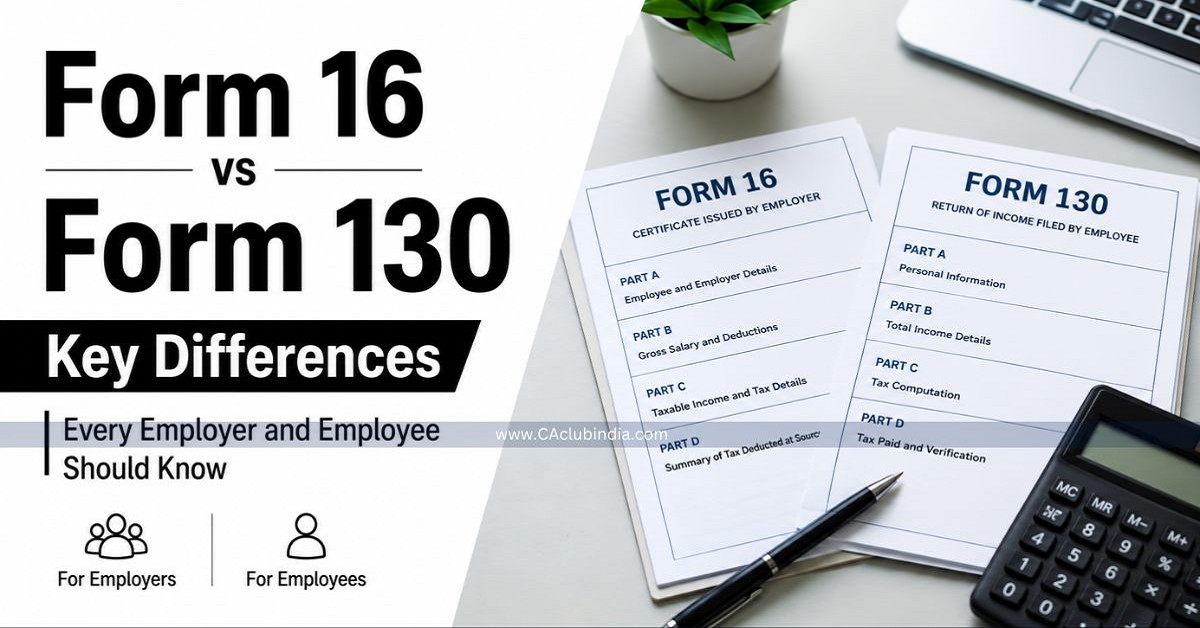
The Indian government has officially replaced Form 16 with the new Form 130 starting Fiscal Year 2026-27. Consequently, salaried taxpayers will now receive Form 130 instead of the traditional Form 16 for tax year 2026-27 onwards. However, Form 16 remains valid for the Financial Year 2025-26, and employers must issue it by June 15, 2026.
Why Form 16 Became Form 130
| Aspect | Form 16 (FY 2025-26) | Form 130 (FY 2026-27+) |
| Number of Parts | 2 parts (A & B) | 3 parts (A, B, & C) |
| Generation Method | Employer-issued | TRACES portal-only |
| Manual Certificate | Allowed | Completely removed |
| Salary Breakdown | Summary-level | Detailed component-wise |
| Deductions Visible | Limited | Full detail with Annexures |
| Automation Level | Semi-auto | Fully pre-filled, system-driven |
The Indian government has officially replaced Form 16 with the new Form 130 starting Fiscal Year 2026-27. Consequently, salaried taxpayers will now receive Form 130 instead of the traditional Form 16 for tax year 2026-27 onwards. However, Form 16 remains valid for the Financial Year 2025-26, and employers must issue it by June 15, 2026.
Why Form 16 Became Form 130
The new Income Tax Act, 2025, triggered a comprehensive renumbering of all tax forms. Accordingly, Form 16 now becomes Form 130, while Form 16A transforms into Form 131 for non-salary TDS. Furthermore, Form 26AS has been renamed Form 168. This change aims to reduce errors, prevent tax evasion, and simplify compliance for taxpayers.
Additionally, the shift moves reporting from an "assessment year" framework to a "tax year" framework. Therefore, taxpayers will now understand their salaries and taxes more clearly.
Key Differences Between Form 16 and Form 130
Form 130 introduces Part C, which consolidates salary, exemptions, deductions, and final tax liability in one place. Moreover, the new annexure provides a complete computation of taxable income.
What Form 130 Contains
Part A captures employer and employee details, including PAN, TAN, and employment period. Part B summarises salary and TDS figures. Part C delivers a detailed calculation of taxable income with two annexures. Specifically, the form includes:
- Full salary breakup (basic, HRA, allowances)
- Complete details of exemptions and deductions
- Total taxable income, tax payable, relief, and net tax amount
- Full TDS/TCS information
Importantly, Form 130 can only be generated through the TRACES portal after the employer files and processes quarterly TDS returns. Any Form 16 issued for the tax year 2026-27 onwards is technically invalid.
Transition Timeline You Must Know
- FY 2025-26 : Form 16 remains valid and must be issued by June 15, 2026
- FY 2026-27 : Form 130 becomes mandatory starting April 1, 2026
- First Form 130 issue date : By June 15, 2027, for tax year 2026-27
Therefore, employees will not receive Form 130 until their employer files quarterly TDS correctly and on time.
Why You Still Need an Excel Utility for FY 2025-26 Form 16
Since Form 16 still applies to FY 2025-26, employers must generate accurate Part A and Part B certificates before the deadline. Consequently, an automatic Excel utility becomes essential for HR and payroll teams.
This Excel tool allows you to:
- Prepare Part A and Part B together in one workflow
- Generate up to 50 employee Form 16s at a time efficiently
- Eliminate manual calculation errors in TDS computation
- Save significant time during peak filing season
- Produce error-free, ready-to-print certificates
Moreover, the utility ensures that salary components, exemptions, deductions, and tax calculations remain consistent across all employees.
How the Automatic Excel Utility Works
First, enter employee master data, ta including PAN, salary breakup, and investment declarations. Next, input employer details such as TAN, address, and financial year information. Then, the tool automatically calculates:
- Gross salary
- Exemptions (HRA, LTA, standard deduction)
- Deductions under Chapter VI-A
- Taxable income
- TDS liability month-wise and annually
Subsequently, the utility generates Form 16 Part A (TDS summary) and Part B (salary + tax computation) simultaneously. Finally, you can export or print certificates for all 50 employees in one click.
Benefits for Employers and Employees
For Employers
- Process bulk Form 16 generation instantly
- Reduce payroll team workload significantly
- Avoid compliance penalties from incorrect certificates
- Maintain audit-ready records effortlessly
For Employees
- Receive accurate TDS certificates quickly
- Verify salary and tax details easily
- Match Form 16 with Form 26AS (now Form 168) seamlessly
- File ITR without discrepancies
What to Verify in Your Form 16 (FY 2025-26)
Before accepting your Form 16, check these critical items:
- Personal and employer details: Confirm PAN, TAN, and employment period
- Salary and deductions: Ensure HRA, standard deduction, and investments appear correctly
- TDS figures: Cross-check with AIS and Form 26AS (Form 168)
- Document authenticity: Verify that the certificate matches your monthly payslips
Final Takeaway
Form 16 remains valid for FY 2025-26, but Form 130 replaces it permanently from FY 2026-27. Therefore, employers must issue accurate Form 16 certificates now using reliable automation tools. The automatic Excel utility for Form 16 Part A and B enables you to prepare 50 employee certificates simultaneously, saving time and eliminating errors.
Simultaneously, prepare yourself for Form 130’s stricter digital requirements. Consequently, when April 2026 arrives, you will transition smoothly into India’s fully automated, pre-filled, audit-ready tax ecosystem.











 CAclubindia
