
Introduction: The Parallel Economy That Holds India Back
One of the most persistent challenges to India's inclusive financial growth is the existence of a parallel economy, commonly known as the black money economy.
For over seven decades, successive governments have tried to eradicate this menace through various schemes - from voluntary disclosure and amnesty programs to demonetization and currency swaps. Yet, despite the best intentions, black money continues to circulate and distort India's economic system.
In my book "Bharat: The Development Dilemma," I have explored several structural barriers slowing India's progress. Among them, the parallel economy fueled by black money remains one of the most damaging. This chapter discusses the origins of black money, its economic impact, governmental responses, and the way forward - focusing on two critical areas that require urgent reform.
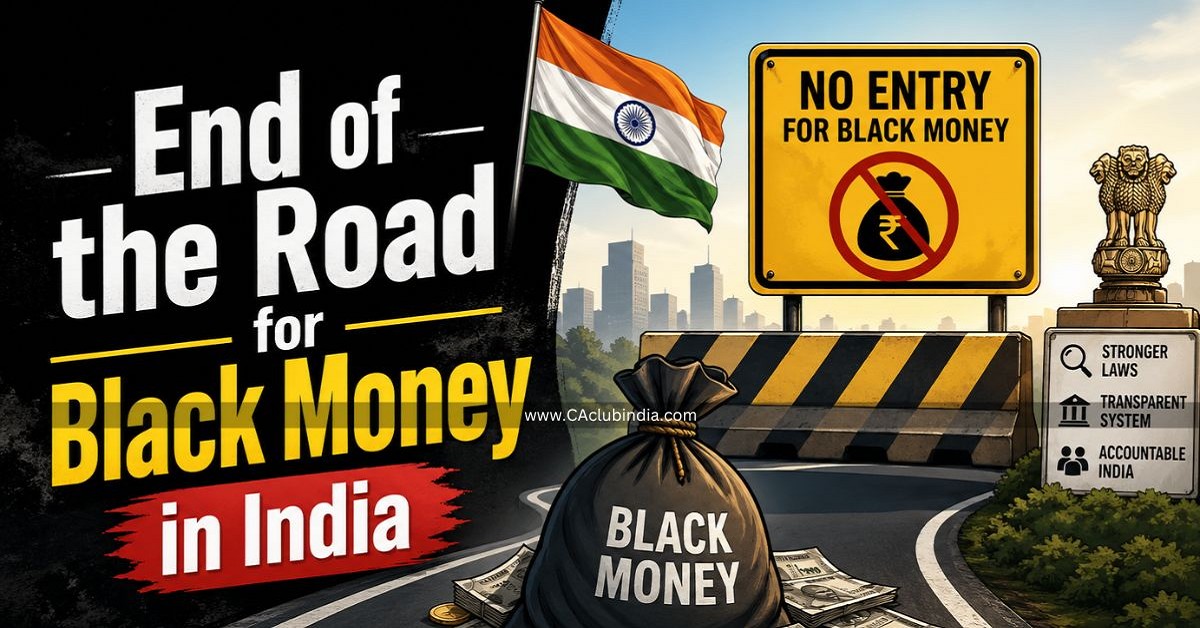
The Legislative Loopholes That Sustain Black Money
A significant portion of black money in India exists not because of criminal intent alone, but due to flawed and impractical legislation. In my considered view, two specific policy instruments have unintentionally sustained the black economy:
1. Section 68 of the Income Tax Act, and
2. Government-notified DLC (District Level Committee) rates for real estate transactions.
Both, though designed with good intentions, have become counterproductive for India's economic health.
Section 68: A Tool for Harassment, Not Reform
Section 68 empowers revenue authorities to treat any unexplained credit in an assessee's account as taxable income. While this seems logical on paper, its implementation has caused widespread misuse and litigation.
In practice, Section 68 is often invoked even for trivial or technical discrepancies. Honest taxpayers are subjected to unnecessary scrutiny, and amounts received for legitimate reasons are taxed as "unexplained income," along with interest and penalties.
This misuse has given rise to what can only be called tax terrorism - where fear of arbitrary action discourages entrepreneurship, compliance, and transparency.
The true spirit of the Income Tax Act is to collect taxes on legitimate income earned by individuals or entities. Revenue officers are expected to focus on income generation, not to police every small transaction or receipt. When officers go beyond this mandate, they effectively act as investigators - a role meant for agencies like the Police ,CBI or Enforcement Directorate, not the Income Tax Department.
If a case genuinely involves criminality, unethical earnings, or money laundering, it should be referred to competent investigative authorities under the Indian Penal Code. Revenue officers should not assume the dual role of tax collectors and law enforcers.
This overlapping jurisdiction has blurred boundaries, promoted harassment, and severely dented taxpayer confidence - thereby undermining the country's broader financial integrity.
The DLC Rate Mechanism: Institutionalizing the Black Economy
The second major contributor to the black money cycle is the system of DLC (District Level Committee) rates - hypothetical property values notified by the government.
According to current rules, all property transactions must be registered at a value not less than the DLC rate. On the surface, this appears to curb underreporting. But in reality, DLC rates are usually far below prevailing market prices.
This gap between the government's valuation and the market's reality has created a legalized pathway for converting black money into assets. Those with unaccounted wealth buy properties officially at DLC value and pay the remaining amount in cash. Once registered, the transaction cannot be challenged, even though it's widely known that the purchase involved unaccounted money.
This discrepancy is especially prominent in agricultural land, where DLC rates are often a fraction of actual market values. As a result, agricultural property has become a preferred destination for absorbing black money.
The Consequences: Distorted Markets and Penalized Honesty
The persistence of low DLC rates has far-reaching economic and ethical consequences:
- It fuels speculative property markets, inflating prices beyond the reach of genuine buyers.
- It discourages transparency, as even honest individuals are forced to engage in unethical practices to remain competitive.
- It widens the wealth gap, since those with illicit funds can accumulate assets while law-abiding citizens struggle to afford property.
Ironically, the same system meant to regulate real estate has become a safe haven for laundering black money, while punishing honesty and compliance.
A Practical Way Forward
To strike at the root of the problem, India must abolish both Section 68 and the DLC rate mechanism - or at least reform them fundamentally.
If property transactions were required to reflect true market values, and if registrars were empowered to question unrealistic valuations, black money inflows into real estate would decline sharply. Local registrars, being familiar with regional property trends, could raise red flags and refer suspicious cases to investigative agencies - rather than allowing them to be legitimized under artificially low government rates.
This reform would:
- Curb black money usage in property,
- Stabilize real estate prices, making homes affordable for genuine buyers, and
- Promote financial honesty across the system.
Similarly, a rational restructuring of Section 68 is essential. Tax authorities should be empowered to question major irregularities but restrained from harassing taxpayers for minor or technical lapses. Their focus must return to income-based taxation, not speculative policing of every receipt.
Conclusion: Towards a Transparent Economic System
India's fight against black money has often been long, emotional, and politically charged. But the real solution lies not in dramatic measures or mass schemes - it lies in simplifying, rationalizing, and humanizing our tax and valuation systems.
If India removes the two biggest structural enablers - Section 68 of the Income Tax Act and the outdated DLC rate system - the black economy can be dismantled with surprising ease.
These reforms would mark the beginning of the end for black money paving the way for a transparent, equitable, and genuinely inclusive economic future for Bharat.











 CAclubindia
