
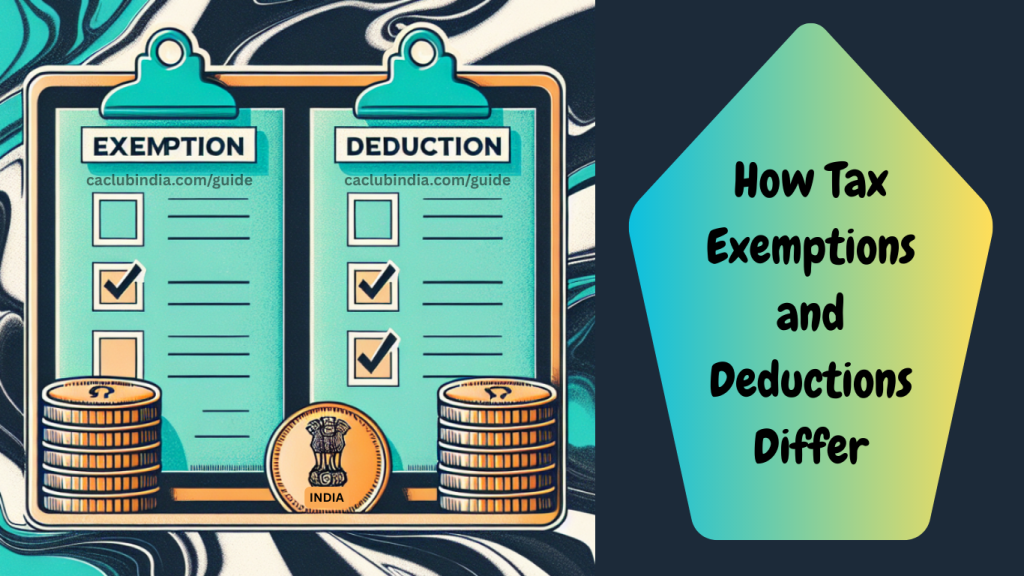
Exemptions refer to specific income components excluded from taxation. For example, the House Rent Allowance (HRA) and Leave Travel Allowance (LTA) are traditional examples of exemptions.
Deductions can reduce taxable income by accounting for specific expenses, investments, or contributions. Examples include deductions under Section 80C for a life insurance policy or investment such as ELSS or PPF.
Differences Between Exemptions and Deductions
| Feature | Exemption | Deduction |
| Definition | A part of your income that is not taxable | An amount you subtract from your taxable income |
| Applied on | Gross Income (before arriving at total income) | Total Income (after exemptions) |
| Purpose | To exclude specific types of income from taxation | To encourage certain expenses or investments |
| Examples | HRA (House Rent Allowance), LTA, Agricultural income | Section 80C (LIC, PPF), 80D (health insurance), 80E. |
| Appears in | Income head itself (like Salary) | Under Chapter VI-A (deductions) |
Available Deductions/Exemptions Under Old Regime
- Standard Deduction ₹50,000
- Section 80C: ₹1.5 lakh (LIC, PPF, EPF, ELSS, etc.)
- Section 80D: Health insurance premium
- HRA (House Rent Allowance)
- LTA (Leave Travel Allowance)
- Interest on home loan (Section 24)
- Education loan interest (Section 80E), and many more.
New Regime Deductions and Exemptions
- Standard Deduction (₹75,000)
- Employer’s contribution to NPS (Section 80CCD(2))
- Family pension deduction
- Agniveer Corpus Fund deduction
Which Regime to Choose?
Scenario : Salary of ₹10,00,000 (No HRA/Home Loan)
| Detail | Old Regime | New Regime |
| Gross Salary | ₹10,00,000 | ₹10,00,000 |
| Standard Deduction | ₹50,000 | ₹75,000 |
| 80C Deduction (assumed) | ₹1,50,000 | Not allowed |
| Taxable Income | ₹8,00,000 | ₹9,25,000 |
| Tax (approx) Before Rebate | ₹72,500 | ₹46,500 |
New regime is better if you do not have high deductions to claim.
How to Choose Between Old & New Regime?
| Situation | Suggested Regime |
| Assessee claiming many deductions (80C, HRA, etc.) | Old Tax Regime |
| Assessee does not have major investments or deductions | New Tax Regime |
| Assessee is Pensioner with no income | New Regime (₹75k deduction is helpful) |
What is Rebate Under Section 87A?
It is a rebate or reduction in the total tax payable, not on income, and it’s available only to resident individuals whose total income is within a specified limit.
Rebate for FY 2024–25 (AY 2025–26)
New Tax Regime (Default)
| Condition | Benefit |
| Total income up to ₹7,00,000 | Full rebate up to ₹25,000 → No tax payable |
If taxable income (after standard deduction ₹75,000) is ₹7,00,000 or less, the tax payable will be zero under the new regime.
Old Tax Regime
| Condition | Benefit |
| Total income up to ₹5,00,000 | Rebate up to ₹12,500 → No tax payable |
Under the old regime, if income after all deductions (like 80C, 80D, etc.) is ₹5,00,000 or less, tax liability is fully offset by the rebate.
Key Points About Section 87A
- Rebate is available only to individuals (not HUF, firms, companies).
- Applicable to residents of India only.
- Rebate is applied after calculating income tax liability but before adding health & education cess.
Conclusion
In FY 2024-25 the new tax regime has been made the default option for individual taxpayers. However, new tax regime deductions are relatively few, eligible tax payers can still choose to opt for the old tax regime instead.









 CAclubindia
