
The certificate of incorporation lands in your inbox, and for a few minutes it feels like the hard part is over. And yet, ask almost any founder what came next, and they'll describe the same panic. Which bank account do I open first? Who files what? Is GST optional or not?
Your registration is just step one. Here's what the next 90 days actually look like.
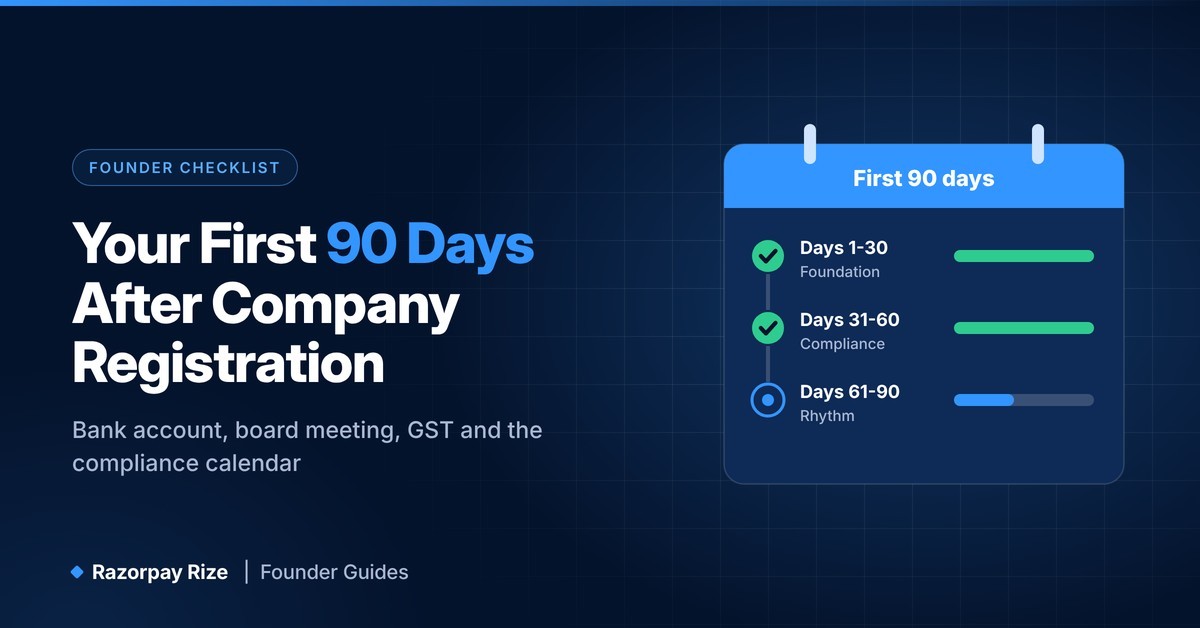
Days 1–30: Set the foundation
Start with the certificate itself. It carries your Corporate Identification Number (CIN), and your company's PAN and TAN are usually issued along with it through the SPICe+ process. Check every detail- company name, registered address, director names- because corrections later cost time.
Keep digital copies of everything in one shared folder - certificate, PAN, TAN, MoA, AoA, and board minutes. You'll be asked for them again by banks, investors, and tax portals, usually at the least convenient moment.
Then work through three things, in order:
- Open a current account. Banks typically ask for the certificate of incorporation, MoA, AoA, company PAN, a board resolution, and KYC of every signatory. Subscribers should deposit their share capital into this account, not a personal one.
- Hold your first board meeting. The law expects it within 30 days of incorporation. Use it to appoint the first auditor, authorise bank signatories, approve the registered office, and record share allotment.
- Appoint your first auditor. The board must do this within 30 days, and Form ADT-1 follows within 15 days of the appointment.
Days 31–60: Make it compliant
This is the stretch where paperwork quietly decides you'll sleep well in month ten.
First, issue share certificates to your subscribers within two months of incorporation, and set up your statutory registers - members, directors, and share transfers. Many founders skip this because nobody reminds them. Auditors and investors, eventually, will ask.
Second, begin the process for your declaration of commencement of business (Form INC-20A). You have 180 days from incorporation, and missing it attracts penalties starting at ₹50,000 for the company.
Third, sort out GST. It isn't mandatory for every new company. Registration is required once aggregate turnover crosses ₹40 lakh for goods or ₹20 lakh for services (lower in some special category states), or earlier if you supply goods across state lines or sell through e-commerce platforms. Once you become liable, you have 30 days to apply. Many founders register early anyway - it makes B2B customers more comfortable, and you can claim input tax credit on early expenses.
Days 61–90: Build the rhythm
By now, the company exists on paper and in the bank. What it needs is a heartbeat, a predictable compliance calendar you can follow without panic.
Mark the recurring dates: monthly or quarterly GST returns, quarterly TDS returns if you've paid salaries or professional fees, advance tax instalments, and the annual filings - AOC-4 for financial statements and MGT-7 for the annual return. Your first AGM is due within nine months of your first financial year ending.
If you're hiring, check PF, ESIC, and professional tax applicability for your state. If you're building something new, consider applying for DPIIT startup recognition, which can open up tax benefits and easier access to government schemes. A Udyam registration helps if you'll deal with MSME-linked credit or tenders.
And start monthly bookkeeping now. Cleaning up twelve months of messy books at year-end is far harder than reconciling thirty days at a time.
What founders get wrong?
Most mistakes are just small things that compound: a delayed ADT-1, a missed INC-20A, personal money mixed with company funds, a GST registration that waited until a customer demanded it.
Put every deadline on a shared calendar, assign one person to own it, and review it on the first of each month. One note of caution, though: thresholds, penalties, and due dates change through notifications, and your situation (state, sector, funding) may alter the list above.
Which brings us to something founders rarely hear: you shouldn't have to track all this alone. Platforms like Razorpay Rize pair registration with a post-incorporation compliance calendar. Over time, the checklist becomes habit. The anxiety of week one fades, and the company starts to feel like what it was always meant to be.









 CAclubindia
