
When Physical Movement Creates Legal Confusion
Under the GST regime, the e-Way Bill has become a prevalent concern for numerous stakeholders. Established to prevent tax evasion in the transportation of goods, it has, over time, become an essential component of all physical transfers, regardless of their purpose or nature. This evolving perception has prompted inquiries about compliance, particularly in instances where, according to the law's original intent, Rule 138 was not intended to apply .
A frequently asked question concerns high-value infrastructure assets, such as metro trains. These assets are often transported across various States- not for sale or transfer, but for lease or operational purposes. The situation becomes somewhat more intricate when such movements occur between persons deemed distinct under Section 25(4) of the CGST Act, 2017. During audits and internal reviews, a common question naturally arises- though it may sometimes be legally misplaced- namely, if metro trains are physically relocated from one State to another, how is it possible that no e-Way Bill is generated during such movement?
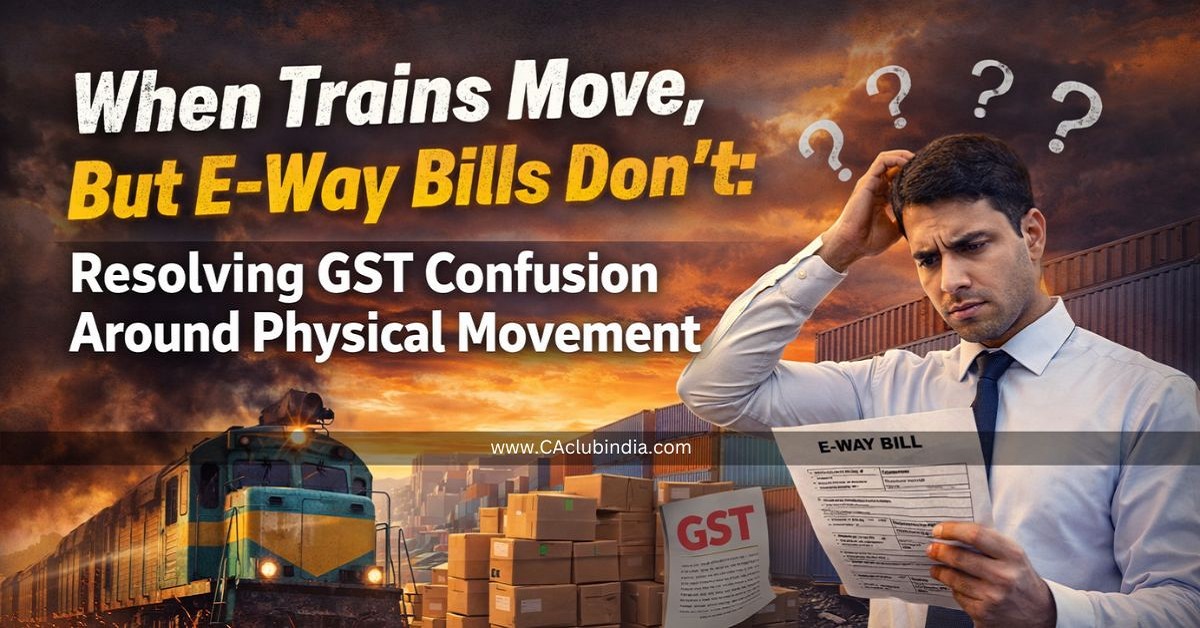
This article thoroughly examines that question through a comprehensive legal analysis. Rather than focusing on isolated regulations, it integrates the complete statutory framework of Rule 138 with the core principles of leasing services, the architecture of the e-Way Bill system, and, most importantly, the consistent interpretations articulated in CBIC circulars, FAQs, and official advisories. The confusion typically arises not from ambiguity within the law but from the application of compliance tools without first comprehending the actual nature of the supply involved.
" जो दिखता है वही सच हो , ये ज़रूरी तो नहीं ,
कानून नज़र नहीं , नीयत को पहचानता है कहीं। "
[What is visible need not always be the truth;
The law looks beyond sight- it recognises intent.]
The Statutory Purpose and Design of the e-Way Bill Mechanism
The e-Way Bill is supported by Section 68 of the CGST Act, 2017, and Rule 138 of the CGST Rules, 2017. A detailed examination of these provisions reveals that the primary emphasis extends beyond the mere physical transportation of goods. Rather, it is centred on regulating the movement of goods within a commercial framework, particularly when such movement could be exploited for tax evasion.
The e-Way Bill serves merely as a compliance and tracking instrument; it does not establish tax liability nor create any tax obligations. Its primary function is to oversee vehicle and transporter information, validate distances, and monitor logistical details involved in road transportation. Unlike Sections 7 to 9 of the CGST Act, which ascertain the taxable nature of a transaction, Section 68 addresses only the documentation necessary for specific goods movements and does not extend the scope of taxable supplies.
Attaining a thorough understanding of this foundational knowledge is crucial prior to exploring the application of the e-Way Bill framework to specialised infrastructure assets, such as metro rolling stock.
Leasing of Metro Trains - Determining the True Nature of Supply
When establishing the necessity of an e-Way Bill, it is essential to first comprehend the nature of the supply involved. This classification is particularly crucial, as it affects both the applicable tax rates and the procedures required to maintain compliance.
Paragraph 1(b) of Schedule II to the CGST Act, 2017 explicitly stipulates that any transfer of the right in goods, without an accompanying transfer of ownership, constitutes a supply of services. The leasing of metro trains appropriately falls under this provision. The ownership of the rolling stock remains with the lessor, while the lessee merely obtains the contractual right to operate the trains for a defined period and purpose.
Leasing metro trains is considered a taxable service, classified under Service Accounting Code 9973 for leasing or rental services without an operator. This approach is widely accepted and aligns with legal principles under both GST and pre-GST systems, including the important BSNL ruling, which holds that providing the right to use something without transferring ownership remains a service.
" हक़ उपयोग का मिले , मालिकाना न जाए हाथ ,
तो सेवा ही कहलाएगी , चाहे चले पहिए साथ। "
[Whent he right to use is given but ownership stays intact,
It remains a service- no matter that the wheels may move.]
It's important to remember that simply moving goods from one place to another doesn't automatically mean a supply has taken place. This clear understanding has been officially acknowledged by CBIC, helping to clarify how GST applies.
Circular No. 47/21/2018-GST dated 08 June 2018 clarifies that when a taxable person moves goods, it doesn't automatically mean a supply has occurred. Instead, whether a supply actually exists depends on the details in the contract, the intentions of the parties involved, and if there's a transfer of title or rights in the goods.
GST is charged only based on commercial intent, not on distance travelled. When metro trains are moved under a leasing agreement, it doesn't mean there's an intent to sell or transfer them. Instead, it's simply part of providing a service. This movement is merely a necessary step in delivering the service and does not constitute a sale of goods.
" हर चलन सौदा नहीं होता , हर सफ़र व्यापार नहीं ,
क़ानून पूछता है मंशा क्या है , रास्ता क्या है - ये बात नहीं। "
[Every movement is not a transaction, every journey not a trade;
The law asks about intent, not merely the path taken.]
Principal Supply and the Incidental Role of Physical Movement
CBIC has consistently highlighted the importance of identifying the principal supply when a transaction includes multiple elements. Circular No. 121/40/2019-GST dated 11 October 2019 reminds us that if a supply has more than one part, the principal supply decides how the whole transaction is taxed and classified.
The Circular also explains that when goods are provided along with a service, and such supply of goods is ancillary or incidental to the provision of the service, the entire transaction is to be treated as a supply of service.
In leasing arrangements, the main offering is the leasing service itself. The physical movement or placement of the leased asset simply helps deliver the service at the agreed location. This movement is not considered a separate supply of goods, nor does it trigger the specific requirements meant for goods transactions.
" असल रंग तस्वीर का , किनारों से तय नहीं ,
जो केंद्र में है वही निर्णायक , बाकी सब सहायक सही। "
[A picture's essence is not defined by its borders;
What stands at the centre decides- everything else only supports.]
Structural Limitations of Rule 138 in the Context of Rolling Stock
Rule 138 is primarily focused on road transport. It assumes transportation by vehicles on public roads and requires sharing vehicle numbers, transporter IDs, and distance-based validity. This rule is not meant to cover self-propelled rolling stock that operates on railway tracks under specialised regulatory oversight . Rule 138(14)(b) provides that, notwithstanding anything contained in this rule, no e-way bill is required to be generated where the goods are being transported in a non-motorised conveyance.
Metro trains operate within a well-organised system that includes railway permissions, safety certifications, and approvals from the Commissioner of Metro Railway Safety. It is worth noting that CBIC has not yet amended Rule 138 to directly cover rail-running rolling stock, such as locomotives, coaches, or metro rakes. This silent legislative approach shows a clear understanding that the e-Way Bill system is not well-suited to managing the movement of these assets.
The familiar legal principle, lex non cogit ad impossibilia- the law does notrequire the impossible- really comes into play here. If the compliance tool just can't be made to work structurally, then it simply can't be applied.
CBIC's Administrative Understanding - FAQs and Advisory
CBIC's FAQs on the e-Way Bill, along with its Advisory dated 16.09.2021, offer valuable insights into the mechanism's main goals. The Advisory clearly states that when the primary supply involves services, there's no need for an e-Way Bill, even if goods are temporarily moved during service delivery.
This clarification is particularly significant as it is derived directly from CBIC's official instructions for the e-Way Bill portal, reflecting the department's authoritative interpretation of the law. Additionally, the FAQs explicitly emphasise that e-Way Bills are required whenever goods are transported. Consequently, it is evident that the system is intended for goods and should not be automatically applied to service contracts solely because of physical movement.
" जहाँ सेवा ही प्रधान हो , वहाँ वस्तु गौण हो जाती है ,
क़ानून भी उसी धुरी पर घूमता है , जो मंशा बन जाती है। "
[Where service stands as the principal, goods become secondary;
The law too turns on the axis of intention.]
Movement of Capital Assets Across Locations
Further guidance is available in Circular No. 144/13/2021-GST, dated 18 June 2021 . It clarifies that you may relocate or utilise capital goods at different locations for operational purposes without altering the nature of the supply, provided ownership remains with you.
Metro trains are regarded as capital assets. Transferring them for leasing or operational purposes does not imply a transfer of ownership; consequently, there is no need to concern yourself with a deemed supply of goods or specific compliance regulations associated with goods.
Distinct Person Provisions - Limited and Purpose-Specific
Section 25(4) of the CGST Act considers establishments of the same entity in different States as distinct persons when it comes to taxing, determining the place of supply, and valuation. However, it's important to note that this legal fiction does not alter the true nature of the transaction.
A leasing service is not regarded as a supply of goods solely because it transpires between distinct parties. It is essential to apply deeming provisions judiciously, solely for their intended purpose, and not to artificially convert service transactions into obligations related to goods.
How Movement Is Lawfully Documented Without e-Way Bills
The absence of an e-Way Bill does not imply the lack of documentation. The movement of metro rolling stock is supported by lease agreements, deployment records, railway movement permissions, safety approvals, commissioning certificates, and fixed asset registers. These documents serve to ensure that all activities are lawful, traceable, and purposefully clear, while avoiding unnecessary overlaps with other compliance measures that may not be applicable to the sector.
Illustration - Leasing of Metro Trains Across States
A metro rail corporation leasing rolling stock from another establishment in a different State. Ownership remains with the lessor, while lease rentals are invoiced periodically with applicable IGST. The trains move on railway tracks and are commissioned after mandatory safety approvals.
In this scenario, the supply is clearly a leasing service. The movement of trains is incidental to the service and governed by railway regulations. The e-Way Bill mechanism has neither practical relevance nor legal applicability. Moreover, the metro trains shall not move on road but on the railway lines. Hence, in terms of Rule 138(14)(b), no e-way bill is required to be generated owing to the transportation of goods by a non-motorised conveyance.
Departmental Objections vs CBIC Clarifications
In practice, audits frequently raise common questions about physical movement, individual identification, the nature of goods, and capital assets. Fortunately, these issues are often resolved promptly by consulting CBIC's circulars, FAQs, and advisories, which consistently underscore the importance of the actual purpose over superficial appearances, the genuine intent over mere actions, and the primary supply over ancillary logistical details.
" अक्सर आपत्ति आवाज़ में ऊँची होती है , पर उत्तर की ताक़त तर्क की गहराई में होती है। "
[Objections may be loud in tone, But answers draw strength from the depth of reason.]
Concluding Reflections
GST is a technology-driven system that stays grounded in real-world commerce. The e-Way Bill acts as a helpful compliance tool, rather than an all-encompassing rule. Using it too broadly for infrastructure projects might push the law beyond its original purpose and create some impracticalities.
Leasing metro trains underscores the significance of understanding the legal and commercial facets of physical movement. When the objective is to deliver a service, ownership remains with the original proprietor, and the movement is governed by specific regulatory regulations. In such instances, the absence of an e-Way Bill does not constitute a compliance issue; rather, it is an integral aspect of the legislative framework.
" क़ानून ने चाल नहीं , कारोबार की आत्मा देखी है ;
जहाँ सेवा ही सच हो , वहाँ ई -Way Bill का प्रश्न अपने आप शांत हो जाता है। "








 CAclubindia
