
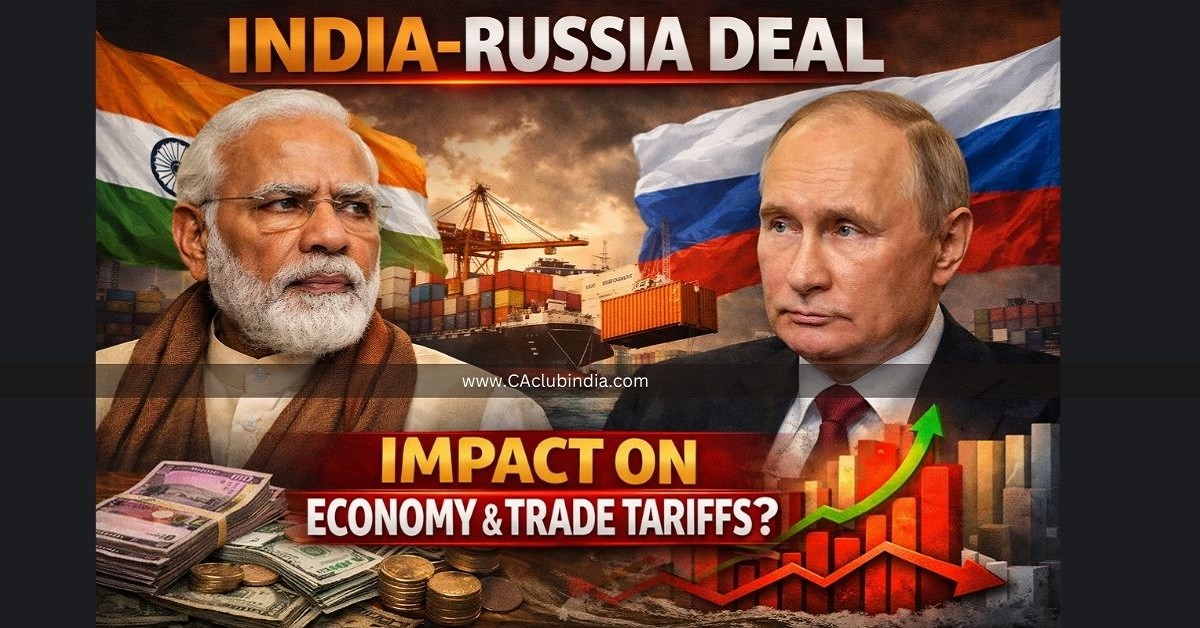
India's recent trade arrangements with Russia and the Russia-led Eurasian Economic Union (EAEU) signal strengthened cooperation in energy, manufacturing, and logistics. However, they also increase India's vulnerability to U.S. tariff measures and broader geopolitical uncertainties. In reality, this "deal" is not a single agreement but rather a set of parallel moves: accelerating an India-EAEU free trade agreement, adopting a long-term trade and investment roadmap (Programme-2030), and navigating U.S. tariff policies on Russian oil that are reshaping India's actual tariff landscape.
What the deal actually is?
India and Russia have accelerated plans for a Free Trade Agreement between India and the EAEU, an economic bloc comprising Russia, Armenia, Belarus, Kazakhstan, and the Kyrgyz Republic. Formal negotiations were initiated in late 2025 following the signing of foundational Terms of Reference in Moscow.
Simultaneously, during the 23rd India-Russia Summit, the two nations adopted "Programme 2030," a strategic roadmap to deepen economic ties. This program sets ambitious targets, including achieving $100 billion in bilateral trade by 2030 and $50 billion in mutual investments by 2025.
Impact on the Indian Economy
Bilateral trade has grown substantially, reaching approximately $69 billion. This expansion has been fueled primarily by India's purchase of discounted Russian crude oil, which has saved the country an estimated tens of billions of dollars compared to other sources. These lower-cost imports have helped reduce energy expenses, curb inflation, and improve the overall trade balance.
However, this reliance has also led to a dependence on a single supplier and created a sectoral trade imbalance, with imports far outweighing exports. To address this, the government is now working to diversify exports by identifying around 300 new product lines-spanning engineering, pharmaceuticals, agriculture, and chemicals-for the Russian market.
The FTA negotiations and Programme-2030 prioritize the development of key connectivity initiatives, such as the International North-South Transport Corridor and the Chennai-Vladivostok maritime route. Once fully operational, these multimodal corridors are expected to significantly reduce logistics costs and transit times for Indian goods bound for Russia, Central Asia, and Europe.
In the long term, this enhanced infrastructure will bolster the competitiveness of Indian manufacturing, stimulate investment in port, warehousing, and shipping logistics, and create new opportunities for Indian companies in sectors like mining, infrastructure, and services-particularly in the Russian Far East and Arctic regions.
Trade tariffs: where they fall
There are two parallel tariff stories:
India-Russia/EAEU Trade Pact (anticipated tariff reductions)
The implementation of a full Free Trade Agreement (FTA) with the EAEU would involve a gradual reduction or elimination of customs duties on a mutually agreed list of goods and potentially some services. This is anticipated to enhance the price competitiveness of Indian exports within Russia and the broader EAEU market.
Export-driven sectors such as pharmaceuticals, textiles, food products, machinery, and chemicals are expected to be prime beneficiaries of this preferential access. Conversely, India is likely to pursue a measured and calibrated approach to liberalization in sensitive sectors, including agriculture and select manufacturing, to safeguard domestic industries.
India and Russia are also advancing the use of national currencies and streamlining cross-border payment systems. Although these measures are not formal tariff reductions, they serve to lower the effective cost of trade by reducing sanctions-related friction, bank transaction fees, and settlement delays.
Potential U.S. Response (Risk of Elevated Tariffs on India)
In reaction to India's sustained, high-volume imports of Russian crude, the U.S. administration under President Trump has imposed an additional 25% tariff on a wide range of Indian goods. This measure raises the total applicable U.S. duty to approximately 50% on the affected products.
Analysts project this could reduce India's exports to the United States by more than 40%, equating to a loss of roughly $37 billion in a single fiscal year. Labour-intensive industries, including textiles, gems and jewellery, and certain engineering goods, are expected to face significant disruption.
Economists caution that these tariffs, if fully implemented and maintained, could reduce India's annual GDP growth by 40 to 50 basis points. This impact would partially negate the macroeconomic benefits India currently gains from discounted Russian oil and improved access to the Russian and EAEU markets.
Net effect on tariffs and trade structure
For Indian exporters, the evolving trade dynamics signal a major geographic shift:
- Lower or preferential tariffs in Russia, and eventually across the EAEU postFTA, will create strong incentives to redirect some export capacity toward that bloc and away from traditional markets, especially the U.S., where tariff barriers are rising.
- However, Russia and the EAEU cannot fully replace U.S. demand across all sectors in the short term. Consequently, many firms-particularly MSMEs with entrenched U.S. market ties-may experience near-term revenue and employment challenges, even as new opportunities open in Russia and the EAEU.
India's strategic response-advancing the EAEU FTA, enhancing logistics corridors like the INSTC, and engaging with Washington-aims to transform its partnership with Russia into a long-term strategy for trade diversification and resilience, rather than a simple bilateral pivot. The success of this approach will hinge on the speed and depth of tariff reductions in any final FTA, and on whether U.S. tariffs prove to be a temporary pressure tactic or a permanent fixture in India's trade landscape.











 CAclubindia
