
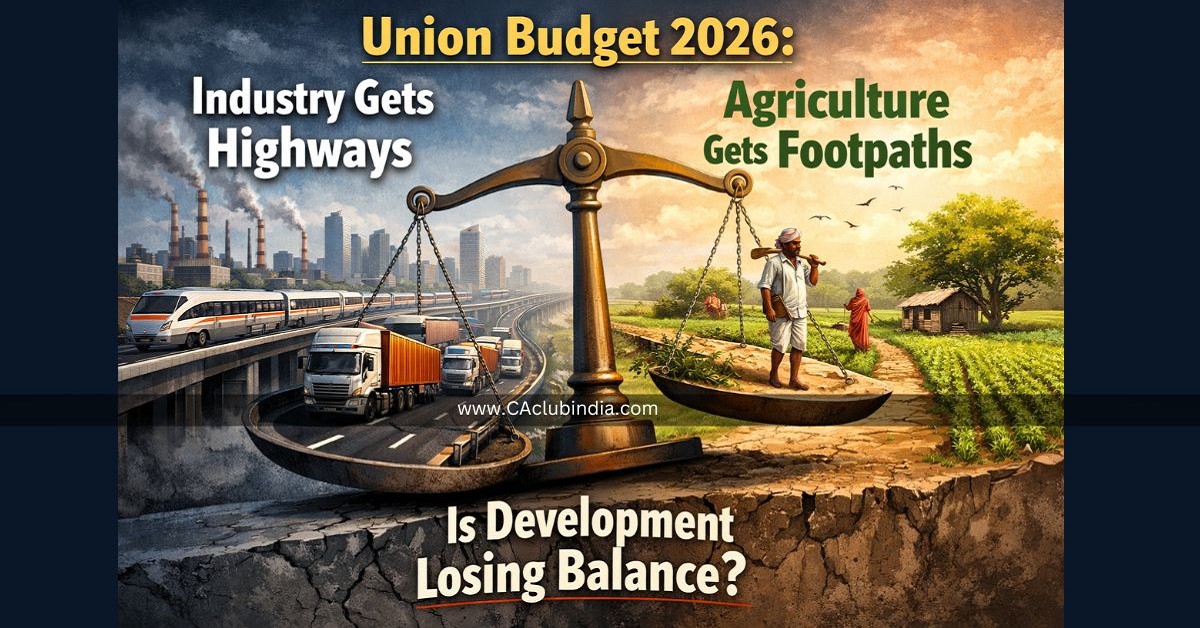
A close reading of the Union Budget 2026–27 clearly reveals the government's strong inclination toward large industries. When compared with last year's budget, one reality stands out sharply - a "red carpet" has been rolled out for industry in the name of infrastructure development, while farmers have once again been left with little more than hollow assurances.
Capital Expenditure Boost, Agriculture on 'Wait and Watch'
Over the last two years, the government has significantly increased capital expenditure (Capex). Massive investments are being made in roads, railways, ports, and highways, running into lakhs of crores of rupees. While such spending is undoubtedly important for long-term national growth, investment in agriculture - the sector on which nearly half of India's population depends - remains disproportionately low.
The speed and scale at which industrial infrastructure is being developed raise an important question: why is the same urgency not visible in irrigation projects, water conservation, or cold-storage infrastructure for agriculture?
Legal Guarantee for MSP: Once Again, Missing
The most persistent and fundamental demand of farmers is a legal guarantee for the Minimum Support Price (MSP). Even in the 2026 Budget, the government has chosen silence on this issue. Assurances of cost-based pricing remain confined to policy documents, while rising prices of fertilizers, diesel, and electricity continue to erode farm profitability.
As a Chartered Accountant analysing these numbers, it becomes evident that while "Ease of Doing Business" is systematically strengthened for industries, there is no equally robust mechanism to protect farmers from market exploitation.
Crop Insurance and the Climate Gamble
With climate change intensifying, farming has increasingly become a gamble. Unseasonal rains, droughts, and extreme weather events are now frequent. Crop insurance was expected to act as a safety net, but in reality, the process of claiming insurance remains so complex that many farmers fail to benefit from it.
While insurance companies continue to post healthy profits, farmers often remain uncompensated for their losses - a contradiction that cannot be ignored.
Rising Costs, Uncertain Incomes
Over the past year, the cost of seeds, fertilizers, pesticides, and farm labour has risen sharply. In contrast, farm-gate prices for agricultural produce have largely remained stagnant. As a result, the rural economy is under severe strain.
The slogan of "doubling farmers' income" now appears increasingly rhetorical. Unless agriculture is accorded the status of an industry - with corresponding policy incentives and protections - growth will remain uneven and exclusionary.
Conclusion: The Need for Balanced Development
The Union Budget 2026 does take India forward on its path to becoming a global manufacturing hub. However, neglecting agriculture - the backbone of the Indian economy - may prove costly in the long run.
Industrial growth is necessary, but it should not come at the cost of farmers' livelihoods. Sustainable development demands that the wheels of progress move forward with agriculture and industry advancing together, not at unequal speeds.
The author can also be reached at ssagarthorat@gmail.com










 CAclubindia
