
From Earning to Sustaining - The Silent Financial Transition of Retirement
Retirement is frequently regarded as a reward for decades of disciplined professional effort; however, it quietly ushers in one of the most intricate financial transitions an individual may encounter. This transition from earning to sustaining is not merely theoretical; it unfolds quietly in the lives of countless retirees, as reflected in Mr Sharma's journey, discussed subsequently.
Savings increase predictably, and financial planning adheres to a structured rhythm. Conversely, retirement disrupts this pattern. Income ceases, yet expenses persist- and often escalate due to age, healthcare requirements, and changing lifestyle ambitions. The primary challenge of retirement, therefore, is not merely wealth accumulation but rather the conversion of amassed savings into a dependable, sustainable, and emotionally comforting income stream. At this pivotal financial juncture, the concept of a Systematic Withdrawal Plan (SWP ) emerges as a prudent mechanism bridging savings and financial stability.
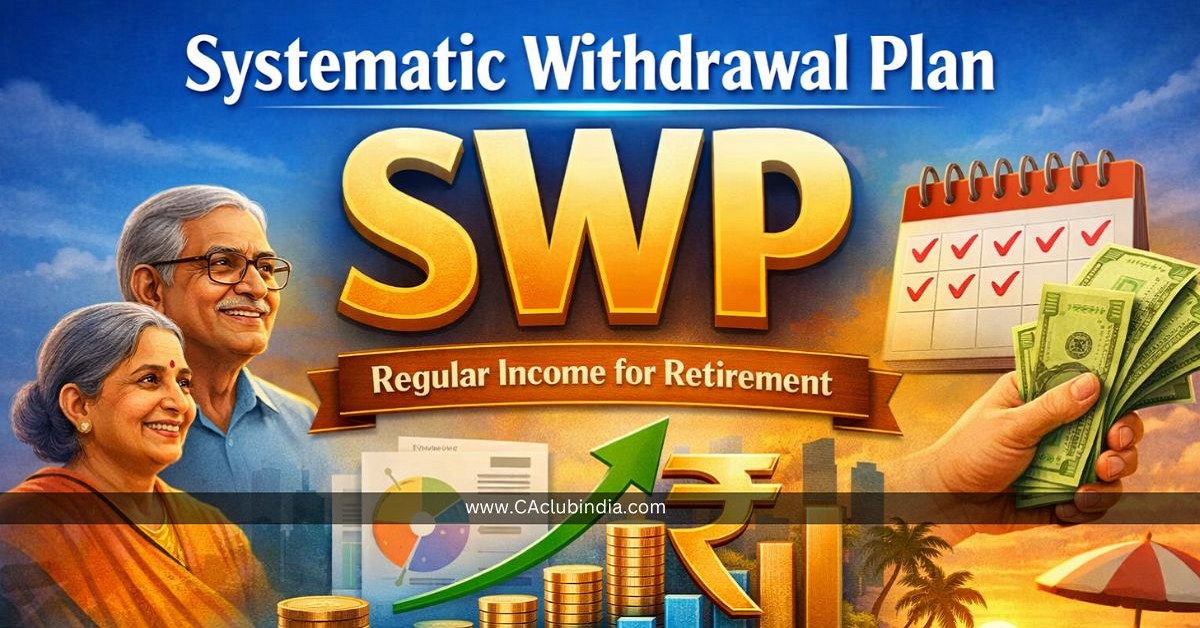
This transition from earning to sustaining is not merely theoretical; it unfolds quietly in the lives of countless retirees. Mr Sharma's journey reflects this emotional and financial transformation in its most human form.
When Retirement Arrives, A New Question Begins
On the evening of his retirement, Mr. Sharma sat quietly in his drawing room, surrounded by farewell mementoes, garlands, and framed photographs reflecting thirty-five years of professional commitment. The structured rhythm of life that had defined his existence - monthly salary credits, office responsibilities, and predictable financial planning - had suddenly come to a pause. Retirement celebrations often appear joyous from the outside, yet internally they mark the beginning of one of the most complex financial and emotional transitions in human life. Throughout his working years, Mr Sharma had mastered the discipline of earning and saving. Every increment strengthened his financial base, every provident fund contribution built long-term security, and every investment decision reinforced his family's stability. However, as he reflected on his accumulated wealth that evening, a subtle but powerful anxiety surfaced: income had stopped, but expenses would continue - and, in many cases, gradually increase.
The transition from wealth accumulation to wealth distribution is seldom addressed in conventional financial planning. Most individuals dedicate decades to learning how to generate income, yet few receive training in managing their savings in a structured and sustainable manner. Retirement presents a paradox wherein accumulated savings, once a source of comfort, begin to evoke uncertainty. Each withdrawal introduces an emotional and financial dilemma concerning sustainability and the longevity of wealth. The apprehension of outliving one's savings remains one of the most subdued yet potent anxieties among retirees. It is precisely at this confluence of financial planning, emotional security, and behavioural discipline that the concept of SWP manifests as a considered financial philosophy rather than merely an investment tool.
Understanding SWP - A Pension Created from Your Own Savings
A Systematic Withdrawal Plan (SWP) constitutes a structured financial arrangement that enables an investor to withdraw a predetermined amount from mutual fund investments at regular intervals, while allowing the remaining corpus to stay invested and potentially appreciate. However, the importance of SWP extends far beyond mere periodic withdrawals. Essentially, SWP encourages disciplined retirement spending and replaces impulsive or ad hoc withdrawals with a consistent financial routine. Each withdrawal involves the redemption of mutual fund units, which typically comprise both capital and accumulated gains, thereby ensuring that only a portion of the investment is withdrawn, while the remaining corpus continues to generate returns.
Economically, SWP signifies a transition from merely safeguarding capital to enhancing its efficiency. Rather than allocating retirement funds exclusively to low-yield assets, SWP maintains capital liquidity and productivity, thereby supporting the preservation of purchasing power over an extended retirement period. Psychologically, SWP restores financial stability by replicating the consistent income retirees experienced during their working years. This structured income approach notably alleviates anxiety and enables retirees to manage their expenses with confidence and dignity. Furthermore, it underscores that retirement income need not depend solely on external pension schemes; it can be generated independently through disciplined financial planning.
Why SWP Has Emerged as a Modern Retirement Strategy
Traditional retirement income instruments were conceived during a period when life expectancy was comparatively lower, healthcare costs were more manageable, and inflation cycles remained relatively stable. In contemporary India, demographic dynamics have experienced significant shifts. Extended longevity has led to retirement durations of 25 or even 30 years, while healthcare inflation has consistently exceeded general inflation, thereby substantially increasing financial vulnerability in old age. Furthermore, evolving lifestyle aspirations among older adults have transformed retirement from a mere survival phase into a period of active engagement, encompassing travel, social participation, and personal wellness expenditures.
Fixed-income instruments are typically reliable but tend to yield returns that barely keep pace with inflation over time, thereby slowly reducing purchasing power. SWP addresses this core issue by integrating income with growth opportunities through market-linked investments. It allows part of the portfolio to stay invested, aiming to synchronise retirement income with inflation while offering flexibility to modify withdrawals as financial needs and economic conditions evolve . Most importantly, SWP promotes disciplined spending habits during retirement by fostering systematic withdrawals, helping prevent impulsive decisions that could deplete savings prematurely.
The Most Critical Question - How Much Should One Withdraw?
Choosing the right withdrawal rate is the most crucial decision in retirement planning, as it directly impacts how long savings last. While factors such as investment choices, asset allocation, and tax strategies are important, the key to sustainable retirement income lies in the amount of money withdrawn annually. Withdrawing too much too quickly risks depleting funds prematurely, whereas withdrawing too little may limit lifestyle and undermine retirement goals. Finding the ideal withdrawal amount involves balancing current financial comfort with long-term security.
Global retirement research frequently references the concept known as the "safe withdrawal rate," which broadly suggests that withdrawing approximately three to four per cent of the retirement corpus annually allows the investment to sustain income across extended retirement periods. This principle is derived from long-term historical analysis of market returns and inflation patterns, indicating that moderate withdrawal levels enable the remaining investment corpus to continue compounding while supporting regular income requirements. However, although the safe withdrawal rule provides a significant initial framework, it should never be regarded as a rigid mathematical formula. Retirement planning occurs within a dynamic economic environment, influenced by market volatility, inflation trends, healthcare costs, and individual longevity.
One often overlooked risk in retirement planning is longevity risk- the risk that individuals may outlive their savings. With advances in healthcare, better nutrition, and increased health awareness, life expectancy has risen significantly, especially in urban India. It's increasingly common for those retiring at sixty to live into their late eighties or nineties. Therefore, retirement plans must ensure that income lasts for potentially three decades or more. A withdrawal plan that seems viable for fifteen or twenty years may fall short if longevity exceeds expectations. As a result, withdrawal strategies should consider not only financial factors but also realistic estimates of life expectancy and possible healthcare costs.
An additional critical yet less well-understood factor influencing the sustainability of withdrawals is the phenomenon known as " sequence of returns risk." Retirement forecasts often assume that investments will yield a constant average return over time. In actuality, market performance seldom follows a uniform trajectory. The order in which positive and negative market returns manifest can profoundly impact the viability of retirement plans. Should market downturns occur in the early years of retirement - when withdrawals have already commenced - the investment fund may experience disproportionate depletion. The combined effect of market losses and regular withdrawals during these early retirement years can cause a permanent diminishment of the power of compound growth, even if markets subsequently recover. Conversely, if favourable market returns occur during the early retirement period, the corpus benefits from robust compounding, thereby substantially improving long-term sustainability. Awareness of sequence risk encourages retirees to implement conservative withdrawal strategies in the early years of retirement and to maintain diversified asset allocations.
Inflation risk constitutes a significant factor that subtly affects the sustainability of withdrawals. Many retirees underestimate the long-term effects of inflation, particularly healthcare inflation, which has historically outpaced overall consumer price inflation. Data from India indicate that healthcare costs, insurance premiums, and assisted living expenses tend to escalate notably with age. Hence, withdrawal strategies should incorporate considerations for both current expenses and anticipated future cost increases. Many financial advisors advocate inflation-adjusted withdrawal strategies, in which withdrawal amounts are adjusted annually to account for inflation. Such a systematic approach ensures that retirees maintain their purchasing power while avoiding undue strain on their investment funds.
Indian retirement realities increasingly necessitate comprehensive withdrawal planning that accounts for family responsibilities, cultural expectations, and varied income sources. Unlike in some Western economies, where retirees often enjoy greater financial independence from extended family obligations, Indian retirees frequently support their children's entrepreneurial ventures, grandchildren's education , or cover family medical emergencies. While these responsibilities embody strong cultural values, they impose additional financial demands that must be realistically integrated into withdrawal strategies. Furthermore, retirees who receive pension income, rental earnings, or part-time consulting income may opt for lower withdrawal rates from their investment corpus, thereby enhancing the long-term sustainability of their retirement funds.
Behavioural discipline is equally vital to the success of withdrawal strategies. Many retirees increase withdrawals during favourable market conditions or reduce them abruptly during downturns, often guided by emotional responses rather than methodical financial planning. A sustainable withdrawal approach demands consistency, regular review, and expert advice rather than reactive financial decisions. Retirement income planning should be regarded as an ongoing process rather than a single decision made at retirement.
Understanding the appropriate withdrawal rate is essential, as it determines whether retirement savings are sustained or progressively depleted over time. To understand how these principles operate in practice, consider a real-world retirement scenario.
How SWP Functions in Real Life - A Numerical Illustration
The practical significance of withdrawal discipline becomes clearer when viewed through real-life financial planning. Consider the retirement journey of Mrs Mehta, who retires at age 60 with a ₹1.50 crore corpus and seeks a steady monthly income without jeopardising her long-term financial security. After consulting a financial planner, she invests in balanced mutual funds that are expected to yield approximately 8% annually. She chooses a monthly SWP withdrawal of ₹60,000, totalling ₹7.20 lakh annually, which is approximately 4.8 [7.20 * 100/1.50] per cent of her initial corpus. If the funds perform in line with their long-term averages, her investment can continue to grow while providing regular income.
The genuine financial importance of this arrangement lies in the delicate balance between capital withdrawal and capital growth. Each withdrawal reduces the investment base; however, market returns can either replenish it or slow the rate of reduction. Over extended periods, disciplined withdrawals allow compounding benefits to continue for the investor, even into retirement. If Mrs Mehta had withdrawn substantially higher amounts, the advantages of compounding would have been compromised, thereby hastening the depletion of the corpus. Conversely, prudent withdrawal levels enable the retirement corpus to generate income while progressively accommodating inflation and lifestyle changes, exemplifying the long-term sustainability philosophy inherent in SWP.
First Retirement Story - When Discipline Preserves Wealth
The retirement journey of Mr and Mrs Verma provides a compelling example of how disciplined withdrawal strategies impact financial sustainability . Upon retiring with a corpus of ₹1 crore, they initially planned to withdraw ₹80,000 per month, assuming that their accumulated savings would adequately support their lifestyle. Financial analysis, however, indicated that such withdrawal levels could deplete their corpus within fifteen years under moderate-return scenarios. Following professional consultation, they reduced monthly withdrawals to ₹40,000 and diversified their investments across hybrid and equity-oriented funds to preserve growth potential.
Over the subsequent fifteen years, their portfolio underwent multiple market cycles, including periods of economic slowdowns and recoveries. Nevertheless, their disciplined withdrawal strategy enabled market growth to offset inflation, thereby ensuring financial stability even during unforeseen medical emergencies. Their experience exemplifies that success in retirement depends not solely on investment returns but also on behavioural discipline and strategic financial planning, emphasising SWP as a mechanism that harmonises lifestyle aspirations with long-term financial sustainability.
Second Retirement Story - When Financial Planning Becomes Emotional Security
Mrs Harpreet Kapoor retired as a school principal after dedicating nearly four decades to shaping young minds. Renowned among her students for her discipline, warmth, and calm authority, she consistently exemplified a life characterised by meticulous planning and a strong sense of responsibility. She diligently saved throughout her career, made consistent contributions to provident fund and mutual fund investments, and ensured that her children received quality education without compromising their finances. By the time she retired at the age of sixty-two, she had accumulated a retirement corpus of approximately ₹1.20 crore, which she believed would adequately support her post-retirement years.
Nevertheless, in contrast to her disciplined professional career, Mrs Kapoor's transition into retirement commenced with emotional hesitation rather than financial clarity. During the first two years after retirement, she refrained from implementing a systematic income-planning strategy. Her primary reliance was on fixed deposits, as they provided psychological assurance and certainty . Each quarter, upon receipt of interest income, she experienced reassurance. However, over time, she observed that her expenses were escalating more rapidly than her interest income. Increasing medical insurance premiums, occasional hospital visits, home maintenance expenditures, and family social obligations began to deplete a larger portion of her savings.
Simultaneously, Mrs Kapoor experienced a more profound emotional difficulty that many retirees quietly endure: the anxiety of financial dependence. Although her children were economically secure and consistently reaffirmed their support, she felt uneasy about depending on them. Having led a life of financial independence, she wished to maintain it in retirement, not solely for economic security but also to uphold her personal dignity.
During this phase, her financial advisor introduced her to the concept of a Systematic Withdrawal Plan . Initially, she resisted the idea. The thought of withdrawing funds from market-linked investments induced anxiety. She feared that market volatility might diminish her corpus and render her vulnerable in advanced age. Her hesitation exemplified a common behavioural pattern among Indian retirees: associating safety exclusively with fixed-income instruments and perceiving market-linked instruments as inherently risky.
Following comprehensive discussions and retirement projections, Mrs Kapoor progressively consented to reorganise her investment portfolio. She diversified her principal across debt-oriented and hybrid mutual funds and commenced a systematic withdrawal plan of ₹45,000 per month. Her financial advisor clarified that her withdrawal rate was consistent with sustainable withdrawal models and that her residual investments would continue to generate growth to offset inflation and future financial obligations.
In the first few months, Mrs Kapoor watched her investment statements with concern. Market fluctuations sometimes led to brief declines in her portfolio's value, reigniting her prior fears. Nevertheless, she observed that her periodic withdrawals proceeded smoothly and that her investment value stabilised as markets rebounded. Even more significantly, the consistent SWP income brought back a familiar pattern to her finances, similar to the steady monthly income she had during her teaching years.
Over time, SWP offered Mrs Kapoor more than financial gain- it renewed her emotional confidence. She began attending social events, travelled with retired colleagues, and established a small scholarship fund in her late husband's memory to aid less fortunate students. Knowing that her income was reliably managed helped her find personal fulfilment in retirement.
Nearly eight years into her retirement, Mrs Kapoor encountered a medical emergency necessitating hospitalisation and extended treatment. The financial preparedness established through her SWP strategy and emergency contingency reserves enabled her to cover medical expenses without jeopardising her long-term financial stability. Most notably, she experienced emotional relief, confident that she could face adversity independently without becoming financially dependent on her children.
Mrs Kapoor's narrative exemplifies a profound truth regarding retirement planning: financial instruments serve not only as sources of income but also as providers of emotional reassurance, personal dignity, and psychological independence. In her case, SWP evolved beyond a mere withdrawal strategy to become a structured financial partner, facilitating her transition from uncertainty to confidence, and from financial anxiety to purposeful living.
Her journey underscores a perennial financial principle. Retirement planning is effective not solely through the accumulation of wealth but also through the prudent allocation of assets consonant with emotional well-being, behavioural discipline, and long-term fiscal sustainability.
From Understanding SWP to Living Retirement with Confidence
The journeys of Mr Sharma, Mrs Mehta, the Vermas, and Mrs Kapoor collectively reveal that retirement income planning is not merely a technical financial exercise but a deeply personal and emotional transformation. SWP, at its core, provides retirees with the confidence that their lifetime savings can continue to support them without fear of sudden depletion. Yet, while SWP offers a structured and flexible income solution, its long-term success depends upon disciplined withdrawal behaviour, careful asset allocation, and periodic financial review. In the next part of this discussion, we shall move beyond understanding SWP and examine the behavioural, taxation, and technical realities that ultimately determine whether retirement wealth survives market cycles, inflation pressures, and longevity challenges.
You have reached your daily limit of 2 Free Articles
Subscribe to CCI PRO for unlimited access
Why Upgrade to CCI PRO?
- No Ads
- WhatsApp Community
- Daily E-Newsletter
- Unlimited Articles Access
- Profile Visitors
- Link Social Profiles
- Featured Job Posts
- Pro Badge
- Expert GST Guidance
- Unlimited Forum Replies
- Download Content in PDF
Already a PRO member? Login here for an ad-free experience. 011-411-70713










 CAclubindia
