
I. Applicability:
In order to promote Employee generation, deduction under this section is given to all Assesses, whose books of accounts are required to get audited u/s.44AB.
II. Quantum and Duration of Deduction:
Where the gross total income of an assessee to whom section 44AB applies, includes any profits and gains derived from business, a deduction of an amount equal to 30% of additional employee cost incurred in the course of such business in the previous year, would be allowed for three assessment years including the assessment year relevant to the previous year in which such employment is
provided.

III. Conditions to be fulfilled:
In order to get a deduction under this section, the following conditions are required to be satisfied:
1 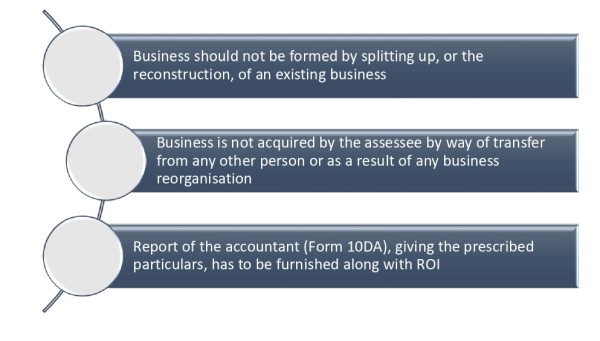
IV. Meaning of Terms used in the Section:
(a) Additional Employee Cost:- means the total emoluments paid or payable to additional employees employed during the previous year.
Provided that in the case of an existing business, the additional employee cost shall be nil, if:-
i. there is no increase in the number of employees from the total number of employees employed as on the last day of the preceding year;
ii. Emoluments are paid otherwise than by an account payee cheque or account payee bank draft or by use of an electronic clearing system through a bank account
[or through such other electronic mode as may be prescribed2
Provided further that in the first year of a new business, emoluments paid or payable to employees employed during that previous year shall be deemed to be the additional employee cost.
(b) Additional Employee:- means an employee who has been employed during the previous year and whose employment has the effect of increasing the total number of employees employed by the employer as on the last day of the preceding year, but does not include:-
i. Employee whose total emoluments are more than Rs.25000/- p.m. or
ii. Employee for whom the entire contribution is paid by the Government under the Employee's Pension Scheme. Or
iii. An employee who does not participate in the recognized provident fund or
iv. Employee employed for a period of < 240 days during the previous year.
The above said period of 240 days is substituted to 150 days in case of an assessee engaged in the business of manufacturing Apparel, Footwear, and Leather products.
If an employee is employed during the previous year for less than 240 days or 150 days, as the case may be, but is employed for a period of 240 days or 150 days, as the case may be, in the immediately succeeding year, he shall be deemed to have been employed in the succeeding year.
Accordingly, the employer would be entitled to a deduction of 30% of the additional employee cost of such employees in the succeeding year.
Ex:- M/s. ABC Ltd which is engaged in the business of manufacturing footwear deployed 20 employees on 01.02.2020, as they were employed for <150 days during the F.Y 2019-20, the assessee will not any deduction under this section for the F.Y 2019-20.
But if during the P.Y 2020-21 they were employed for >150 days, then M/s. ABC Ltd will be eligible to claim a deduction of 30% of employee cost paid to those 20 employees.
(c) Emoluments:- means any sum paid or payable to an employee in lieu of his employment by whatever name called, but does not include:
i. any contribution paid or payable by the employer to any pension fund or provident fund or any other fund for the benefit of the employee under any law for the time being in force; and
ii. any lump-sum payment paid or payable to an employee at the time of termination of his service or superannuation or voluntary retirement, such as gratuity, severance pay, leave encashment, voluntary retrenchment benefits, commutation of pension, and the like.
- 1. Provided that nothing contained in this clause shall apply in respect of a business that is formed as a result of re-establishment, reconstruction, or revival by the assessee of the business in the circumstances and within the period specified in section 33B.
- 2. Rule 6ABBA – Credit/Debit Card; Net Banking; IMPS; UPI; RTGS; NEFT & BHIM











 CAclubindia
