Revision for Accounting Standards - CA Intermediate (Part 4)


Quick Summary
This article provides a revision of Accounting Standard 7 (AS 7) concerning Construction Contracts, specifically for CA Intermediate students. It details the two main types of contracts: fixed price and cost-plus, and explains how contract revenue and costs are recognised based on the stage of completion. The standard also covers situations where contract outcomes cannot be reliably estimated and how changes in estimates are treated.

AS 7 Construction Contracts

(Introduced in December 1983, Revised and applicable for accounting Periods on or after April 1, 2003)
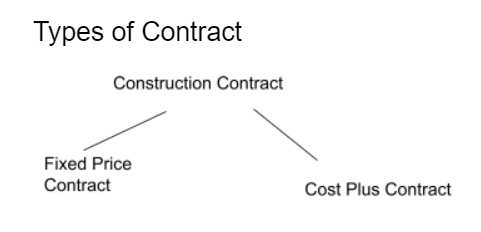
Types of Contract

Types of Contract

Fixed Contract

 In fixed Contract Price is agreed as a fixed sum.

AS 7 Construction Contracts: CA Intermediate Revision

Cost Plus Contract

It is a type of construction contract in which the contractor is reimbursed for allowable or otherwise defined costs, plus percentage of these costs or a fixed fee.

Contract Revenue
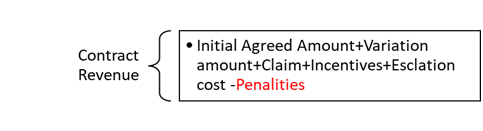
Contract Revenue

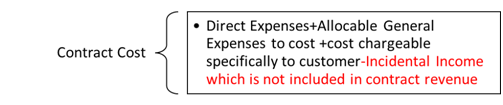
Contract Cost

Contract Cost

Measurement of contract revenue

Percentage of Completion Method: Under the Percentage completion method, the revenue is recognized in the profit and loss account in the accounting period in which work is performed.

Formulae
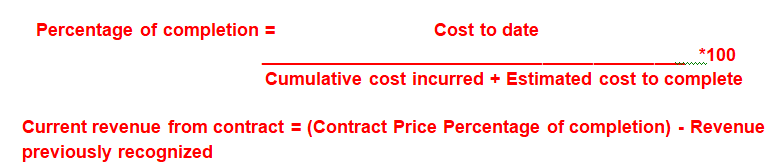
Formulae

Recognition of contract revenue and expenses
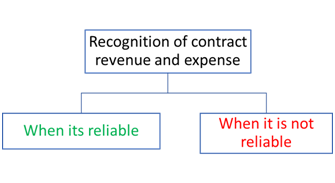
Recognition of contract revenue and expenses

  1. Contract revenue and contract costs associated with the construction contract should be recognised in accordance with the stage of completion of the contract activity at the reporting date.
  2. An expected loss shall be recognised immediately
 

In case of Fixed price contract and Cost plus Contract (when it is reliable)
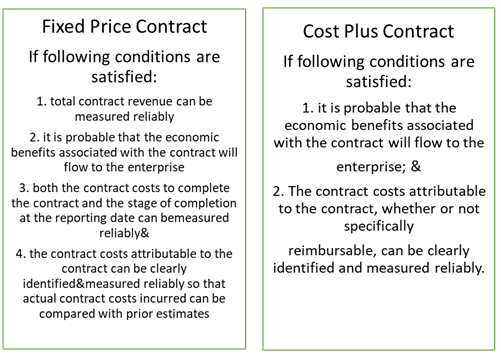
Fixed price contract and Cost plus Contract

When the outcome of a construction contract cannot be estimated reliably:

  • revenue should be recognised only to the extent of contract costs incurred of which recovery is probable; and
  • contract costs should be recognised as an expense in the period in which they are incurred. An expected loss on the construction contract should be recognised as an expense immediately.

Changes in Estimate (Para 37)

Any change in the estimate of the outcome of a contract, is accounted for as a change in the accounting estimate as per AS-5. The changed estimates are to be used to determine the amount of revenue and expense to be recognised in the profit and loss account in the period in which change is made.

Treatment of Contract Cost
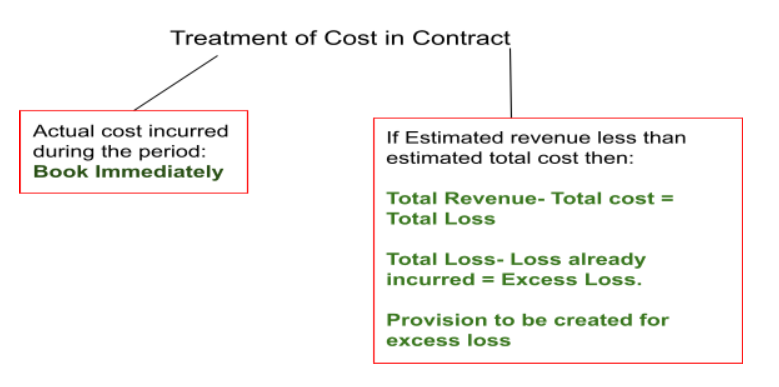
Treatment of Contract Cost


Disclosure Para 38

  • Contract Revenue
  • Contract Cost
  • Stage of Completion and the methods
  • the methods used to determine the contract revenue recognised in the period
  • Advance received if any
  • Retention amount
  • Profit recognised
  • Progress Bill.

Also Read:

FAQ :

The two main types of construction contracts covered by AS 7 are Fixed Price Contracts, where the price is agreed as a fixed sum, and Cost Plus Contracts, where the contractor is reimbursed for costs plus a fee or percentage.

Under the Percentage of Completion Method, contract revenue is recognised in the profit and loss account during the accounting period in which the work is performed, reflecting the stage of completion.

An expected loss on a construction contract should be recognised as an expense immediately.

Any change in the estimate of a contract's outcome is accounted for as a change in accounting estimate, and the changed estimates are used to determine the revenue and expense recognised in the current period.

Required disclosures include contract revenue, contract costs, the stage of completion and methods used, advances received, retention amounts, profit recognised, and progress bills.


5228 Views 3 Likes Comment   Share Students   Report


About the Author

Practice

I simplify complex income tax, TDS, banking, and investment updates into practical insights for taxpayers, salaried professionals, pensioners, and senior citizens. I regularly write on ITR filing, tax compliance, savings schemes, and the latest financial rule changes in India.

Comments :

Related Articles


Loading


Popular Articles


CCI Pro

CCI Articles

submit article