
1. Electricity in a Hotel: Not a Facility, but a Fundamental Service Enabler
In the hospitality industry, electricity is not merely a utility expense; it is an integral element of the service provided to guests. A hotel room without lighting, air conditioning, or operational charging points is hardly habitable. Elevators rely on uninterrupted power to transport guests and staff between floors. Kitchen operations necessitate a continuous electricity supply for refrigeration, cooking appliances, and compliance with food safety standards. Additionally, fire safety systems, CCTV surveillance, and access control mechanisms function effectively only when the electricity supply remains stable and uninterrupted.
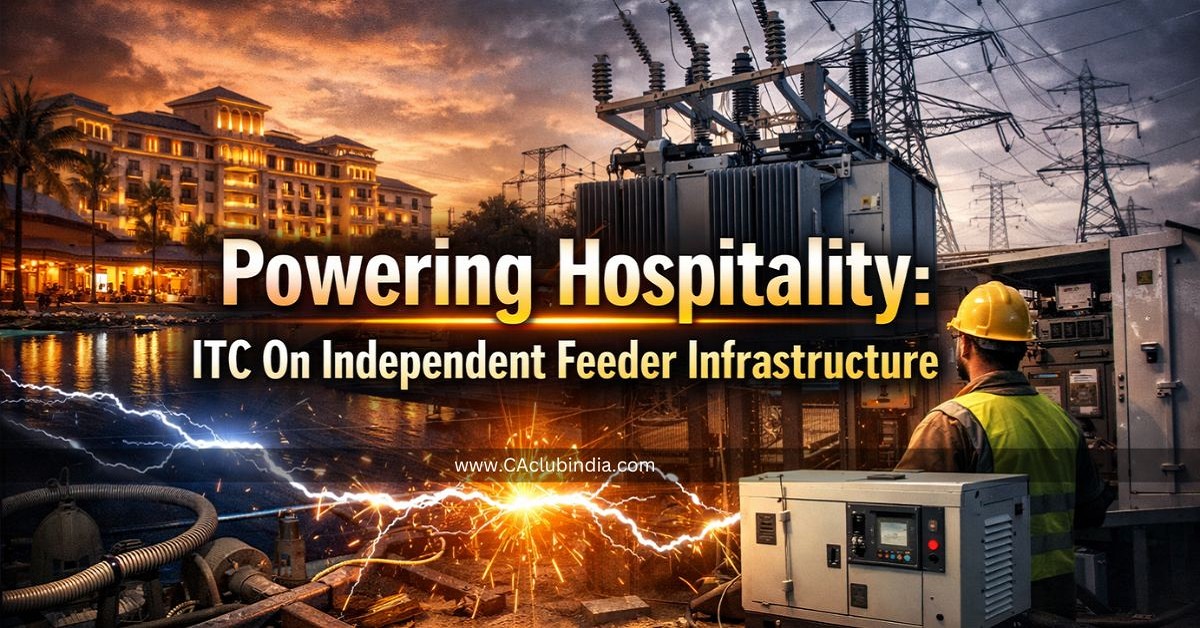
Even brief disruptions can lead to the cancellation of reservations, compromise guest safety, and expose the hotel to both reputational and regulatory risks. Consequently, it is a standard commercial practice for hotels to pursue independent feeder connections from electricity distribution entities to mitigate reliance on congested general feeder networks. These feeders are sanctioned following technical feasibility assessments and upon recovery of infrastructure expenses from the hotel, including the erection of poles, laying of conductors, and installation of electrical accessories.
At this stage, one is reminded of a simple truth:
"बिना आधार के कोई ऊँचाई टिकती नहीं,मजबूत जड़ें हों तो आँधी भी डरती नहीं।"(Without strong foundations, no height can survive;when roots are strong, even storms learn to fear.)
Just as robust roots support a tree, a reliable power infrastructure underpins hotel operations.
2. Section 16: Business Nexus in Its Purest Form
Section 16(1) of the CGST Act, 2017, authorises Input Tax Credit (ITC) on any goods or services or both utilised in the course or furtherance of business activities. In the context of hotel operations, electricity is inherently linked to service provision; it is integral to delivering services. Each taxable supply of accommodation, banquet services, or restaurant services presupposes an uninterrupted power supply. Without electricity, the outward supply itself becomes commercially impossible, thereby satisfying not merely incidental use but functional indispensability under Section 16(1).
When a hotel invests in an independent feeder, the purpose is not asset creation or property improvement but to ensure operational continuity. The feeder directly supports taxable outward supplies by keeping guest rooms air-conditioned, banquet halls lit during events, refrigeration units maintaining food quality, and elevators functional for guests. Therefore, the connection between the inward supplies used to establish the feeder and the hotel's outward taxable supplies is direct, immediate, and commercially vital, satisfying the criteria of Section 16(1).
3. Section 17(5)(c) and 17(5)(d): Construction vs Operational Infrastructure
Section 17(5)(c) of the CGST Act, 2017 prohibits the claiming of Input Tax Credit (ITC) on works contract services that are utilised for the construction of immovable property, excluding plant and machinery. Similarly, Section 17(5)(d) disallows ITC on goods or services or both used for the construction of immovable property on one's own account, and excludes plant and machinery.
Thus, the legislation does not prohibit ITC for all construction-related activities, but restricts credit only where the construction results in land, buildings, or other civil structures intended to function as the place of business itself. The feeder line does not generate accommodation spaces, banquet halls, or service counters; it merely ensures their continued functionality. Therefore, the feeder does not qualify as immovable property akin to civil construction but rather as operational infrastructure. In this context, the wisdom of effort over mere appearance becomes relevant:
"जो दिखता है वही सच नहीं होता,कई ताक़तें चुपचाप काम करती हैं।"(What is visible is not always the truth;many strengths work silently in the background.)
Electrical infrastructure works silently, but without it, visible luxury collapses.
4. Statutory definition of Plant and Machinery: Electricity as Apparatus
The explanation to Section 17 provides that the expression "plant and machinery" means apparatus, equipment and machinery fixed to the earth by foundation or structural support, that are used for making outward supply of goods or services or both and includes such foundation and structural support, but excludes-
(i) land, buildings, and other civil structures;
(ii) telecommunication towers; and
(iii) pipelines laid outside the factory premises.
Thus, the statute explicitly recognises that equipment, even when permanently fixed, remains eligible for Input Tax Credit (ITC). In the present context, Electrical poles, conductors, and insulators are clearly apparatus used to transmit energy. They serve no structural or real estate purpose. Even the foundations and structural supports that hold such equipment in place are expressly included in the statutory definition of plant and machinery. Therefore, by statutory definition, feeder infrastructure qualifies as plant and machinery rather than a civil structure.
5. Operational Reality in Hotels: Power Is Part of Guest Experience
In a hotel that hosts conferences and social events, power stability is not merely a matter of operational convenience but a contractual obligation. Lighting systems, audiovisual equipment, food service machinery, and climate control must operate uninterrupted. Guests residing on higher floors rely on elevators for mobility, and contemporary safety systems necessitate a continuous electrical supply to ensure constant alertness.
Therefore, electricity provision is not merely an operational input, but an integral component of service quality and safety assurance. The independent feeder line, in this context, is regarded as an essential element of service delivery, comparable to housekeeping staff or kitchen equipment. It directly and continuously sustains business operations, unequivocally establishing its status as part of the business infrastructure.
6. Judicial Thinking: Substance of Use, Not Permanence of Fixation
Judicial precedents have consistently established that the permanence of installation does not transform equipment into immovable civil property. If the asset performs an operational function within a business context, it remains classified as plant and machinery. Electrical installations, transformers, and industrial machinery anchored to concrete foundations have all been duly recognised by the judiciary as components of the plant. Courts have consistently applied the "functional test" rather than the "fixation test" while determining whether an asset qualifies as plant and machinery.
Conversely, judicial denial of Input Tax Credit (ITC) has predominantly occurred in cases involving the construction of commercial edifices intended for leasing or sale, in which the building itself constitutes the subject of commerce. Feed infrastructure does not generate revenue; rather, it facilitates revenue-generating services. Therefore, judicial reasoning endorses the availability of ITC in such instances.
7. Outside the Premises, Yet Inside the Business
The segment of the feeder line that may extend beyond the hotel boundaries does not diminish the business relationship. Electricity is conveyed solely along the hotel's feeder for its use and serves no standalone function. Under the GST law, there is no requirement for assets to be situated within the factory or hotel premises, nor is there any stipulation that business use must be confined to the registered place of business. It suffices that they are utilised in the course of business. In the realm of business, numerous essential processes transpire beyond the confines of visible premises yet remain fundamental to the provision of services. The feeder line exemplifies one such invisible enabler. Here an Urdu thought captures the idea beautifully:
"रौशनी की राह में दीवारें क्या मायने रखती हैं,जहाँ मंज़िल तय हो, वहाँ रास्ते खुद बन जाते हैं।"(What do walls matter in the path of light;when the destination is clear, paths create themselves.)
8. Capitalisation Does Not Alter Legal Character
The accounting treatment does not influence tax eligibility. Even when the electrical infrastructure is capitalised, it remains plant and machinery. The CGST Act does not prohibit ITC merely because an asset is capital in nature; rather, it restricts ITC on buildings and civil structures. Consequently, the capitalisation of feeder infrastructure does not compromise the entitlement to ITC.
9. Illustration
Consider a hotel that incurs an expenditure of ₹40 lakh on poles, conductors, insulators, and erection services for an independent feeder connection, with GST charged separately. The Input Tax Credit (ITC) on the entire GST amount shall be admissible, as the asset qualifies as plant and machinery supporting hotel operations. In the event that a segment of the project expenditure pertains to the construction of masonry control rooms or concrete civil platforms, the Input Tax Credit (ITC) concerning such civil construction may be applicable under Section 17(5)(d). Conversely, ITC for electrical infrastructure should remain eligible. This underscores the significance of maintaining segregated billing and accounting practices.
10. Documentation: Strengthening the Credit Trail
The preservation of the concerned Electricity Distribution Company approvals, technical estimates, contractor invoices describing the electrical nature of work, and capitalisation under electrical installations or plant and machinery is essential. When documentation accurately reflects operational intent and asset characteristics, ITC disputes can be effectively mitigated.
11. Legal Conclusion - Why ITC on Independent Feeder Infrastructure Is Admissible
Hotels allocate resources to independent feeders not to elevate property value, but to safeguard service reliability and ensure guest safety. Electrical transmission systems, whilst permanently installed, are considered business infrastructure rather than civil engineering. They are intended to power service delivery rather than accommodate service activities. Therefore, ITC shall be available on goods or services, or both, used for creating independent feeder connections approved by electricity distribution companies, except to the limited extent of standalone civil construction. Denying ITC on such operational infrastructure would contradict both legal intent and business reality. And as one final thought reminds us:
"जो ज़रूरी है, वही असली पूँजी है,बाक़ी सब दिखावा है, कुछ पल की चमक।"(What is essential is the real capital;all else is display, a momentary shine.)
In GST too, what enables a business to claim credit?
12. Practitioner's Checklist: Safeguarding ITC on Independent Feeder Infrastructure
While the legal position robustly supports ITC eligibility for electrical feeder infrastructure used for hotel operations, practical adherence to compliance protocols remains essential to maintain the credit during audit or assessment processes. Advisers consulting for hotels and large commercial entities should, therefore, ensure that fundamental safeguards are established from the inception of the project.
Firstly, it is imperative that all approvals and technical sanction letters issued by the electricity distribution company explicitly specify that the feeder is designated solely for the relevant hotel establishment. Such documentation serves to establish exclusive business use and preclude any implication of personal or non-commercial utilisation.
Secondly, cost estimates and work orders should clearly identify electrical items and services, including poles, conductors, insulators, transformers, and erection and commissioning services. Wherever civil works are involved, such as the construction of control rooms or concrete platforms, they should be separately quantified and invoiced. This segregation is vital for safeguarding ITC on eligible electrical components, while voluntarily excluding civil construction portions that may be subject to Section 17(5)(d).
Thirdly, tax invoices should be issued in the name of the hotel entity and must include accurate GST details, including HSN or SAC descriptions that reflect the electrical nature of the supply. Vague descriptions such as "infrastructure work" or "development charges" should be avoided, as they undermine the asset classification argument.
Fourthly, the accounting treatment should reflect capitalisation under electrical installations or plant and machinery, and not under buildings or civil works. While the accounting treatment does not legally determine Input Tax Credit (ITC) eligibility, it significantly influences departmental perception and the approach to audits.
Fifthly, internal technical notes or management approvals explaining why the independent feeder was necessary for operational continuity, guest safety, and service quality can be extremely useful in demonstrating commercial necessity, particularly where high project costs invite scrutiny.
Finally, practitioners are advised to guide clients in maintaining a comprehensive project file that includes approval letters, invoices, payment proofs, capitalisation entries, and technical drawings. In GST litigation, the coherence of the documentation often carries greater weight than legal arguments alone.
When these compliance practices are aligned with the correct legal position, ITC on independent feeder infrastructure becomes not only legally admissible but also practically defensible.
13. Likely Departmental Objections and the Appropriate Counter-Arguments
In practical assessments and audits, ITC claims for infrastructure projects are frequently subject to scrutiny, not necessarily because of ambiguity in the law, but because of the significant monetary amounts involved and the permanently installed nature of the assets. It is therefore advisable for practitioners to anticipate potential objections that may be raised by the department and to be prepared with well-reasoned counter-arguments.
A common objection posits that the feeder line is permanently embedded in the earth, thereby constituting immovable property and rendering ITC inadmissible under Section 17(5)(d). The appropriate counterargument is found in the statutory Explanation to Section 17, which explicitly states that plant and machinery include apparatus and equipment fixed to the earth by foundation or structural support, and also encompasses such foundations and supports. The mere fact of permanence does not transform equipment into a civil structure. Exclusions from ITC include land, buildings, and other civil structures, but operational apparatus are not encompassed within these exclusions. Electrical transmission infrastructure that does not serve a structural function consequently does not fall within the scope of the exclusion.
Another frequently raised objection is that the feeder line is partially located outside the hotel's premises and therefore cannot be considered used in the course of business. This objection fails to recognise that Section 16 imposes no geographical restriction on ITC. The law mandates business use, not physical presence within the boundary walls. When electricity is transmitted through the feeder exclusively to the hotel and is utilised solely in business operations, the functional nexus is established regardless of the placement of the poles. Numerous business processes in contemporary commerce operate beyond physical premises yet remain integral to taxable supply chains.
Occasionally, officers may contend that, given the expenditure is capitalised, it should be regarded as immovable property and, consequently, the Input Tax Credit (ITC) should be suspended. This perspective conflates accounting classification with statutory restrictions. The GST legislation does not prohibit claiming ITC on capital assets; rather, it specifically restricts ITC on the construction of buildings and civil structures. Although plant and machinery are routinely capitalised in accounting records, they remain eligible for ITC. Therefore, capitalisation alone cannot serve as a valid basis for denying credit.
An alternative objection pertains to payments made to the electricity distribution company or to contractors, which are characterised as "development charges" or "infrastructure charges" and are therefore considered components of immovable property creation. The appropriate legal methodology is to analyse the substantive nature of the supplies rather than merely the nomenclature assigned to the charge. When the underlying work includes the installation of electrical transmission equipment, it remains, irrespective of its label, a supply of goods and services associated with plant and machinery. It is essential that the substantive nature prevails over the form in the determination of tax classification.
In certain instances, officers may rely on judicial precedents, such as Safari Retreats, to deny Input Tax Credit (ITC) on all expenditures related to immovable property. Such reliance is unwarranted because Safari Retreats is concerned with the construction of shopping malls intended for letting, where the building itself constitutes the taxable commercial output and the commercial asset that generates rental income. In cases involving feeder connections, the infrastructure itself does not generate revenue; rather, it enables the operation of hotel services. Judicial reasoning cannot be indiscriminately applied across contexts that are fundamentally different.
Finally, there may be concern that the infrastructure will ultimately vest in the electricity distribution company and therefore, ITC should not be available to the hotel. However, the GST law does not require ownership of assets for ITC eligibility. What matters is whether the inward supplies are used in the course or furtherance of business. Many business assets, such as leased machinery, rented premises, and utility connections, are not owned by the taxpayer; yet, ITC is permitted because business use is the determining factor.
Therefore, when objections are examined through the perspective of statutory language and commercial practicality, the legal stance supporting ITC on independent feeder infrastructure remains strong and justifiable.
14. Comparative Perspective: Why Feeder Infrastructure Stands on a Different Footing from Buildings and Commercial Complexes
Much of the confusion surrounding ITC on infrastructure stems from treating all permanent installations as a single category of immovable property. In reality, the GST law intentionally distinguishes between assets that form the place of business and those that merely facilitate business operations. This distinction becomes evident when comparing feeder infrastructure for hotels with that for shopping malls, office buildings, or commercial complexes.
In the case of shopping malls or office complexes, the building itself constitutes the commercial product. Rental income is generated solely due to the existence of the structure, which provides leasable space. The construction of such buildings directly creates revenue-generating assets. Consequently, courts and the legislature have adopted a restrictive approach regarding Input Tax Credit (ITC) on such civil constructions. This approach culminated in the Supreme Court decision in Safari Retreats and the subsequent insertion of Explanation 2 to Section 17(5), which denies ITC even when such buildings are used for taxable renting services.
In contrast, feeder infrastructure within hotels does not produce any autonomous revenue. Guests do not incur charges specifically for the feeder line; their payments are limited to accommodation, dining, conferences, and hospitality services. The feeder merely ensures the uninterrupted delivery of these services. Consequently, it is regarded not as part of the commercial output but as an operational input. This crucial functional distinction bears significant legal implications.
A comparable distinction is observable within manufacturing industries. Factory sheds and warehouses are classified as civil structures, and Input Tax Credit (ITC) is blocked; however, production machinery, electrical installations, material handling systems, and internal power distribution networks are categorised as plant and machinery and qualify for ITC. Even when such machinery is embedded in foundations and permanently installed, its operational nature supersedes its physical attachment to the ground.
Hospitals offer a pertinent comparison. Operation theatres, ICU equipment, oxygen pipelines, and power backup systems are not classified as civil construction despite their permanent installation. Instead, they are considered vital medical infrastructure that facilitates healthcare services. The legislation acknowledges that without these systems, the delivery of essential services would be unattainable.
Hotels, hospitals, and manufacturing units share a common characteristic: their operational infrastructure facilitates service provision or production but does not constitute the commercial space itself. Conversely, shopping malls and office buildings serve as commercial assets that generate revenue. Consequently, the GST law delineates a clear, though frequently misunderstood, boundary between revenue-generating civil property and operational infrastructure that enables revenue.
From this comparative perspective, independent feeder connections for hotels are clearly classified as revenue-enabling infrastructure rather than revenue-generating civil construction. Therefore, they should be treated under ITC as plant and machinery rather than as buildings and civil structures.
15. Closing Thoughts - When Business Reality Meets Tax Philosophy
Fundamentally, the GST was conceived to eliminate the cascading effect of taxes and to guarantee that business inputs do not incur additional tax expenses. This principle becomes particularly crucial in industries such as hospitality, where the quality of service relies equally on intangible systems as on tangible amenities. Guests may appreciate the décor of a hotel lobby; however, they depend heavily on the unseen dependability of elevators, air conditioning, kitchen equipment, and safety systems. Supporting all these elements is a silent yet essential partner - uninterrupted electricity.
When a hotel invests in an independent feeder connection, it is not expanding real estate or creating commercial property. It is strengthening the backbone of service delivery. The law, through the Explanation to Section 17, consciously recognises that apparatus and equipment fixed to earth can still be considered plant and machinery. This statutory interpretation reflects commercial reality: in modern business, the permanence of installation does not diminish its operational significance.
Tax interpretation, therefore, must align with business logic. When infrastructure facilitates taxable services rather than supplanting them, denying the ITC would amount to taxing efficiency and penalising compliance. Such an approach would neither serve long-term revenue interests nor be consistent with the fundamental principle of GST as a value-added tax with seamless credit flow.
In professional practice, disputes often arise not due to ambiguity in the law, but because its application is disconnected from practical operational contexts. When legal provisions are considered alongside business realities, the solution often becomes apparent. An example of this is the requirement for independent feeder infrastructure for hotels, where statutory language, judicial reasoning, and commercial necessity align in support of ITC eligibility. And perhaps the concluding reflection is most effectively encapsulated in a succinct verse.
"जो रास्ता मंज़िल तक ले जाए, वही सही राह कहलाता है,कानून भी तब न्याय बनता है, जब जीवन से जुड़ जाता है।"(A path is right when it leads to the destination;law becomes justice when it connects with life.)
In GST matters, credit allocation must adhere to the principle of business necessity, rather than being solely influenced by the physical structures involved.
You have reached your daily limit of 2 Free Articles
Subscribe to CCI PRO for unlimited access
Why Upgrade to CCI PRO?
- No Ads
- WhatsApp Community
- Daily E-Newsletter
- Unlimited Articles Access
- Profile Visitors
- Link Social Profiles
- Featured Job Posts
- Pro Badge
- Expert GST Guidance
- Unlimited Forum Replies
- Download Content in PDF
Already a PRO member? Login here for an ad-free experience. 07941056694










 CAclubindia
