
Capital goods companies here in India seem to be a happy lot these days. Their stocks are shinning and their order books are plump. But that's not such a recent phenomenon either. Except for the dark days of the credit crisis, capital goods companies have come to become perennially popular on the bourses for quite a few years now. The reason?
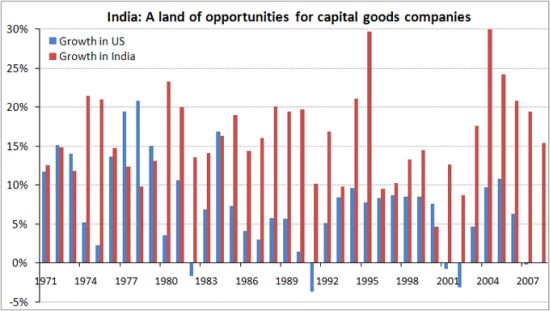
To the uninitiated, the chart below may offer some clues -
 |
| Data Source: Bureau of Economic Analysis, CMIE |
This chart pegs the yearly growth in the 'Gross fixed capital formation' (GFCF) in the US and India from 1971 onwards. Don't get frustrated if you've never heard that complicated sounding term before. It is actually nothing but the value of all kinds of fixed assets bought by people in the country in a year, minus fixed assets sold off or disposed off as scrap in that year.
In effect, it is a measure of the net amount of investments in new fixed assets by all the people and organisations in the country. This would include investments in fixed assets by households, public and private companies, and the government. And what are these fixed assets? These are any kind of capital assets that are used in the production of other goods and services that are long term in nature. Plant, machinery, buildings, construction, vehicles, equipment, land, infrastructure etc. are all examples of these.
Now, with a better perspective of what we're talking about, let's have a look at the above chart again. It represents the yearly growth in investments in fixed assets. You will notice that even though until about 1984 India and the US saw roughly similar rates of growth in investments of new fixed assets, from then onwards India has consistently seen higher growth rates, and by a huge margin too.
You may say that this is the case because the US is growing on a much larger base then India. And that would be true. But at the same time it is not just a higher level of fixed assets that is enough, it is the growth factor that brings in the best opportunities for the people of a country. For if only attaining a higher level without continuing to have further growth were good enough, then countries like the US and Japan should have been very content by now. But they're evidently not. And the reason for that is that the magic 'G' word - Growth - is missing from their lives.
But that is surely not the case with India as is evinced by the chart. And that is what is keeping the L&Ts and the BHELs of this country as excited as they are currently. For all the companies here in India, big and small, that make such capital goods, from electrical equipments to exploration rigs, from machinery to motors, and from construction equipment to cement plants, a big juicy pie in the form of future growth awaits them. And while 3-5% revenue growth may be enough to fill an American company with joy, Indian capital goods companies may continue to enjoy those dazzling 20-30% growth rates for some time to come.











 CAclubindia
