 Poojitha Raam Vinay
Overview
Income tax slabs are the income ranges on which different tax rates apply in India. The tax system is progressive - the more you earn, the higher the rate on each additional slab. For FY 2025-26 (AY 2026-27), every individual taxpayer must choose between two regimes: the New Tax Regime (default) and the Old Tax Regime (optional). The slab rates differ significantly between the two, and picking the right one can save you thousands of rupees.
Important Note: Though the Income Tax Act 2025 takes effect from 1st April 2026, the provisions of the 1961 Act apply for AY 2026-27, as it pertains to income earned up to 31st March 2026.
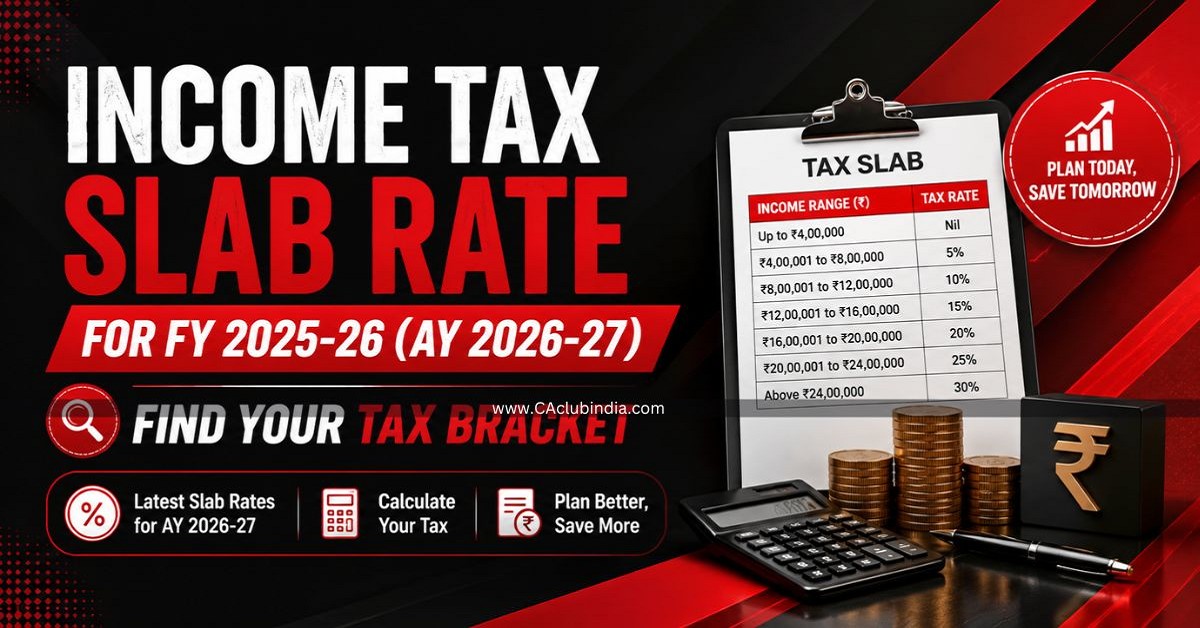
New Tax Regime - Income Tax Slabs FY 2025-26 (AY 2026-27)
The new tax regime is the default tax regime for FY 2025-26 under Section 115BAC of the Income Tax Act, 1961. It offers lower tax rates with limited deductions and a basic exemption limit of ₹4 lakh.
| Annual Taxable Income | Tax Rate |
| Up to ₹4,00,000 | NIL |
| ₹4,00,001 – ₹8,00,000 | 5% |
| ₹8,00,001 – ₹12,00,000 | 10% |
| ₹12,00,001 – ₹16,00,000 | 15% |
| ₹16,00,001 – ₹20,00,000 | 20% |
| ₹20,00,001 – ₹24,00,000 | 25% |
| Above ₹24,00,000 | 30% |
Key Benefits of the New Regime for FY 2025-26
- Taxpayers with incomes up to ₹12 lakh will get a rebate of ₹60,000 under Section 87A, effectively bringing their tax liability to zero.
- For salaried individuals, a standard deduction of ₹75,000 applies, making income up to ₹12.75 lakh tax-free after the rebate.
- The maximum surcharge under the new regime is capped at 25%, ensuring more predictable tax outgo for high-income earners.
- The new tax regime slab rates apply uniformly to all taxpayers regardless of age - individuals below 60, senior citizens (60–80 years), and super senior citizens (80+) are all taxed under the same slabs.
Note: The Section 87A rebate is available only for income charged under the normal slab rates. Special rate income like capital gains and online gaming income are not eligible for this rebate.
Old Tax Regime - Income Tax Slabs FY 2025-26 (AY 2026-27)
The old tax regime is optional. It allows over 70 exemptions and deductions - such as HRA, LTA, Section 80C, 80D, and home loan interest — making it beneficial for taxpayers with high investment and expenditure claims.
For Individuals Below 60 Years of Age
| Annual Taxable Income | Tax Rate |
| Up to ₹2,50,000 | NIL |
| ₹2,50,001 – ₹5,00,000 | 5% |
| ₹5,00,001 – ₹10,00,000 | 20% |
| Above ₹10,00,000 | 30% |
Section 87A Rebate (Old Regime): Under the old tax regime, a tax rebate of up to ₹12,500 is allowed, making taxable income up to ₹5 lakh effectively tax-free.
For Senior Citizens (60 to 80 Years) - Old Regime
The income-tax exemption limit is ₹3 lakh for senior citizens as per the old tax regime.
| Annual Taxable Income | Tax Rate |
| Up to ₹3,00,000 | NIL |
| ₹3,00,001 – ₹5,00,000 | 5% |
| ₹5,00,001 – ₹10,00,000 | 20% |
| Above ₹10,00,000 | 30% |
For Super Senior Citizens (Above 80 Years) - Old Regime
For super senior citizens aged over 80 years, the old tax regime provides a higher tax exemption limit of ₹5,00,000. Income exceeding ₹5,00,000 is taxed at 20% up to ₹10,00,000 and at 30% thereafter.
| Annual Taxable Income | Tax Rate |
| Up to ₹5,00,000 | NIL |
| ₹5,00,001 – ₹10,00,000 | 20% |
| Above ₹10,00,000 | 30% |
Also Read - ITR Forms for Senior Citizens in AY 2026-27
Surcharge Rates for FY 2025-26
A surcharge is levied on the income tax amount (not on income) for high earners.
The applicable surcharge rates for FY 2025-26 (AY 2026-27) are:
- 10% on income tax if total income exceeds ₹50 lakh but does not exceed ₹1 crore
- 15% if total income exceeds ₹1 crore but does not exceed ₹2 crore
- 25% if income exceeds ₹2 crore but does not exceed ₹5 crore.
- Under the old regime, a 37% surcharge applies for income exceeding ₹5 crore. The maximum surcharge under the new tax regime is capped at 25%, whereas the maximum surcharge payable under the old tax regime is 37%.
Health & Education Cess
- Health & Education Cess @ 4% is to be paid on the amount of income tax plus surcharge (if any) in both regimes.
New Regime vs Old Regime - Quick Comparison
| Feature | New Tax Regime | Old Tax Regime |
| Default/Optional | Default | Optional |
| Basic Exemption | ₹4 lakh | ₹2.5 lakh (below 60 yrs) |
| Standard Deduction (Salaried) | ₹75,000 | ₹50,000 |
| Section 80C Deduction | Not Available | Up to ₹1.5 lakh |
| Section 80D (Health Insurance) | Not Available | Up to ₹25,000–₹50,000 |
| HRA Exemption | Not Available | Available |
| Section 87A Rebate Limit | ₹12 lakh (rebate ₹60,000) | ₹5 lakh (rebate ₹12,500) |
| Age-based higher exemption | No | Yes (Senior/Super Senior) |
| Max Surcharge | 25% | 37% |
| NPS 80CCD(2) employer contribution | Available | Available |
How to Calculate Your Tax: Step-by-Step
- Calculate Gross Total Income from all sources (salary, house property, capital gains, business/profession, other sources)
- Apply eligible deductions - only applicable under Old Regime (80C, 80D, HRA, etc.) or allowed deductions under New Regime (Standard Deduction, 80CCD(2))
- Arrive at Net Taxable Income
- Apply the slab rates as per the regime chosen
- Check Section 87A rebate eligibility (₹12 lakh limit in new regime; ₹5 lakh in old regime)
- Add surcharge, if applicable
- Add Health & Education Cess @ 4%
- Deduct TDS/TCS/Advance Tax already paid - balance is tax payable or refund due
Also Read - Self Assessment Tax 2026: How to Pay Online?
Who Should Choose Which Regime?
New Tax Regime is typically better if:
- You have limited investments and deductions
- You are a young salaried professional just starting out
- Your deductions total less than ~₹3.75 lakh
Old Tax Regime is typically better if:
- You claim high Section 80C, 80D, HRA, and home loan deductions
- You are a senior citizen with large Section 80TTB and 80D benefits
- Your total eligible deductions exceed ~₹3.75 lakh
Deductions Available Under Old vs New Regime
| Deduction | Old Regime | New Regime |
| Standard Deduction | ₹50,000 | ₹75,000 |
| Section 80C | ₹1.5 lakh | Not Available |
| Section 80D | ₹25,000–₹1 lakh | Not Available |
| HRA | As per formula | Not Available |
| LTA | Available | Not Available |
| Home Loan Interest (Sec 24b) | ₹2 lakh (self-occ.) | Not Available |
| NPS 80CCD(1B) | ₹50,000 | Not Available |
| NPS 80CCD(2) (Employer) | Available | Available |
| Section 80TTB (Senior Citizens) | ₹50,000 | Not Available |
Special Benefits for Senior Citizens - Old Regime
Key deductions available to senior citizens under the old regime include:
- Section 80TTB: Deduction of up to ₹50,000 on interest income from savings accounts, fixed deposits, and recurring deposits
- Section 80D: Deduction of up to ₹50,000 on health insurance premiums; medical expenditure also qualifies
- Section 80C: Up to ₹1.5 lakh for PPF, tax-saving FDs, life insurance premiums, and pension schemes
- Section 80DDB: Up to ₹1 lakh for medical treatment of specified diseases.
Additionally, senior citizens do not have to pay advance tax during the year if they do not have business income - only self-assessment tax needs to be paid after computing the final tax liability
ITR Filing Due Date for FY 2025-26
- The due date to file ITR 1 and 2 for FY 2025-26 (AY 2026-27) is 31st July 2026.
- The due date to file ITR 3 and 4 for FY 2025-26 (AY 2026-27) is 31st August 2026.
Explore More - Due Date For Filing ITR AY 2026-27
Frequently Asked Questions (FAQs)
Is income up to ₹12 lakh completely tax-free in FY 2025-26?
Yes, under the new tax regime, income up to ₹12 lakh is effectively tax-free due to the Section 87A rebate of ₹60,000. For salaried individuals, after the ₹75,000 standard deduction, income up to ₹12.75 lakh is tax-free.
What is the basic exemption limit under the new and old regimes?
For FY 2025-26, the basic exemption limit under the new tax regime is ₹4 lakh and ₹2.5 lakh under the old tax regime.
Are the income tax slabs the same for men and women?
Yes. The income tax slabs and rates are identical for both male and female taxpayers.
Can NRIs choose the new tax regime?
Yes, NRIs can also opt for the new tax regime. The tax slabs for NRIs are the same with a basic exemption limit of ₹4 lakh under the new tax regime and ₹2.5 lakh under the old tax regime. However, NRIs do not enjoy basic exemption limit relaxation for senior and super senior citizens under the old tax regime, as it is only available for resident taxpayers.
Is the 87A rebate available on capital gains income?
No. The rebate is available only for income charged under the normal slab rates. Special rate income like capital gains and online gaming income are not eligible for this rebate.
Do the new regime slabs apply equally to senior citizens?
The new tax regime offers no higher tax exemption limit for senior citizens or super senior citizens. There is no separate higher exemption based on age under the new regime.
What is the last date to switch from the new regime to the old regime?
Salaried individuals without business income can switch between regimes each year at the time of filing their ITR. For taxpayers with business and professional income, they can opt out by furnishing Form 10-IEA on or before the due date under Section 139(1).
You have reached your daily limit of 2 Free Articles
Subscribe to CCI PRO for unlimited access
Why Upgrade to CCI PRO?
- No Ads
- WhatsApp Community
- Daily E-Newsletter
- Unlimited Articles Access
- Profile Visitors
- Link Social Profiles
- Featured Job Posts
- Pro Badge
- Expert GST Guidance
- Unlimited Forum Replies
- Download Content in PDF
Already a PRO member? Login here for an ad-free experience.










 CAclubindia
