
Filing your Income Tax Return (ITR) on time is not just a legal obligation but also a smart financial habit. For Financial Year (FY) 2025–26, which corresponds to Assessment Year (AY) 2026–27, taxpayers must be aware of the applicable due dates, penalties for delay, and key compliance requirements.
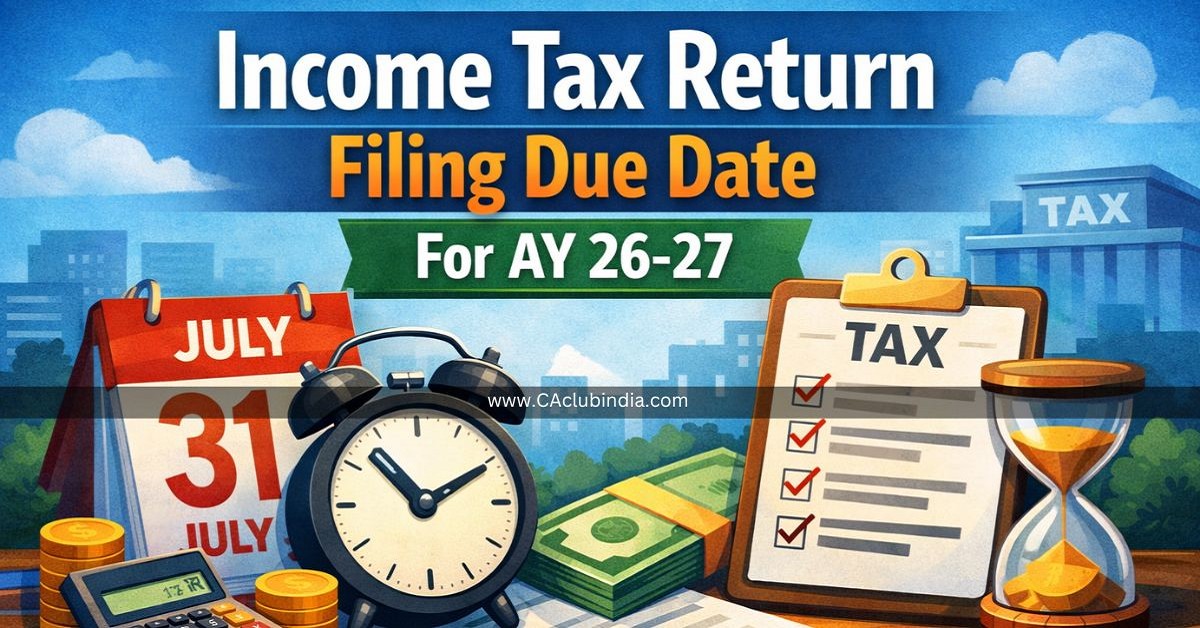
Overview: ITR Filing Due Date for AY 2026–27
The Income Tax Return filing due date depends on the category of taxpayer and whether an audit is applicable. Standard Due Dates for FY 2025–26 (AY 2026–27)
| Category of Taxpayer | Due Date |
|
Individuals, HUFs, AOPs, BOIs filing ITR-1 or ITR-2 (not requiring audit) |
31 July 2026 |
|
Assessee with PGBP income (accounts not audited under IT Act or any law), Partner of un-audited firm; Spouse of such partner (if Sec 10 applies). Filing ITR-3 or ITR-4. |
31st August 2026 |
| Businesses requiring tax audit | 31 October 2026 |
| Taxpayers with transfer pricing report (Form 3CEB) | 30 November 2026 |
Who Needs to File ITR for AY 2026–27?
You must file your Income Tax Return if:
- Your total income exceeds the basic exemption limit
- You want to claim a refund of excess TDS or advance tax
- You have foreign income or foreign assets
- You are a company or partnership firm
- You have conducted high-value financial transactions
- You wish to carry forward losses
Even if your income is below the taxable limit, filing ITR can be beneficial for loans, visas, and financial credibility.
Why Filing ITR Before the Due Date Matters?
Filing your return on or before the due date offers several benefits:
- Avoid late filing fees under Section 234F
- Faster processing of refunds
- Ability to carry forward losses
- Lower risk of scrutiny and notices
- Compliance with banking, visa, and loan requirements
- Late filing may also attract interest under Sections 234A, 234B, and 234C.
What Happens If You Miss the ITR Due Date?
If you fail to file your return by the original due date:
You can still file a belated return, but:
- Late fees may apply
- Certain losses cannot be carried forward
- Refund processing may get delayed
The belated return can be filed up to 31 December 2026 (subject to law applicable at that time).
Key Documents Required for ITR Filing AY 2026–27
- PAN and Aadhaar
- Form 16 / Form 16A
- Bank statements
- AIS & TIS
- Investment proofs (80C, 80D, etc.)
- Capital gains details (if any)
- Business or professional income details
Keeping documents ready ensures smooth and error-free filing.
FAQs
What is the ITR filing due date for individuals for AY 2026–27?
For individuals and HUFs not requiring audit, the due date is 31 July 2026.
What is the assessment year for FY 2025–26?
The assessment year corresponding to FY 2025–26 is AY 2026–27.
Is the due date same for salaried and self-employed persons?
Yes. If audit is not applicable, both salaried and self-employed individuals have the same due date—31 July 2026.
What is the due date for tax audit cases?
For taxpayers whose accounts are subject to audit, the due date is 31 October 2026.
Can the ITR due date for AY 26–27 be extended?
Yes. The government may extend the due date, but only through an official notification. Taxpayers should not assume extensions.
What is the penalty for late filing of ITR?
Late filing may attract a fee under Section 234F, depending on income level, along with interest on tax payable.
Can I file ITR after the due date?
Yes, you can file a belated return, but with penalties and restrictions on loss carry-forward.
Is it mandatory to file ITR if tax is already deducted?
Yes. If your income exceeds the exemption limit or meets specified conditions, filing ITR is mandatory—even if TDS is deducted.
Can I revise my ITR after filing?
Yes. You can file a revised return if you discover errors, within the permitted time limit.
Why should I file ITR even if my income is below taxable limit?
ITR helps in:
- Visa applications
- Loan approvals
- Claiming refunds
- Building financial history
You have reached your daily limit of 2 Free Articles
Subscribe to CCI PRO for unlimited access
Why Upgrade to CCI PRO?
- No Ads
- WhatsApp Community
- Daily E-Newsletter
- Unlimited Articles Access
- Profile Visitors
- Link Social Profiles
- Featured Job Posts
- Pro Badge
- Expert GST Guidance
- Unlimited Forum Replies
- Download Content in PDF
Already a PRO member? Login here for an ad-free experience. 07941056694










 CAclubindia
