
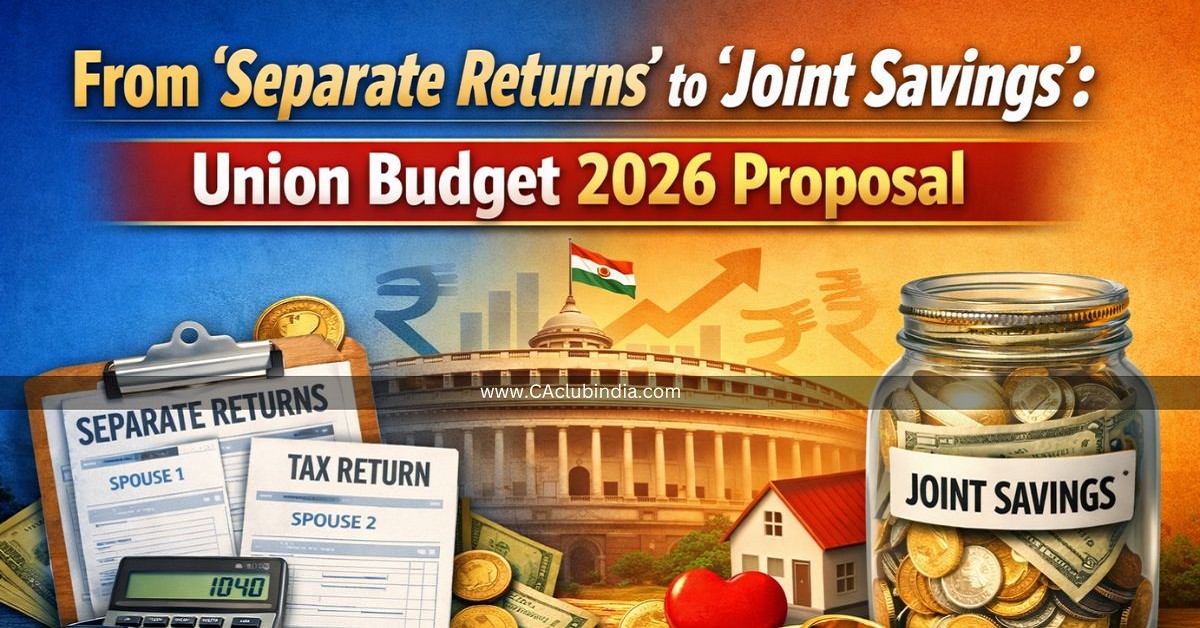
The Institute of Chartered Accountants of India (ICAI) has recommended introducing an optional joint taxation system for married couples prior to the 2026 Budget. Under this proposal, spouses with valid PAN cards could choose to combine their incomes and file a single Income Tax Return (ITR) under revised tax slabs, while still retaining the option to file separately.
The budget will recognize the household as a core economic unit. Reforms will enhance the financial benefits of marriage, simplify family taxation, and direct household savings toward productive investments to fuel national growth.
The Flagship Reform: A New, Optional "Joint Taxation Regime"
Positioned as the cornerstone of household-centric fiscal policy, this initiative transcends the current system, where joint filing confers negligible benefit.
It establishes an optional and entirely new Joint Taxation Regime for legally married couples, irrespective of personal law. The regime's architecture includes several pivotal features:
- Enhanced Basic Exemption: A consolidated exemption limit of ₹ 12.5 Lakhs is granted to the household, a significant increase from the individual limit of ₹ 3 Lakhs.
- Expanded Tax Slabs: The thresholds for all tax slabs under the new regime are doubled for joint filers. This effectively means the household's aggregate income is subject to progressive rates as if it were a single income stream benefiting from far broader brackets.
- Inter-Spousal Loss Set-Off: Complete portability of specified losses (from house property and business) is permitted, allowing spouses to optimize their combined tax liability.
- Streamlined Compliance: The requirement to file a single return with a unified set of deductions represents a major reduction in administrative complexity.
Supercharging Savings: Joint Financial Instruments
The budget proposes several financial instruments to strengthen household security:
- "Suraksha Sanchay" Account: A new, tiered joint savings account for spouses. For monthly deposits up to a specified limit (e.g., ₹ 1,000), the government will provide an annual co-contribution (e.g., ₹ 100). This is designed to build a dedicated emergency or medical fund.
- Enhanced Deduction for Joint Policies: An additional deduction of ₹ 25,000 under Section 80C for premiums paid on joint-life insurance or health policies.
- Higher Deposit Limits for Senior Couples: Increased investment ceilings in schemes like the Senior Citizen Savings Scheme (SCSS) for accounts jointly held by a senior citizen couple.
Housing & Homeownership: The Family Nest
To accelerate family formation and asset creation, the budget introduces two key incentives for couples:
- Boost for Joint Home Loans: An extra deduction of ₹ 50,000 on interest paid during the first five years of a first joint home loan. This benefit is in addition to the existing limit under Section 24(b).
- Tax Relief on Joint Property Transfer: Capital gains tax will be exempted when transferring a residential property between spouses, or into joint ownership, provided the sale proceeds are reinvested in another joint property within a defined period.
Women & Caregiver Empowerment
The "Griha Lakshmi" scheme includes two core components:
- A monthly DBT of ₹1,000 to the primary (preferably female) account of eligible households where one spouse is a documented homemaker/caregiver (income criteria apply), thereby recognizing unpaid care work.
- The automatic enrollment of a newborn girl child in such households into the Sukanya Samriddhi Yojana, supported by an initial seed capital deposit.
Long-Term Security & Pension
To strengthen retirement security for couples, the budget proposes:
- "Partner's Pension" Protection: A 50% top-up to the surviving spouse’s own pension/annuity (from NPS/PPF) if their partner, particularly a homemaker without an independent pension, passes away. This benefit, subject to limits, would be funded via a small voluntary premium or a sovereign fund.
- Joint NPS Tier-II Accounts: Introduction of joint NPS Tier-II accounts with special tax advantages to promote combined retirement savings.
Supporting Fertility & Childcare Costs
The budget reinforces support for families through fiscal benefits and enhanced welfare:
- Childcare Expense Deduction: A new, standalone deduction of ₹75,000 per child annually (for up to two children) will be introduced. This deduction is specifically for documented childcare, education, and health expenses and is exclusively available to couples opting for the Joint Taxation Regime.
- Expansion of Maternal and Child Nutrition: Allocations for the POSHAN Abhiyaan and the Anganwadi system will be substantially increased. This expansion is strategically linked to the broader "Joint Savings" policy ecosystem, creating a cohesive support structure for family welfare.
Revenue Implications & Fiscal Strategy
The fiscal cost of the proposed tax concessions and direct benefit transfers is recognized. However, this expenditure is positioned not as a cost, but as a strategic investment in longterm social stability and human capital development. This investment will be funded through a multi-pronged approach:
- Rationalization of Subsidies: Continued efficiency gains from Direct Benefit Transfers (DBT) will enable the phased withdrawal of older, regressive subsidies.
- Broadened Tax Base: Medium-term financialization of household savings is expected to expand the overall tax base.
- "Prosperity Surcharge": A modest levy on ultra-high-net-worth individuals (with annual income exceeding ₹5 crore) will specifically fund the "Suraksha Sanchay" cocontribution.
- Increased GST Revenue: Higher disposable income within the household sector is anticipated to boost consumption and, consequently, Goods and Services Tax (GST) collections.
Conclusion: A Budget for "We" over "Me"
The Union Budget 2026, anchored in the theme "From Separate Returns to Joint Savings," represents a visionary and socially-aware economic strategy. It transcends the traditional view of the tax code as a mere revenue instrument, repurposing it to fortify society's core institution, the family. By doing so, it concurrently mobilizes domestic savings for national development, aligning economic policy with social objectives to foster a synergistic outcome for household welfare and the national economy.
FAQs
What is the core idea of the "Joint Taxation" proposal?
The proposal suggests giving married couples the option to file a single, consolidated Income Tax Return (ITR). Instead of being taxed as two independent individuals, their total household income would be combined and taxed under a specialized slab structure designed for couples.
Is this mandatory?
No. A key feature of the proposal is that it is optional. Couples can choose to file jointly only if it results in lower tax liability. If filing separately remains more beneficial (common for dual-income households in high tax brackets), they can continue with the current system.
How would the tax slabs change for joint filers?
While the government has not yet finalized rates, the ICAI and tax experts have proposed illustrative slabs:
- Up to ₹6–8 Lakh: Nil tax (effectively doubling the individual exemption).
- ₹8–16 Lakh: 5% tax.
- ₹16–24 Lakh: 10% tax.
- Progressive slabs up to 30% for higher income brackets.
Who benefits the most from this proposal?
- Single-Earner Households: Households where only one spouse works would see a massive drop in tax, as they can utilize the higher "joint" exemption limit.
- Couples with High Income Disparity: If one spouse earns ₹25 lakh and the other earns ₹3 lakh, pooling the income can pull the higher earner out of the top 30% tax bracket.









 CAclubindia
