
Overview
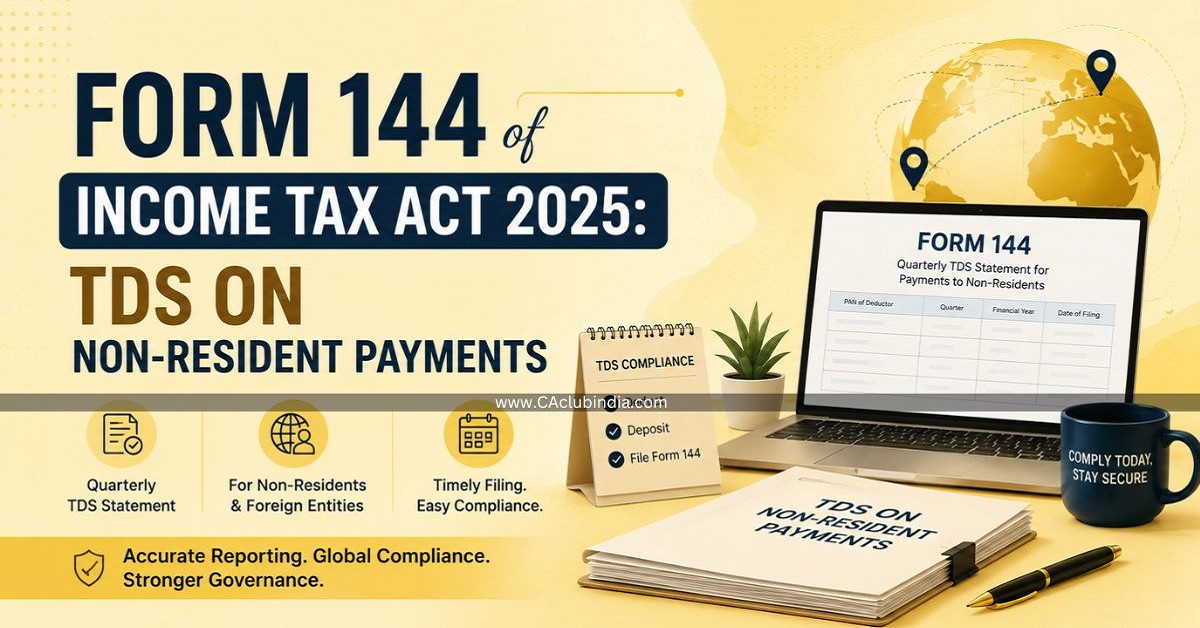
Under the Income-tax Act, 2025 (the new direct tax code), Form No. 144 is the prescribed quarterly statement for reporting Tax Deducted at Source (TDS) on non-salary payments made to nonresidents, which includes NRIs and foreign companies. In the context of the previous regime (Income Tax Rules, 1962), this form serves as the replacement for the erstwhile Form 27Q. Its filing is mandated under Section 397(3)(b) of the new Act and is governed by Rule 219 of the Income-tax Rules, 2026.
Key Features of Form 144
- Scope: The form is designed to capture cross-border or foreign remittances on which tax has been withheld. This covers payments such as interest, dividends, royalties, fees for technical services (FTS), professional fees, contract payments, and capital gains (e.g., purchase of property from an NRI).
- No Threshold Limit: Unlike domestic payments, foreign remittances generally do not benefit from any minimum exemption threshold. Consequently, even small-value payments that attract TDS must be deducted and reported in this form.
- DTAA Compliance: Where a lower rate of deduction is claimed under a Double Taxation Avoidance Agreement (DTAA), the relevant treaty benefits—along with supporting documents such as Tax Residency Certificates (TRC) or Form 10F details—must be explicitly mapped in the annexure to this form.
- System-Friendly Streamlining: The revised 2025 format has been redesigned for improved e-filing automation, with personal details (Name, Designation, PAN, Address) placed in separate, distinct fields. Additionally, the older term "Assessment Year" has been replaced with "Tax Year" to align with the new framework.
Who is required to file Form 144?
Every person responsible for deducting TDS on payments (other than salary) to a non-resident, including companies, firms, partnerships, government bodies, and individuals.
What is generated after filing Form 144?
Based on Form No. 144 data, TRACES generates Form 131 (earlier Form 16A) as the TDS certificate for non-salary payments.
Where is the deducted TDS reflected?
The deducted TDS appears in the deductee's Form 168 and Annual Information Statement (AIS).
Form Structure & Requirements
The statement follows a consolidated layout designed to enable seamless integration with the tax portal. It is divided into the following sections:
- Part A (Deductor Details): This section captures the dedutor's entity or individual particulars, including TAN, PAN, and the details of the person responsible for making the tax deduction.
- Part B (Challan Details): This part contains information relating to the tax already deposited with the government, such as the BSR code, date of deposit, challan serial number, and the total amounts of tax, interest, and fees paid.
- Annexure (Deductee-wise Breakup): This is a line-by-line breakdown of each non-resident recipient. It requires the deductor to furnish details such as the recipient's name, PAN or foreign Tax Identification Number (TIN), country of residence, transaction amount and date, the applicable section code, and specific reason codes where a lower or nil rate of tax has been applied.
Due Dates for Filing (Quarterly)
Form 144 must be compiled and uploaded electronically through the income tax e-filing utilities, matching these strict quarterly deadlines:
| Quarter Period | Due Date for Filing |
| Q1: April - June | 31st July of the relevant Tax Year |
| Q2: July - September | 31st October of the relevant Tax Year |
| Q3: October - December | 31st January of the relevant Tax Year |
| Q4: January - March | 31st May of the immediately following Tax Year |
Also Read - TDS Return Due Date For FY 2026-27
Non-Compliance Repercussions
Critical Note on Late Filings: Delaying the filing beyond the prescribed due date invites an automatic late fee under Section 427, levied at ₹200 per day until the statement is submitted - subject to a ceiling equivalent to the total TDS amount for that return. In addition, failure to file or submission of inaccurate information may result in substantial penalties, ranging from ₹10,000 to ₹1,00,000.
Furthermore, if the non-resident recipient fails to provide a valid PAN and no alternative foreign residency documentation is furnished, the statutory higher deduction rate (typically 20%) becomes applicable under Section 397(2).
FAQs
1. Does Form 144 completely replace Form 27Q?
Yes. Form 144 is the direct successor to the old Form 27Q from the 1962 rules. If you are reporting non-salary withholding tax for an NRI, a foreign company, or any other non-resident entity for transactions occurring under the new Act, you must file Form 144.
2. Is there a minimum threshold limit for deducting TDS and filing Form 144?
Generally, no. Unlike domestic payments (which have specific thresholds like ₹30,000 or ₹50,000 before TDS kicks in), payments made to non-residents under Section 195 are subject to withholding tax from the very first rupee. If a payment is taxable in India, you must deduct tax and report it on Form 144 regardless of the transaction size.
3. Can I modify Form 144 after it has been submitted?
Not directly. Once submitted on the e-filing or TRACES portal, a Form 144 filing cannot be edited. However, if you made a mistake (e.g., wrong PAN, incorrect challan mapping, or typo in the payment amount), you can file a Correction Statement once the Central Processing Cell (CPC-TDS) finishes processing your original return.
4. What is the time limit for filing a Correction Statement?
You can file a correction statement for Form 144 within two years from the end of the specific tax year in which the original statement was required to be delivered.
5. If I apply a lower tax rate using a DTAA treaty, do I still use Form 144?
Yes. Even if you are applying a beneficial tax rate under a Double Taxation Avoidance Agreement (DTAA) rather than the standard domestic rate, the transaction must be reported in Form 144. In the deductee annexure, you are required to select a specific flag indicating that a treaty rate was applied and maintain the non-resident's Tax Residency Certificate (TRC) and Form 10F in your records.
6. What happens if a non-resident does not have an Indian PAN?
If the non-resident fails to provide a valid PAN, statutory rules under Section 397(2) normally trigger a higher withholding rate (typically 20%). However, you can avoid this higher rate if you collect and report alternative tracking data in the form, such as their foreign Tax Identification Number (TIN), country of residence, email, contact number, and address.











 CAclubindia
