
Introduction -
Meaning:-
Consign means to "send". In Accounting, the term "consignment account" relates to accounts dealing with a situation where one person (or a firm) sends goods to another person (or a firm) on the basis that the goods will be sold on behalf of and at the risk of the former. The following should be noted carefully:-
• Party which sends the goods (consignor) is called the principal.
• Party to whom goods are sent (consignee) is called the agent.
• Ownership of the goods, i.e., the property in the goods, remains with the consignor or the principal; the agent or the consignee does not become their owner even though goods are in his possession. On sale, of course, the buyer will become the owner.

• Consignor does not send an invoice to the consignee. He sends only a "Proforma Invoice", a statement that looks like an invoice but is really not one. The object of the proforma invoice is only to convey information to the consignee regarding particulars of the goods sent.
• Usually, the consignee recovers from the consignor all expenses incurred by him on the consignment. This however can be changed by agreement between the two parties.
• It is also usual for the consignee to give an advance to the consignor in the form of cash or a bill of exchange. It is adjusted against the sale proceeds of the goods.
• For his work, the consignee receives a commission calculated on the basis of the gross sale. For ordinary commission, the consignee is not responsible for any bad debt that may arise. If the agent is to be made responsible for bad debts, he is to be paid a commission called del-credere commission. It is calculated on total sales, not merely on credit sales until and unless agreed.
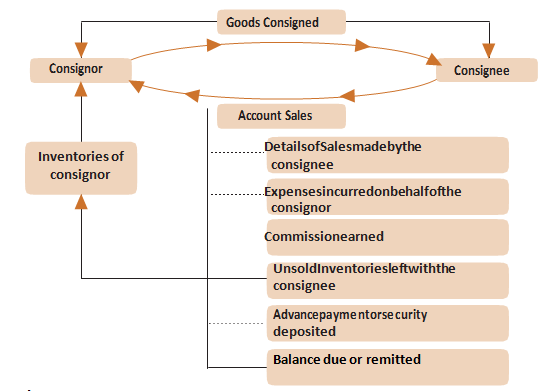
• Periodically, the consignee’s ends to the consignor a statement called Account Sales. It sets out the sales made by the consignee, the expenses incurred on behalf of the consignor, the commission earned by the consignee, and the balance due to the consignor.
• Firms usually like to ascertain the profit or loss on each consignment or consignments to each consignee.
Consignment Account relates to accounts dealing with such business where one person sends goods to another person on the basis that such goods will be sold on behalf of and at the risk of the former.
Accounting Entries - When goods are sent to the consignee
Consignment A/c ........Dr
To Goods Sent on Consignment A/c
(Being Goods Sent on Consignment)
Commission:-
The commission is the remuneration paid by the consignor to the consignee for the services rendered to the former for selling the consigned goods. Three types of commission can be provided by the consignor to the consignee, as per the agreement, either simultaneously or in isolation.
Accounting Entries - Commission to Consignee
Consigner A/c ........Dr
To Commission A/c
(Being Commission earned)
Types of Commission:-
1) Ordinary Commission
The term commission simply denotes ordinary commission. It is based on a fixed percentage of the gross sales proceeds made by the consignee. It is given by the consignor regardless of whether the consignee is making credit sales or not. This type of commission does not give any protection to the consignor from bad debts and is provided on total sales.
2) Del-credere Commission
To increase the sale and to encourage the consignee to make credit sales, the consignor provides an additional commission generally known as del-credere commission. This additional commission when provided to the consignee gives protection to the consignor against bad debts. In other words, after providing the del-credere commission, bad debts are no more the loss of the consignor. It is calculated on total sales unless there is an agreement between the consignor and the consignee to provide it on credit sales only.
3) Over-riding Commission
It is an extra commission allowed by the consignor to the consignee to promote sales at a higher price than specified or to encourage the consignee to put hard work into introducing a new product in the market. Depending on the agreement it is calculated on total sales or on the difference between actual sales and sales at invoice price or any specified price. In order to encourage the consignee to earn higher margins, it can also be in the form of a share of additional profits made by the consignee on the sale of goods.
Account Sales:-
An account sale is the periodical summary statement sent by the consignee to the consignor. It contains details regarding:-
- Sales made,
- Expenses incurred on behalf of the consignor,
- Commission earned,
- Unsold inventories left with the consignee,
- Advance payment or security deposited with the consignor and the extent to which it has been adjusted,
- Balance payment due or remitted.
It is a summary statement and is different from the Sales Account.










 CAclubindia