
If you're a Chartered Accountant, you've probably had this thought at least once in the past year:
Is AI going to replace my work?
I remember a client proudly telling me, Sir, ChatGPT can prepare my financial summary in 30 seconds. Why do I need a CA now?
I smiled, but inside I was thinking, Is this the beginning of something big?
Yes, it was. AI has entered accounting, finance, taxation, audit, compliance, and advisory work at full speed.
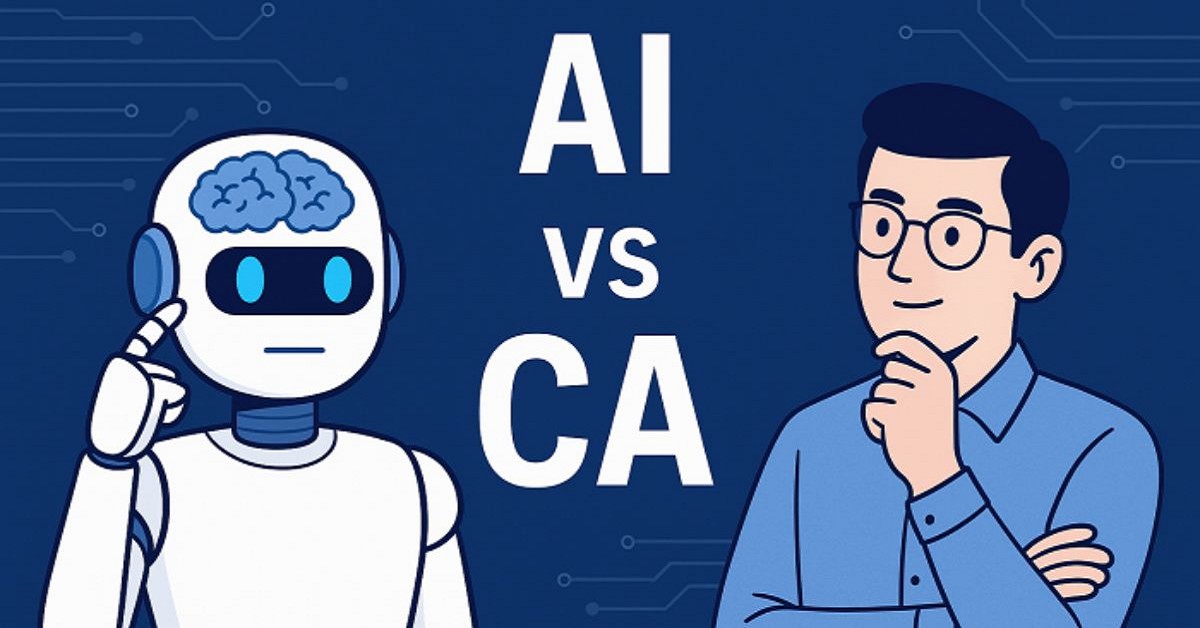
But here's the truth no one says openly, AI is powerful, but it doesn't eliminate Chartered Accountants, it eliminates inefficiency.
This blog explains the real relationship between AI and humans, especially for professionals working in numbers, laws, and judgment-heavy fields like ours.
What Is Artificial Intelligence?
Artificial Intelligence (AI) refers to systems that can perform tasks that normally require human thinking, such as analysing data, solving problems, understanding text, or making predictions.
In accounting and finance, AI shows up in tools like:
- Automated bookkeeping
- GST reconciliation software
- OCR-based invoice extraction
- Predictive analytics
- Chatbots for queries
- AI-powered audit tools
- Excel + AI functions
- Fraud risk detection systems
AI doesn't "think" like humans, it recognizes patterns from massive amounts of past data.
For example:
- AI sees thousands of invoices → learns their structure → extracts data automatically.
- AI reads financial statements → highlights anomalies → flags potential risks.
It's super-fast, extremely efficient, and consistent. But it still depends on the quality of input and rules you give it.
Advantages of AI for Chartered Accountants
AI brings several real, practical benefits to the accounting industry:
- Faster data processing: GST returns, reconciliations, ledger checks, and financial summaries can be completed in seconds.
- Reduced manual errors: AI systems are consistent, they don't get tired, distracted, or confused by big data sets.
- Saves time on routine work: Bookkeeping, voucher matching, invoice extraction, and report generation become automated.
- Better financial analysis: AI can analyse multiple years of data instantly and spot trends humans may miss.
- Helps in forecasting: Cashflow predictions, budget planning, and risk analysis become smarter with AI-based models.
- Improves client servicing: Chatbots and AI assistants can answer basic queries 24/7.
- Cost-effective for firms: Automation reduces repetitive workload and lets CA teams focus on high-value tasks.
- Enhances productivity: Tools like Excel AI, Power BI AI visuals, and accounting software with AI features help teams work faster.
AI doesn't replace CAs, it gives them more power and speed.
Limitations of AI
Despite the hype, AI has serious limitations:
- No understanding of context: AI can read numbers, but cannot understand why something happened financially.
- Cannot interpret legal nuances: AI can't apply judgment in complex Income Tax or GST situations.
- Risk of incorrect or "hallucinated" answers: AI sometimes gives confident but wrong responses.
- Depends on clean data: Poor-quality data, poor-quality results.
- Cannot replace professional ethics: AI doesn't know fairness, compliance, or responsibility.
- Lacks accountability: In audits, only a human can take responsibility - not a machine.
- Privacy concerns: Uploading confidential documents to open AI tools is risky.
- No emotional intelligence: AI cannot understand client relationships, trust, or sensitive situations.
These limitations show why CAs remain essential.
Challenges Posed by AI to Humans
AI doesn't attack jobs, it challenges the old way of working. Here's what professionals must be aware of:
1. Routine work is disappearing: Basic tasks like data entry, invoice matching, standard reporting are becoming automated.
2. Skill gap: People who don't learn AI tools fall behind those who do.
3. Increased client expectations: Clients expect speed and accuracy - Why can't you do it instantly? AI can.
4. Pressure to stay updated: AI evolves quickly, professionals must continuously learn.
5. Competition increases: Younger CAs using AI tools deliver faster results at lower costs.
6. Risk of misuse
- If someone blindly trusts AI, mistakes can damage credibility.
- AI challenges humans to upgrade, not surrender.
Economic Implications: Job Market After AI
Jobs are declining
Roles heavy on repetitive tasks like:
- Data entry operators
- Basic accountants
- Manual reconcilers
- Invoice processors
Jobs that will grow
Roles that require judgement, interpretation, and decision-making:
- Financial advisors
- Tax consultants
- Audit professionals
- Forensic accountants
- Management accountants
- AI-enabled accountants
- Data-driven finance analysts
AI will not replace Chartered Accountants; it will replace:
- Slow CAs
- outdated CAs
- CAs who don't evolve
AI will reward:
- CAs who use technology
- CAs who guide businesses with insights
- CAs who provide strategic and advisory services
AI shifts accounting from "data-handling" to decision-making.
How can we collaborate with AI?
1. Let AI handle repetitive tasks
Bookkeeping → automatedGST reconciliation → automatedDocument extraction → automatedReport generation → automated
This frees up time for higher-value work.
2. Use AI as an assistant, not a replacement
AI drafts → human reviewsAI analyses → human interpretsAI predicts → human validates
3. Use AI tools inside your existing workflows
- Excel AI formulas
- Power BI AI visuals
- Tally + automation
- Accounting software with AI features
- AI chat assistants for quick queries
4. Upskill continuously
Learning AI basics increases your value instantly.
5. Maintain human judgment
AI cannot understand:
- law interpretation
- grey areas
- exceptions
- client emotions
- ethical boundaries
This is where CAs remain irreplaceable.
6. Use AI to improve client service
Deliver faster insights, monthly dashboards, tax summaries, and automated reminders.
Key Takeaways
- AI is powerful but not independent, it still needs guidance.
- It handles repetitive work well but fails in judgement-heavy scenarios.
- Chartered Accountants who use AI will outperform those who don't.
- AI changes the job market but also creates new opportunities.
- The future is AI + Human Accountability, not AI vs Human.
- Collaboration with AI leads to faster, smarter, and more accurate financial work.
Final Thoughts
AI isn't your competitor, it's your assistant.
The only real competition is between:
- professionals who adopt AI
- professionals who ignore it
As a Chartered Accountant, your expertise, judgement, ethics, and decision-making ability cannot be replaced by any machine.
AI can calculate. AI can summarize. AI can automate. But AI cannot understand human business problems, apply law interpretation, or build trust.
Use AI as a tool. Use your experience as the foundation. Together, they make you unstoppable.
FAQs
1. Will AI replace Chartered Accountants?
No. AI replaces repetitive tasks, not professional judgement or legal interpretation.
2. Is AI accurate enough for tax or audit work?
AI can assist, but final decisions must always be reviewed by a qualified CA.
3. What skills should CAs learn to stay relevant?
AI tools, automation basics, data analytics, Excel AI, and business advisory skills.
4. Can I upload client data into AI tools?
Only in secure, private AI platforms. Avoid sharing sensitive data in public tools.
5. What tasks should I automate first?
Reconciliation, bookkeeping, report drafting, analytics, and invoice processing.
6. Should small CA firms adopt AI?
Yes. AI reduces workload, cuts costs, and improves client service, especially for small teams.
You have reached your daily limit of 2 Free Articles
Subscribe to CCI PRO for unlimited access
Why Upgrade to CCI PRO?
- No Ads
- WhatsApp Community
- Daily E-Newsletter
- Unlimited Articles Access
- Profile Visitors
- Link Social Profiles
- Featured Job Posts
- Pro Badge
- Expert GST Guidance
- Unlimited Forum Replies
- Download Content in PDF
Already a PRO member? Login here for an ad-free experience. 07941056694









 CAclubindia
