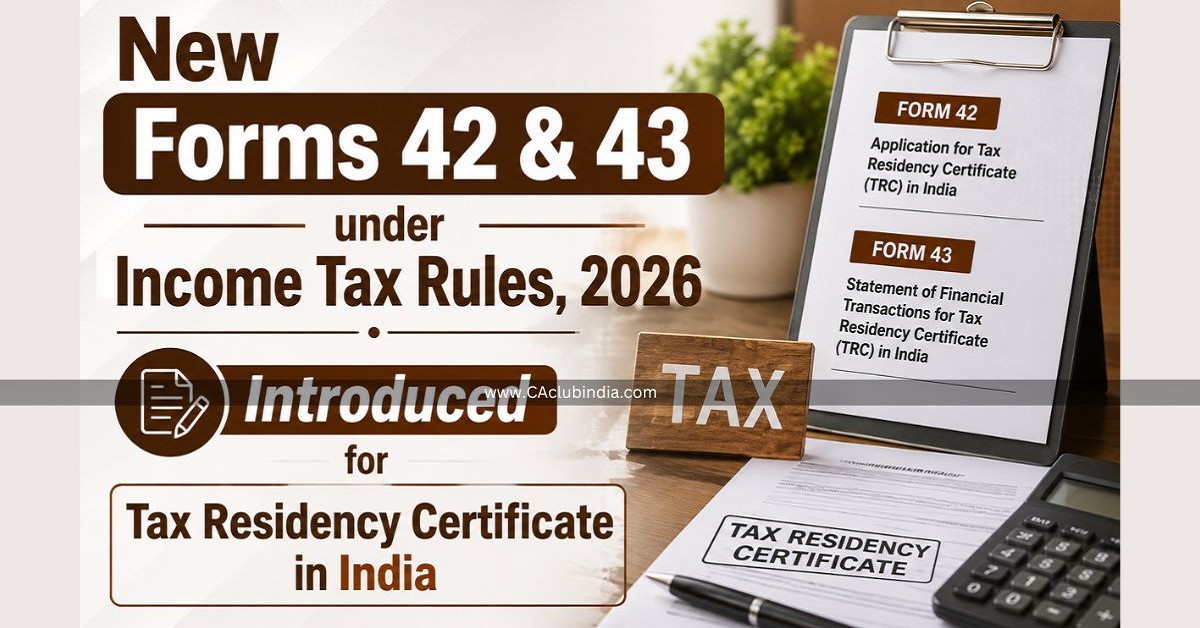
The Income Tax Department has streamlined the process for obtaining a Tax Residency Certificate (TRC) by introducing new Form 42 and Form 43 under the Income Tax Rules, 2026. The new system replaces the earlier Form 10FA and Form 10FB, making the process more structured and digital-friendly.
The update is particularly important for resident taxpayers who need a Tax Residency Certificate to claim benefits under a Double Taxation Avoidance Agreement (DTAA) or to meet tax-related requirements in foreign countries. A TRC serves as proof that a taxpayer is a resident of India for tax purposes.
What Has Changed?
Under the revised framework, resident taxpayers can now apply online for a TRC through Form 42 on the Income Tax e-filing portal . Once the application is processed, the department will issue the certificate digitally in Form 43, replacing the earlier certificate format. The issued TRC will also be available for download directly from the e-filing portal, reducing paperwork and delays.
One of the biggest improvements in the new process is that supporting documents now need to be uploaded at the time of application itself, allowing quicker verification and processing by the Assessing Officer.
Who Needs to File Form 42?
Any resident taxpayer in India who wants to claim tax treaty benefits abroad or is required to furnish proof of Indian tax residency in another country may file Form 42. This applies to salaried individuals working overseas, businesses with cross-border transactions, freelancers receiving foreign income and others dealing with international tax obligations.
How to Apply for a TRC?
The process has been kept fairly straightforward. Taxpayers need to log in to the Income Tax e-filing portal using their PAN, choose the relevant tax year and submit Form 42 by specifying the period for which the TRC is required. Since TRCs are issued tax-year-wise, taxpayers requiring a certificate for a period spanning multiple tax years will need to file separate applications for each year.
Applicants are also required to upload supporting documents such as a passport or proof of stay in the case of individuals, while non-individual entities must provide incorporation or registration certificates along with any additional relevant information.
No Deadline, But Apply When Needed
Interestingly, there is no fixed due date for filing Form 42 . Taxpayers can apply as per their requirement, although only one application can be filed for a tax year. This flexibility is expected to benefit individuals and businesses dealing with international tax compliance on a case-by-case basis.
For taxpayers navigating overseas income, foreign investments or DTAA claims, the simplified TRC process could mean fewer procedural hurdles and faster access to residency certificates.













 CAclubindia