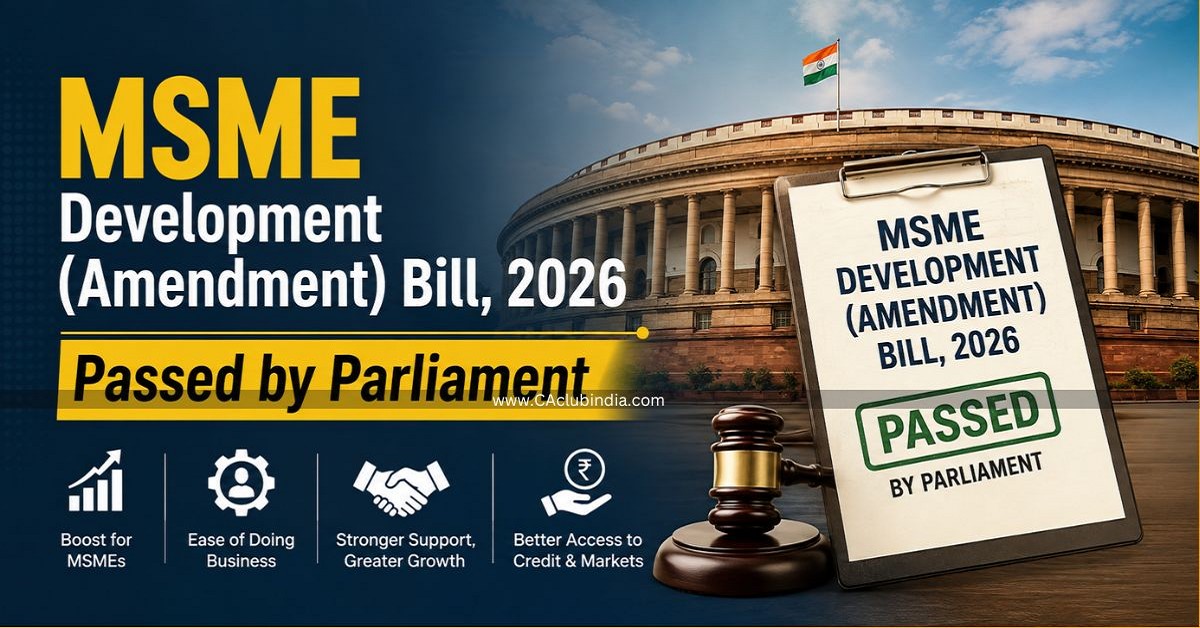
The Parliament has passed the MSME Development (Amendment) Bill, 2026. The new law seeks to modernize the two-decade-old MSMED Act, 2006 and address key challenges faced by small businesses, particularly in areas such as registration, compliance, payments and dispute resolution.
The amendments come at a time when MSMEs have emerged as a critical pillar of the Indian economy, contributing significantly to GDP, manufacturing output and exports.
Why the Amendment Was Needed
The MSMED Act was enacted in 2006 when India's MSME landscape was vastly different. Over the years, digitalization, e-commerce, formalization of businesses and technology-driven operations have transformed the sector.
According to the Economic Survey 2025-26, MSMEs contribute 31.1% of India's GDP, 35.4% of manufacturing output, and 48.58% of exports. More than 9.16 crore MSMEs are registered on the Udyam platform, generating employment for over 40 crore people.
Recognizing this growing economic importance, the government has updated the legal framework to better support MSME growth and competitiveness.
Key Changes Introduced in the MSME Amendment Bill, 2026
1. New Basis for MSME Classification
One of the most important changes relates to how MSMEs will be classified.
Under the earlier law, classification depended on investment limits in plant, machinery or equipment, with separate treatment for manufacturing and service enterprises.
The amended law simplifies the framework by classifying MSMEs based on:
- Investment in plant and machinery or equipment
- Annual turnover
This approach aligns with the current MSME classification system already being used for policy implementation and Udyam Registration.
2. Easier and Free Registration for All MSMEs
The Bill makes MSME registration simpler and more accessible.
Key changes include:
- Registration will be free of cost.
- Filing will remain voluntary.
- A national digital platform will be notified by the Central Government.
- State Governments may also create their own digital registration platforms.
- State-level scheme benefits can be linked with registration on these platforms.
The move is expected to encourage more enterprises to join the formal economy and avail government benefits.
3. Focus on Faster Dispute Resolution
Delayed payments continue to be one of the biggest concerns for small businesses. The amendments aim to strengthen mechanisms for resolving payment disputes and reducing delays.
The government has indicated that the revised framework seeks to make dispute resolution more time-bound while reducing payment-related constraints faced by MSMEs.
4. Simplified Compliance Framework
The Bill also focuses on reducing compliance burdens and improving ease of doing business for entrepreneurs.
By leveraging digital platforms and streamlining procedures, the legislation aims to allow MSMEs to spend less time on paperwork and more time on business growth.
What This Means for MSMEs
The new law is expected to:
- Improve access to government schemes.
- Encourage formal registration of businesses.
- Reduce compliance-related hurdles.
- Strengthen payment recovery mechanisms.
- Support business expansion and competitiveness.
- Promote ease of doing business across India.
For startups, small manufacturers, traders and service providers, the changes could result in a more business-friendly regulatory environment.
Looking Ahead
With Parliament approving the MSME Development (Amendment) Bill, 2026, the government has taken another step towards building a stronger support system for India's small businesses. As MSMEs continue to drive employment, exports and economic growth, the updated legal framework is expected to help the sector adapt to the demands of a rapidly evolving economy.
Key Highlights
- Parliament passes the MSME Development (Amendment) Bill, 2026.
- MSME classification to be based on investment and turnover.
- MSME registration to be free and voluntary.
- National and state digital platforms to support registration.
- Focus on faster dispute resolution and reduced payment delays.
- Reforms aimed at improving ease of doing business for MSMEs.
Source: Click Here











 CAclubindia