Union Finance Minister Nirmala Sitharaman has indicated that the government is open to hearing stakeholders' views on the possible removal of Long-Term Capital Gains (LTCG) tax on equities. Her remarks have brought equity taxation back into focus as investors seek changes to India's tax framework ahead of the Union Budget 2027-28.
Speaking at the Bloomberg New Economy Forum in New Delhi on October 13, Sitharaman acknowledged that both domestic and foreign investors have been raising concerns about LTCG tax, Securities Transaction Tax (STT), and the taxation of different asset classes.
The Finance Minister described the ongoing discussions as healthy and said she would keenly listen to the views being presented. However, she refrained from indicating whether the government would abolish or reduce the existing LTCG tax, noting that preparations for the upcoming Budget had already begun.
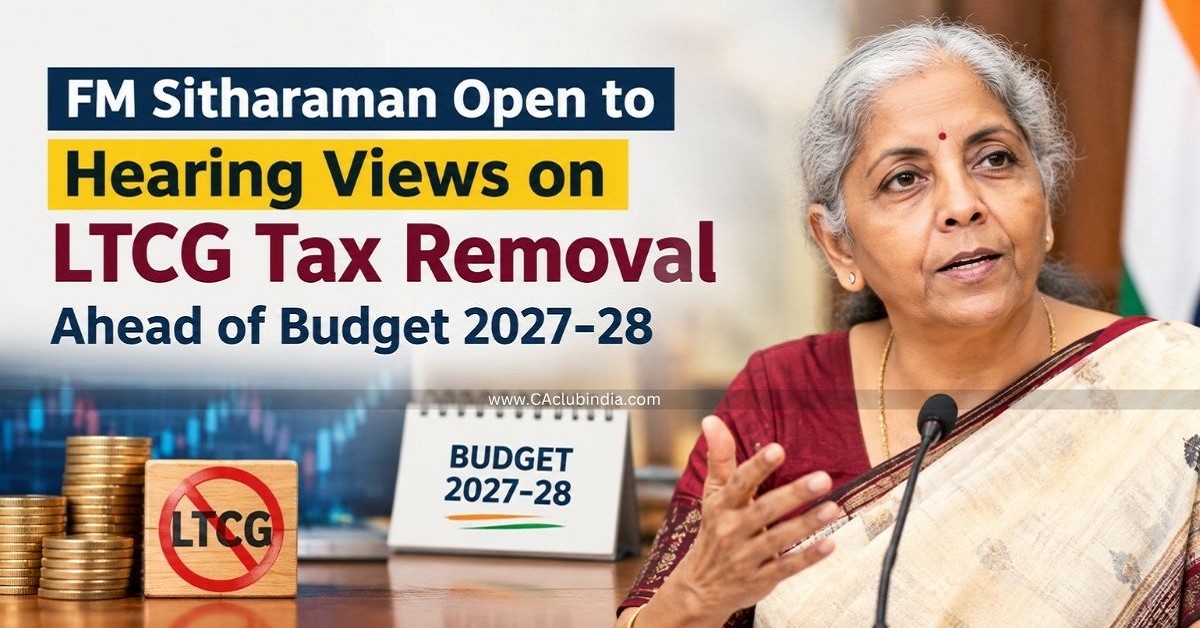
LTCG Tax Removal: What Has the Finance Minister Said?
The possibility of removing LTCG tax on equity investments has become an important topic of discussion among market participants. Investors have been questioning whether the existing tax structure affects investment decisions and the attractiveness of Indian equity markets.
FM Sitharaman acknowledged that the issue has been raised by investors both within India and overseas. She also highlighted the broader debate around STT and whether different asset classes should be taxed on similar lines.
Her comments suggest that the government is willing to hear stakeholders' concerns. However, there has been no official announcement confirming the removal or reduction of LTCG tax.
Current LTCG Tax Rules on Listed Equity Investments
Under the capital gains tax regime introduced in the Union Budget 2024-25, the tax rates on specified equity investments were revised with effect from July 23, 2024.
The current provisions generally include:
- Long-Term Capital Gains (LTCG): Gains from qualifying listed equity shares, equity-oriented mutual funds and business trusts are taxed at 12.5% where the applicable conditions are satisfied.
- Annual exemption limit: Eligible LTCG on these investments is exempt up to ₹1.25 lakh in a financial year.
- Short-Term Capital Gains (STCG): Gains from specified assets transferred within the prescribed short-term holding period are generally taxed at 20%, subject to applicable conditions.
- Securities Transaction Tax (STT): STT continues to apply to specified securities transactions under the applicable rules.
Any proposal to remove LTCG tax would require the government to consider its impact on investor returns, market participation and tax revenues.
Why Are Investors Seeking LTCG Tax Relief?
Investors and market participants have renewed calls for a review of equity taxation, including the combined impact of LTCG tax and STT on securities investments.
Some stakeholders believe that reducing the tax burden could improve the attractiveness of Indian equities, encourage longer-term investments and help strengthen foreign investor participation.
The debate has gained importance amid concerns about foreign portfolio investor outflows and volatility in the domestic stock market. Market participants are also examining whether India's tax structure remains competitive with other investment destinations.
SBI Research has also advocated measures to encourage longer-term equity investment, including the removal of LTCG tax on equities and changes to the holding-period framework.
However, the removal of LTCG tax could have significant revenue implications for the government. Capital gains taxation has become an important source of tax collections, making any proposed change a matter of balancing investor interests with fiscal considerations.
LTCG Tax and STT: Will the Government Review Both?
Alongside LTCG tax, the treatment of STT remains another issue under discussion. Unlike capital gains tax, which applies to taxable profits from the transfer of assets, STT is levied on specified securities transactions.
Market participants have questioned whether both levies should continue to apply to equity investments and whether the tax treatment of different asset classes should be made more consistent.
The Finance Minister's remarks indicate that these questions remain part of the wider discussion on India's taxation framework. Nevertheless, no specific changes to STT or capital gains tax have been confirmed.
Stock Market Reacts to Sitharaman's Remarks
The Finance Minister's comments lifted investor sentiment on October 13, 2026. The BSE Sensex surged by approximately 1,109 points, while the Nifty 50 closed above the 22,700 mark.
The market reaction reflected optimism around the possibility of a future review of equity taxation. However, the rally should not be interpreted as confirmation that LTCG tax relief will be announced in the next Budget.
What Should Investors Expect Ahead of Budget 2027-28?
With preparations for the Union Budget 2027-28 underway, LTCG tax, STT and the broader treatment of investment income could remain key subjects of discussion.
Investors will be watching for further developments, particularly any official proposals relating to capital gains tax rates, exemption limits or securities transaction charges.
For now, the Finance Minister's statement signals a willingness to listen to stakeholders rather than a confirmed change in policy. Investors should continue to follow the existing tax provisions until the government announces any amendments through an official Budget proposal or other applicable notification.
Conclusion
Nirmala Sitharaman's willingness to hear views on LTCG tax removal has revived expectations of a possible review of equity taxation ahead of Budget 2027-28. However, investors should distinguish between an open discussion and an actual policy decision, as the existing LTCG tax and STT provisions remain applicable unless formally changed.












 CAclubindia