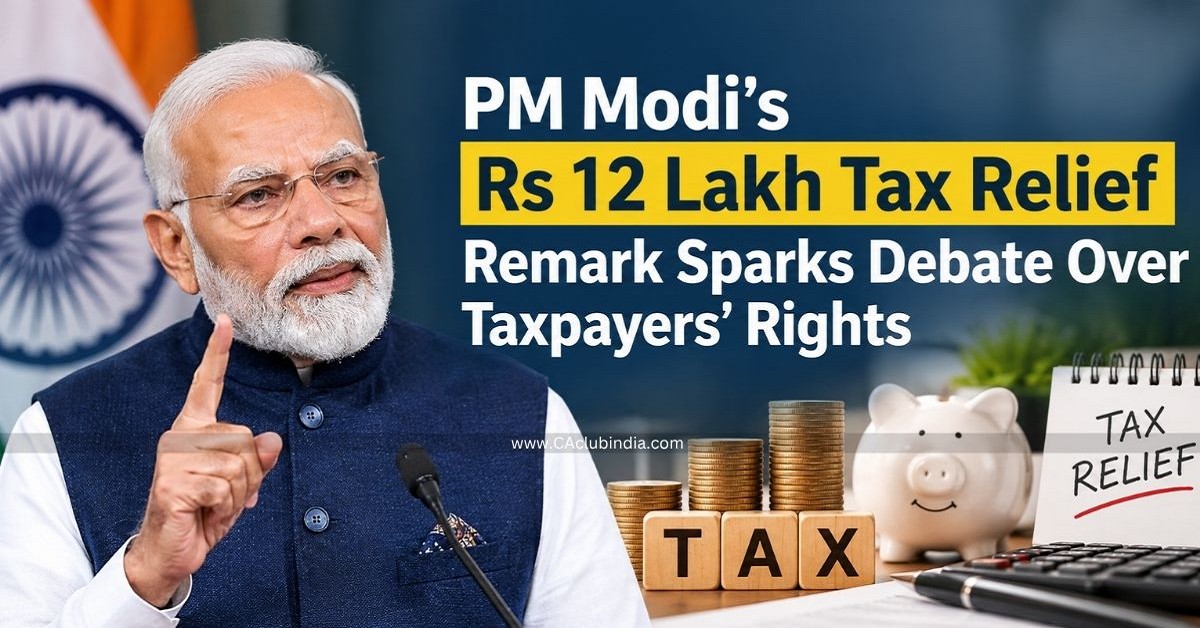
Prime Minister Narendra Modi has highlighted the Centre's income tax relief for the middle class while addressing the NDTV World Summit 2026, drawing attention to the provision that allows eligible taxpayers to pay zero income tax on normal income up to Rs 12 lakh under the new tax regime.
During his address, Modi pointed out that people often become accustomed to benefits once they receive them. Referring to the tax relief, he remarked that the government has to remind people repeatedly about the benefit, adding that receiving a benefit and then taking it for granted is not how things should work.
The remarks have brought the income tax relief announced in the Union Budget 2025-26 back into focus, along with a wider debate over the presentation of tax benefits and the expectations of taxpayers.
How the Income Tax Relief Works
The Rs 12 lakh tax-free threshold was announced in the Union Budget 2025-26 presented by Finance Minister Nirmala Sitharaman on 1 February 2025. The revised tax structure was introduced to reduce the tax burden on the middle class and leave more disposable income with households.
Under the new tax regime, eligible resident individuals with total income of up to Rs 12 lakh can claim a rebate under Section 87A, bringing their income tax liability on eligible income down to zero. This benefit is subject to the applicable conditions and does not cover income taxed at special rates.
For salaried taxpayers, the effective threshold can reach Rs 12.75 lakh because of the Rs 75,000 standard deduction, provided the taxpayer meets the applicable conditions.
The important distinction is that the Rs 12 lakh limit is not a blanket exemption for every type of income. The rebate mechanism, applicable tax slabs and restrictions on special-rate income must be considered while calculating the final tax liability.
Tax Liability Above Rs 12 Lakh: Why the Calculation Matters
While the rebate provides substantial relief to eligible taxpayers within the threshold, income just above Rs 12 lakh can result in a tax liability. This is because the rebate is linked to the taxpayer's total income and the tax calculated under the applicable slab structure.
For instance, under the new regime applicable for Assessment Year 2026-27, the tax slab rates increase progressively, with income between Rs 12 lakh and Rs 16 lakh attracting a 15% rate. The final liability depends on the taxable income, applicable rebate, standard deduction for salaried taxpayers, and health and education cess.
Taxpayers should therefore avoid interpreting the Rs 12 lakh threshold as a general tax exemption applicable irrespective of income type or eligibility. A proper calculation is essential, particularly for those whose income exceeds the rebate threshold.
Political Debate Over the Presentation of Tax Benefits
The Prime Minister's remarks have also drawn political reactions. Critics have questioned the tone in which tax relief is presented, arguing that tax policy should be discussed as part of the government's fiscal and legislative responsibilities rather than as a personal favour to citizens.
Congress leader Pawan Khera has reportedly criticised the framing, emphasising that public money and tax policy should be viewed in the context of citizens' rights and government accountability.
The contrasting positions reflect a broader debate: while the government points to tax reductions as a measure of economic relief, critics argue that the assessment of such policies should also consider the overall tax burden, public services and the treatment of taxpayers.
What Taxpayers Should Keep in Mind
The Rs 12 lakh rebate provision remains an important feature of the new tax regime for eligible individual taxpayers. However, the actual benefit depends on the nature of income, the applicable tax rules and the taxpayer's eligibility for the rebate.
Taxpayers should review their total income and applicable deductions before estimating their tax liability. Salaried individuals should also account for the standard deduction when determining their taxable income.
Ultimately, the debate surrounding Modi's remarks goes beyond the tax-free threshold itself. It highlights the continuing discussion over how tax relief is communicated, how its benefits are measured and what taxpayers expect in return for their contribution to public finances.












 CAclubindia
