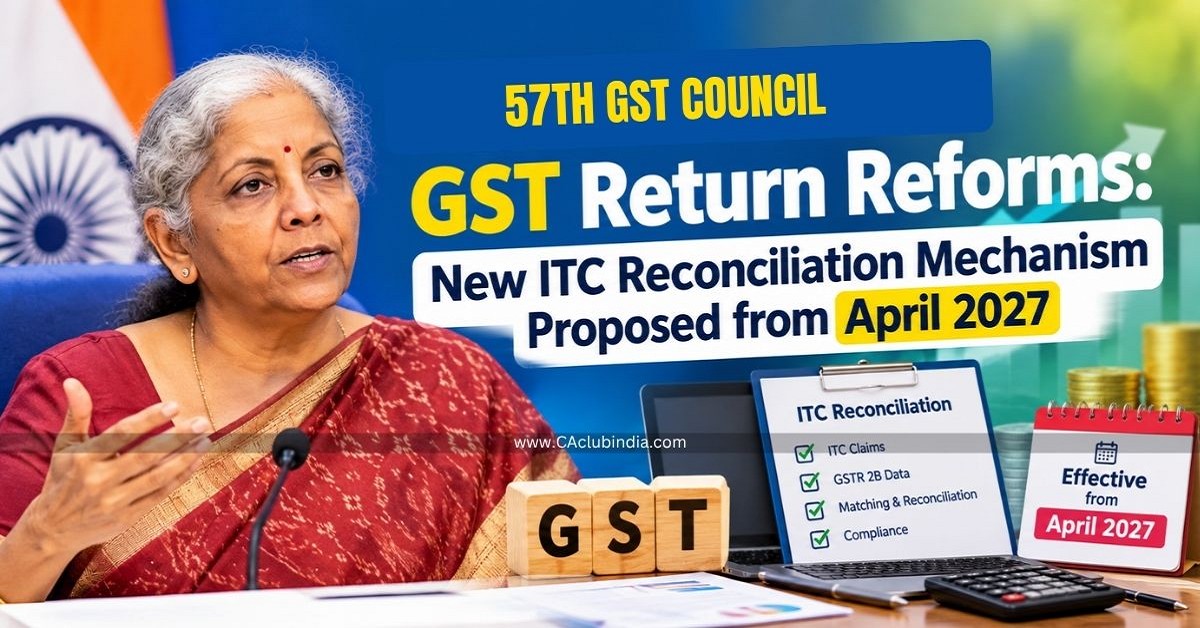
The GST Council has recommended a revised mechanism for reporting and correcting tax liabilities and Input Tax Credit (ITC) in GST returns, with the objective of reducing mismatches, preventing avoidable notices and simplifying return filing for taxpayers. The proposed changes are recommended to come into force from the tax period of April 2027.
The recommendations focus on improving coordination between GSTR-1, GSTR-1A, the Invoice Furnishing Facility (IFF), GSTR-2B and GSTR-3B. They also propose new electronic statements and correction mechanisms to help taxpayers report tax liabilities, claim ITC and record credit reversals more accurately.
The Council has further recommended that the proposed mechanism be placed in the public domain for time-bound consultation, allowing stakeholders to provide feedback before the necessary changes are finalised.
Official copy of the Return-related reforms is as follows
Alternate mechanism for making amendment of liabilities and input tax credit in returns to minimize mismatches and reduction of notices/intimations on account thereof :
The GST Council recommended inter-alia the following measures to streamline return filing process, so as to minimize mismatches in liability and input tax credit (ITC) in returns :
- Enhancements in FORM GSTR-1/1A/IFF to enable better reconciliation of the details furnished in these forms with the details reported in the return in FORM GSTR-3B.
- Insertion of a rule 86D in the CGST Rules, 2017, to provide for a facility namely, “Electronic Statement of tax paid on Reverse charge basis and input tax credit claimed” on the portal, to facilitate the taxpayers in correct reporting of tax liability and ITC on supplies liable to RCM in returns.
- Insertion of sub-rule (1A) in rule 61 of the CGST Rules, 2017 to provide a mechanism of correct reporting and correction/rectification of liability in the return, so that liability in the return in FORM GSTR-3B aligns with the details of liability furnished in FORM GSTR-1/1A/IFF.
- Amendment in FORM GST DRC-03, to declare the details of the underlying invoice for which payment has been made.
- Insertion of sub-rule (6A) in the rule 60 of the CGST Rules, 2017, in respect of the facility namely, Invoice Management System (IMS), to allow a recipient to accept, reject or keep pending a document pertaining to inward supply received on the portal, for the purpose of generation of statement of ITC in FORM GSTR-2B, subject to certain conditions, including the period for which a credit note can be kept pending on IMS.
- Insertion of rule 86C in the CGST Rules, 2017 to provide for a facility namely, “Electronic Credit Reversal and Reclaim Statement” on the portal, to facilitate the taxpayers in correct reporting of ITC reversed and reclaimed in FORM GSTR-3B.
- Insertion of sub-rule (1B) in the rule 61 of the CGST Rules, 2017, to provide a mechanism of correct reporting and correction/rectification of ITC in the return, so that ITC availed in the return in FORM GSTR-3B aligns with the details of ITC made available in FORM GSTR-2B.
- Issuance of a circular to clarify the manner of furnishing correct and proper information of ITC and reversal thereof in return in FORM GSTR-3B, in the context of IMS, Electronic Credit Reversal and Reclaim Statement and Electronic Statement of tax paid on Reverse charge basis and input tax credit.
The Council recommended that the provisions regarding alternate mechanism for amendment of liability and ITC in the GST return, may be brought into force from the return of April, 2027.These measures will considerably reduce mismatches in liability and ITC in returns, thus not only reducing demand notices and system generated intimations on account of such mismatches, but also improving the integrity of ITC across the supply chain, thereby facilitating taxpayers.
Further, the Council recommended placing the proposed revised mechanism in the public domain for a time-bound consultation. Union Finance Minister was authorized to approve requisite changes/modifications, as may be necessary, based on feedback received from the stakeholders.












 CAclubindia
