The Central Government has issued a notification exempting certain unamortized expenditure from the applicability of Section 15(1) of the Banking Regulation Act, 1949.
The notification was issued by the Ministry of Finance (Department of Financial Services) on August 6, 2026, following the recommendation of the Reserve Bank of India.

What the Notification Says
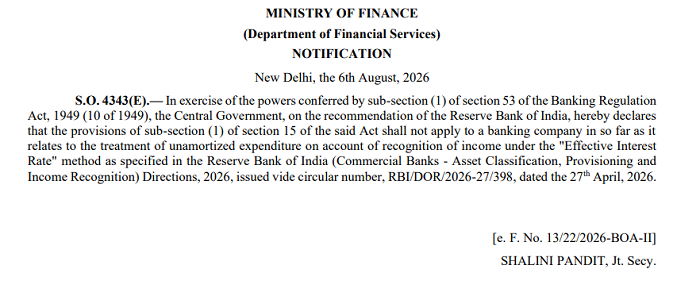
Through Notification S.O. 4343(E), the Central Government has exercised its powers under Section 53(1) of the Banking Regulation Act, 1949, to declare that the provisions of Section 15(1) of the Act will not apply to banking companies in respect of the treatment of unamortized expenditure arising from income recognition under the Effective Interest Rate (EIR) method.
The exemption specifically relates to the accounting treatment prescribed under the Reserve Bank of India (Commercial Banks - Asset Classification, Provisioning and Income Recognition) Directions, 2026, issued vide Circular No. RBI/DOR/2026-27/398 dated April 27, 2026.
Understanding the Effective Interest Rate (EIR) Method
The Effective Interest Rate (EIR) method is a widely accepted accounting approach used by banks and financial institutions to recognize interest income and related costs over the life of a financial asset or liability.
Under this method, various fees, premiums, discounts, and transaction costs are spread over the tenure of a loan or investment rather than being recognized immediately. This often results in certain expenditures remaining unamortized at specific points in time.
The latest RBI Directions require banks to follow the EIR-based framework for income recognition, ensuring greater consistency with modern accounting standards and financial reporting practices.
Why the Exemption Matters
Section 15(1) of the Banking Regulation Act generally places restrictions on the declaration and payment of dividends when certain expenditures remain unprovided for in the books of a banking company.
With the adoption of the EIR methodology, banks may carry unamortized expenditure that arises purely due to accounting treatment rather than actual financial weakness. The newly issued exemption ensures that such accounting adjustments do not inadvertently trigger restrictions under Section 15(1).
The notification is expected to provide regulatory clarity and facilitate smoother implementation of RBI's revised asset classification, provisioning, and income recognition framework.
Impact on Banks
The exemption will primarily benefit scheduled commercial banks and other banking companies governed by the Banking Regulation Act by:
- Aligning regulatory requirements with RBI's EIR-based accounting framework.
- Eliminating potential compliance challenges arising from unamortized EIR-related expenditure.
- Supporting uniform financial reporting and income recognition practices across the banking sector.
- Reducing ambiguity in the treatment of accounting adjustments linked to interest income recognition.
Regulatory Alignment with RBI Directions
The notification reflects the government's continued efforts to harmonize banking regulations with evolving accounting and prudential norms. As Indian banks increasingly adopt globally aligned financial reporting practices, regulatory exemptions such as this help ensure that technical accounting treatments do not create unintended legal or operational hurdles.
The notification comes into immediate effect and applies to unamortized expenditure recognized under the RBI's 2026 Directions relating to asset classification, provisioning, and income recognition.
Key Takeaway
The Central Government has exempted banks from the applicability of Section 15(1) of the Banking Regulation Act, 1949, in relation to unamortized expenditure arising from income recognition under the Effective Interest Rate (EIR) method. The move, recommended by the RBI, is aimed at facilitating implementation of the RBI's 2026 income recognition framework while ensuring regulatory consistency across the banking sector.
Official copy of the notification is as follows










 CAclubindia
