
Since 2018, an economic rift has persisted between China and the United States (US), spurred by a revision in the foreign economic stance under President Donald Trump's administration. The US shifted towards a protectionist approach with its primary trading partner, China. As per the International Trade Center's findings (ITC, 2020), bilateral trade in 2018 amounted to $683 billion, with the US exporting $120 billion worth of goods and importing $563 billion. Trump imposed substantial tariffs on Chinese goods, prompting retaliatory measures from China. Many experts attribute this tension to the US's intent to restrain China, a view widely held across various regions and nations. Nonetheless, underlying economic considerations have also influenced US policymakers to pursue such a strategy.
The rationale behind Trump's decision to impose tariffs included several factors
- Manipulation of currency by China - China's deliberate devaluation of its currency resulted in cheaper Chinese goods, leading to increased exports. This flood of inexpensive Chinese products was detrimental to US manufacturers and the government's interests.
- Coerced technology transfer - China's policy of requiring tech companies to partner with local firms effectively compelled them to divulge proprietary technology. Given that many Chinese companies are state-owned, this practice essentially handed over technological secrets to the Chinese government. Trump sought to put an end to this coercion.
- Safeguarding intellectual property (IP) rights - Trump aimed to protect American companies' intellectual property from infringement and unauthorized usage in China
- Addressing the ballooning trade deficit with China - The substantial trade deficit with China, wherein imports exceeded exports by a significant margin, was a pressing concern for the Trump administration.

The Timeline
- July 2018: Tariffs of 25 percent were imposed on products amounting to approximately $34 billion of US imports from China (List 1).
- August 2018: Additional tariffs were imposed on $16 billion worth of imports from China (List 2).
- September 2018: In response to China's retaliation, Trump imposed 10 percent tariffs on an extra $200 billion of imports (List 3).
- June 2019: The tariff rate on List 3 imports was raised to 25 percent.
- September 2019: Another $102 billion of imports (List 4A) faced 15 percent tariffs.
- February 2020: Tariffs on List 4A imports were reduced to 7.5 percent upon the implementation of the US-China Phase One agreement.
- December 15, 2019: Tariffs on a set of products covering over $160 billion of remaining US imports from China (List 4B) were scheduled to take effect but were rescinded upon the initial announcement of the Phase One agreement on December 13, 2019.
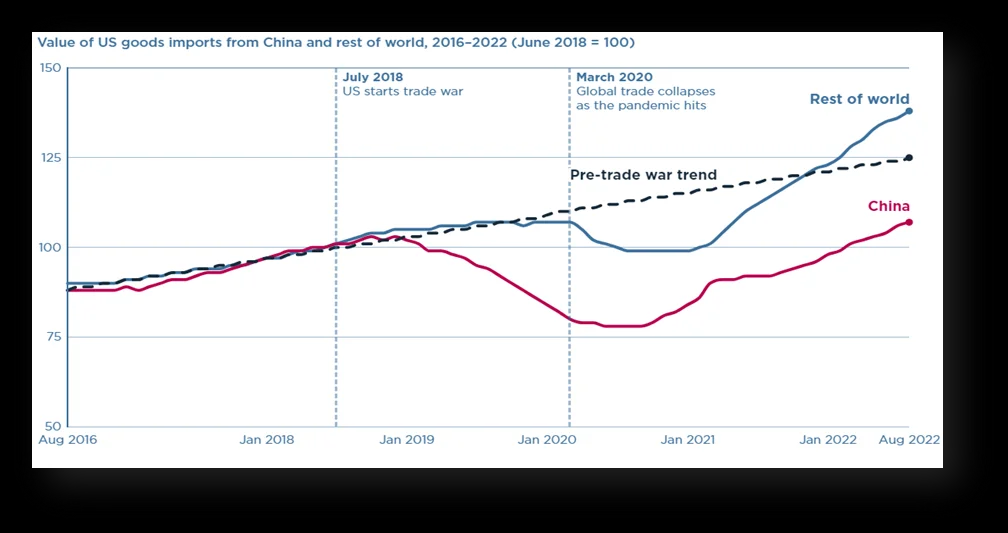
Source - Constructed by the author with US import data from US Bureau of the Census Top of Form
However, imports of specific products from China into the US have experienced a notable increase. Products that were not subjected to tariffs during the trade war have surged by 50 percent compared to the period just before the trade tensions began. Before the trade war, non-tariffed products accounted for approximately 33 percent of total US imports from China, but this figure has since risen to 47 percent.
Trade Shockwaves: 6 Years In, US Unleashes Fresh Tariffs
As the US heads into elections, Joe Biden has announced tariffs on a variety of Chinese imports, sparking the possibility of a trade conflict with Beijing. This move comes as the president aims to garner support from American voters, just months before what promises to be a closely contested rematch with Donald Trump. The newly imposed measures target $18 billion worth of imports, encompassing steel, aluminium, computer chips, solar cells, cranes, and medical products. However, it's the attention-grabbing 100% tariff on Chinese-manufactured electric vehicles (EVs) that has commanded the spotlight.
Also Read: Is the market rally fuelled by P/E expansion or Earning Expansion?
Oversupply?
Yes you heard it right, The US is concerned about oversupply because they feel that china is simply too large and they have already lived this story a decade before when PRC government support led to below-cost Chinese steel that flooded the global market and decimated industries across the world and in the United States.
The recent sanctions entail significant tariff hikes on a range of Chinese imports, including electric vehicle (EV) batteries, computer chips, and medical products. These measures risk provoking a standoff with Beijing during an election year, as Biden endeavours to win Americans' confidence despite their lukewarm reception of his economic policies. While maintaining tariffs implemented by his predecessor, Donald Trump, Biden intends to escalate others, such as quadrupling EV duties to over 100% and doubling semiconductor tariffs to 50%.
The impact of these new measures extends to $18 billion worth of imported Chinese goods, spanning steel, aluminium, semiconductors, electric vehicles, critical minerals, solar cells, and cranes, as confirmed by the White House. "Although the attention-grabbing increase in EV tariffs may have more political than practical repercussions in the US, given the country's minimal import of Chinese EVs, China swiftly pledged retaliation against the US tariff hikes, affirming its opposition and readiness to defend its interest".
As part of the long-awaited tariff update, Biden will increase tariffs this year under Section 301 of the Trade Act of 1974 from 25% to 100% on EVs, bringing total duties to 102.5% (a market China has not been a significant player in up to this point), from 7.5% to 25% on lithium-ion EV batteries and other battery parts and from 25% to 50% on photovoltaic cells used to make solar panels. Some critical minerals will have their tariffs raised from nothing to 25%.
The tariffs on ship-to-shore cranes will rise to 25% from zero, those on syringes and needles will rise to 50% from nothing now and some personal protective equipment (PPE) used in medical facilities will rise to 25% from as little as 0% now. Shortages in PPE made largely in China hampered the United States' COVID-19 response - Reuters
Looking ahead, more tariffs are anticipated in 2025 and 2026, targeting semiconductors, lithium-ion batteries excluding those used in EVs, graphite, permanent magnets, and rubber medical and surgical gloves. Additionally, Biden's previous announcement to raise tariffs on certain steel and aluminium products is slated to take effect this year, according to the White House.
Author: Ankit Baid, Research Analyst at Affluence Advisory
Disclaimer: This article provides general information existing at the time of preparation and we take no responsibility to update it with the subsequent changes in the law. The article is intended as a news update and Affluence Advisory neither assumes nor accepts any responsibility for any loss arising to any person acting or refraining from acting as a result of any material contained in this article. It is recommended that professional advice be taken based on specific facts and circumstances. This article does not substitute the need to refer to the original pronouncement.











 CAclubindia