
A few days back while looking at the Index movements on BSE, I came across an index with the name ‘S&P BSE Dollex’, though many of you might be already aware of this index but it was new to me, the name seemed interesting and I was curious to know what it is exactly. After researching a little about it, I came to know that the Dollex index is the USD version of SENSEX we all know; in fact it’s India’s one of the most tracked index.
S&P BSE Dollex being USD version of SENSEX, indicates the returns on SENSEX taking into effect the currency movements i.e. appreciation or depreciation of INR in terms of US Dollar, means the effective return for FIIs.
To verify I took data for 4 years from 2012 to 2015, chart below shows the relationship between Dollex, SENSEX and INR/USD currency exchange rate-
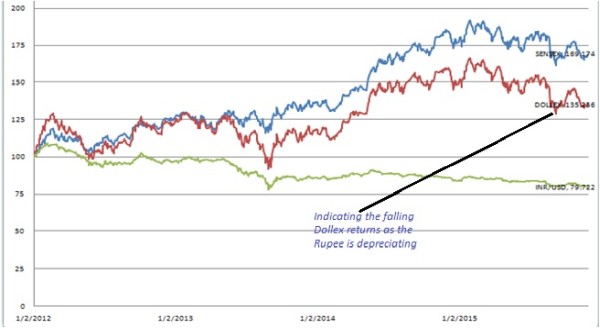
The above chart shows the movements of
- SENSEX (in blue)
- DOLLEX (in red) and
- INR in terms of USD (in green)
As clear from the above chart that returns on the Dollex are returns on SENSEX reduced by rupee depreciation, it is given by the formula:
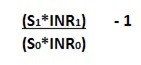
Where S1 and S0 indicates SENSEX at time 1 and 0 respectively;
INR1 and INR0 indicate INR in terms of USD at time 1 and 0 respectively,
When multiplied it gives you USD version of Dollex, forget about how the value of Dollex Index is actually arrived, if you will look at the movements it exhibits the above relationship.
Let’s look at it through one more chart-
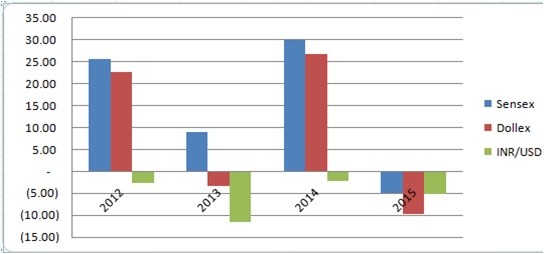
The above chart further clarifies the issue which clearly shows that the difference between SENSEX and Dollex is because of currency depreciation.
Mind you in my data I have taken Rupee in terms of Dollar, and not Dollar in terms of Rupee the way it is mostly expressed.
Implication
Dollex is mostly relevant for foreign investors who invest in Indian markets by exchanging their currency for INR, because of this their return gets decreased as when they invested they had to give more units of their currency in exchange of INR while at T1 when they take out their money and convert it back into their native currency they get less as rupee has depreciated now. This directly impacts the amount of money they are able to take back with them.
For example in our data, for the considered period i.e. 2012-2015
Return on SENSEX is 68.77%,
Return on Dollex is 34.61% because rupee has depreciated by 20.22% in that period.
Therefore, even if the returns on the BSE SENSEX are high, the FIIs manage to take home only a portion of it, not only this when returns on SENSEX are in negative, it worsens the situation even more because then FIIs not only have to bear negative returns on the index but they also get hit by rupee depreciation as shown in Chart2 for year 2015.
(The author has taken movements of SENSEX 30 and Dollex 30)
By Vishal Malhotra (a CA Final Student)
Email- vishal.malhotra379@gmail.com
https://www.linkedin.com/in/vishmalhotra











 CAclubindia
