India's Unified Payments Interface (UPI) is set for a change from October 15, 2026, with a new Merchant Discount Rate (MDR) applying to certain high-value person-to-merchant (P2M) transactions. However, the government has moved to reassure users that the new merchant-side fee will not translate into an additional charge at the time of payment.
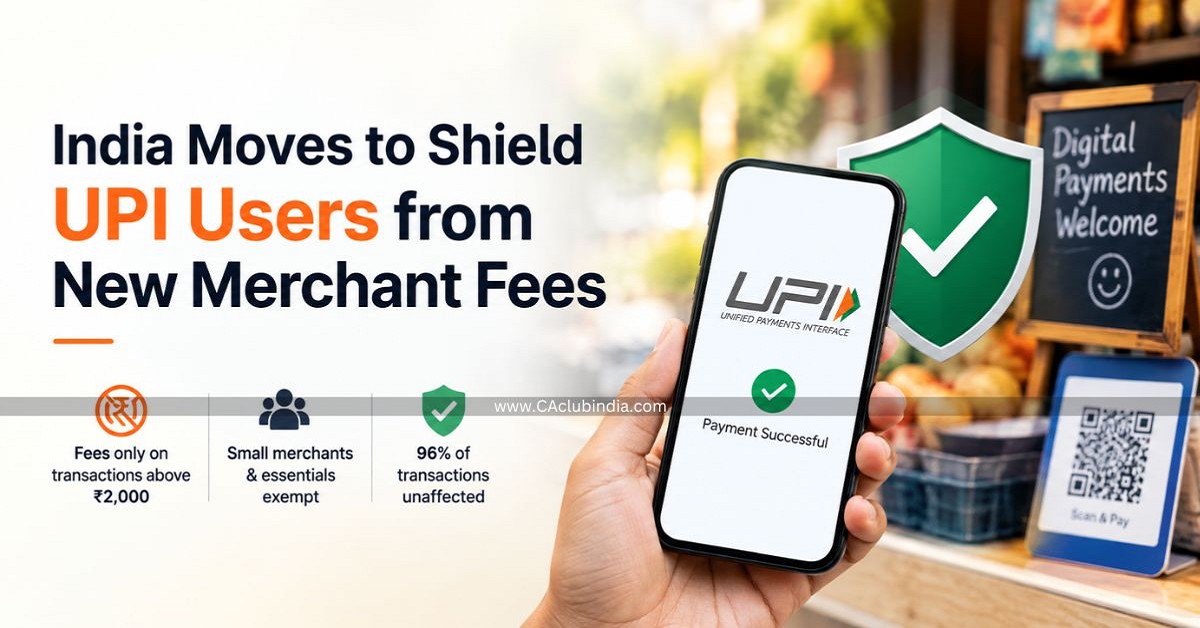
Under the revised framework, a 0.4% MDR will apply to specified UPI merchant transactions above Rs 2,000, with the charge capped at Rs 300 for transactions of Rs 75,000 and above. Payments between individuals will continue to remain free, while merchant payments up to Rs 2,000 will also remain outside the MDR framework. The government says around 96% of UPI merchant transactions will remain unaffected.
Finance Ministry Moves to Prevent Customer Charges
The latest development comes amid concerns from traders and consumers about whether merchants could eventually recover the new payment-processing cost by adding it to customers' bills.
The Finance Ministry is now engaging with the Indian Banks' Association (IBA) to work out a mechanism to ensure that MDR is not passed on to consumers. The ministry is also expected to engage with trader organisations to address concerns and explain how the new framework will operate.
Government sources have reiterated that customers are not required to pay MDR separately when making an eligible UPI payment. Banks have also been advised to ensure that merchants do not pass the charge on to customers.
What Changes From October 15?
The revised framework is targeted at specified P2M transactions rather than everyday UPI transfers.
- UPI payments up to Rs 2,000 to merchants: No MDR
- Person-to-person UPI transfers: Continue to remain free
- Specified merchant payments above Rs 2,000: 0.4% MDR
- MDR cap: Rs 300 for transactions of Rs 75,000 and above
- Small merchants with monthly P2M collections below Rs 1 lakh: Nil MDR
- Specified essential sectors: Flat Rs 5 MDR on qualifying transactions above Rs 2,000
- Capital-market transactions: A separate concessional MDR framework applies
The government has said the framework has been designed with exemptions and concessional rates to protect small-value transactions and smaller merchants.
Fuel and Other Essential Payments Get a Special Rate
Not all transactions above Rs 2,000 will attract the standard 0.4% rate.
Specified essential and thin-margin sectors, including fuel, railways, telecommunications, insurance and agricultural inputs, will attract a flat Rs 5 MDR on qualifying transactions above Rs 2,000. This is intended to provide greater cost certainty for transactions in sectors where margins can be relatively narrow.
MDR Is Not a Government Tax
One of the key points being clarified amid the discussion is the nature of MDR.
The Finance Ministry and NPCI have said that MDR is not a tax, cess or surcharge collected by the government. It is a payment-processing charge within the UPI ecosystem, with the proceeds distributed among participating entities such as banks, payment service providers and UPI application providers.
NPCI has also clarified that GST, where applicable, is levied on the MDR service fee rather than on the underlying UPI transaction value. For example, on a Rs 10,000 transaction subject to 0.4% MDR, the MDR would be Rs 40, with GST calculated on that service fee rather than on the entire Rs 10,000 payment.
Traders Raise Concerns Over the New Charge
The proposed MDR has nevertheless triggered discussion among traders and businesses.
The Confederation of All India Traders (CAIT) has raised concerns about the impact of the new cost on businesses and has urged the government to reconsider the implementation timeline. These concerns have added pressure for greater clarity on how merchants will absorb the charge without affecting customers.
The government's latest engagement with banks and trader organisations indicates that implementation and consumer protection remain key issues ahead of October 15.
What UPI Users Need to Know
For ordinary users, the practical message is relatively straightforward: UPI is not becoming a paid service for all transactions.
Sending money to another individual will remain free, while merchant payments up to Rs 2,000 will continue without MDR. Even for specified merchant transactions above Rs 2,000, the MDR is designed as a merchant-side payment-processing charge rather than a fee that consumers are required to pay separately.
The Finance Ministry's discussions with banks and traders are now focused on ensuring that this distinction is maintained when the new framework takes effect on October 15.
As UPI continues to be a central part of India's digital payments ecosystem, the coming weeks will show how effectively the new MDR framework can be implemented while keeping the customer experience unchanged.










 CAclubindia
