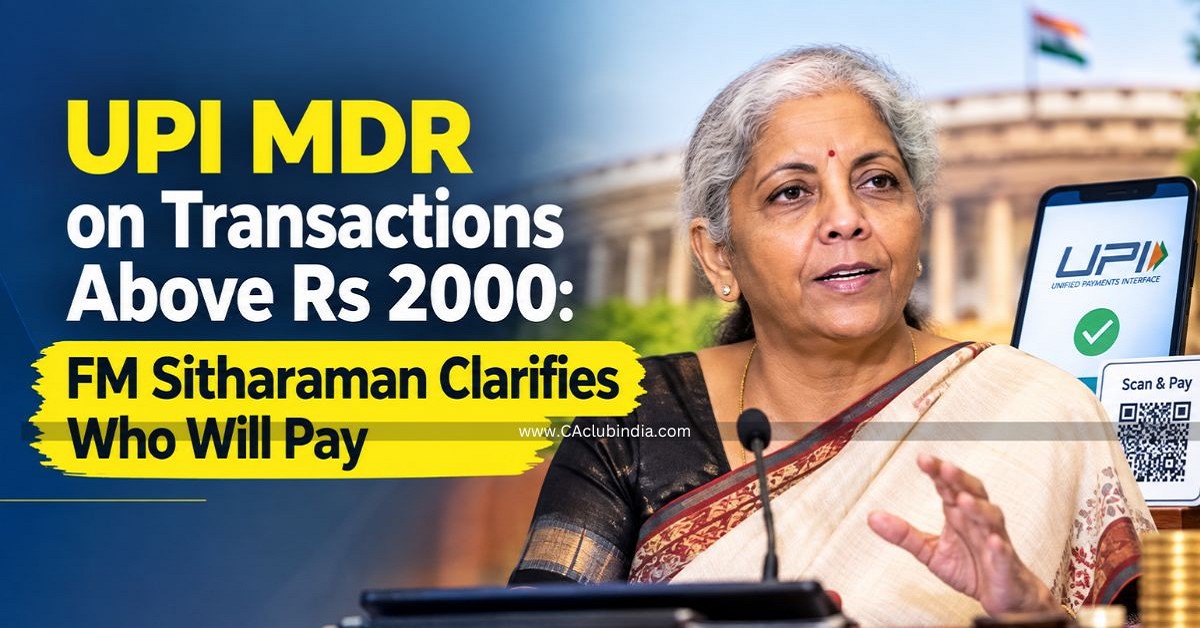
Union Finance Minister Nirmala Sitharaman has clarified that the newly introduced Merchant Discount Rate (MDR) on specified UPI transactions will not be passed on to consumers. The clarification comes amid questions over whether users would have to pay an additional charge when making high-value UPI payments to merchants.
FM Sitharaman said MDR is a charge within the digital payment ecosystem and is neither a tax nor a cess. According to the government, the charge will be absorbed within the payment ecosystem rather than being collected directly from customers using UPI.
The clarification follows the revised UPI framework announced for selected Person-to-Merchant (P2M) transactions above Rs 2,000. Under the framework, a 0.4% MDR will apply to specified transactions, with the charge capped at Rs 300 for transactions of Rs 75,000 and above. The revised framework is scheduled to take effect from October 15, 2026.
Will Consumers Have to Pay UPI MDR?
The key takeaway for UPI users is that customers are not supposed to be charged MDR separately.
The government has stated that banks and payment ecosystem participants have been advised to ensure that the MDR is not passed on to customers. This means a consumer making an eligible UPI payment should not see an additional MDR amount added to the transaction simply because the payment exceeds Rs 2,000.
The clarification is particularly relevant as UPI has become a routine payment method for everything from everyday shopping to larger merchant transactions.
What Is the New UPI MDR Framework?
Under the revised framework, MDR will apply to specified P2M UPI transactions above Rs 2,000.
For standard eligible transactions, the MDR rate is 0.4%, while the maximum charge is capped at Rs 300 for transactions of Rs 75,000 and above. Certain sectors have separate treatment under the framework.
Importantly, Person-to-Person (P2P) UPI transactions remain free, irrespective of the amount transferred.
The government has also said that payments to merchants up to Rs 2,000 and transactions covered under the zero-MDR framework for small merchants will remain unaffected. As a result, around 96% of P2M UPI transactions are expected to remain outside the new MDR framework.
MDR Is Not a Government Tax
One of the major points clarified by the Finance Minister is the nature of MDR.
Unlike a tax or cess collected by the government, MDR is a payment-related charge distributed among participants in the digital payments ecosystem, including banks and payment application providers.
The government has said the framework is intended to support the continued operation, expansion and sustainability of the UPI ecosystem as transaction volumes grow.
Why the Clarification Matters for UPI Users
The introduction of MDR on selected high-value merchant transactions had raised questions among consumers about whether UPI payments would become chargeable.
The latest clarification separates the cost imposed within the payment ecosystem from the amount paid by the customer. While eligible transactions may attract MDR, the government has stated that the cost should not be added to the consumer's UPI bill.
The change therefore does not mean that consumers will start paying a UPI transaction fee for ordinary person-to-person transfers.
UPI Continues to Remain Free for P2P Transactions
The revised framework leaves the basic P2P UPI model unchanged. Individuals can continue transferring money to other individuals through UPI without MDR.
The government has also highlighted that a large majority of merchant transactions will remain unaffected, particularly lower-value payments and transactions covered by the zero-MDR provisions.
With the new framework set to begin from October 15, 2026, the focus will now shift to how banks, payment service providers and merchants implement the rules while ensuring that MDR is not passed on to consumers.
Key UPI MDR Points at a Glance
- MDR on specified P2M transactions above Rs 2,000: 0.4%
- Maximum MDR: Rs 300 for transactions of Rs 75,000 and above
- Consumer MDR: Not to be passed on to customers
- P2P UPI transactions: Continue to remain free
- Transactions up to Rs 2,000: Remain free under the applicable framework
- P2M transactions unaffected: Around 96%
- Effective date: October 15, 2026
The Finance Minister's clarification is aimed at addressing concerns over the impact of the new UPI MDR framework on consumers while explaining that the charge operates within the broader payment ecosystem rather than as a government tax or cess.










 CAclubindia