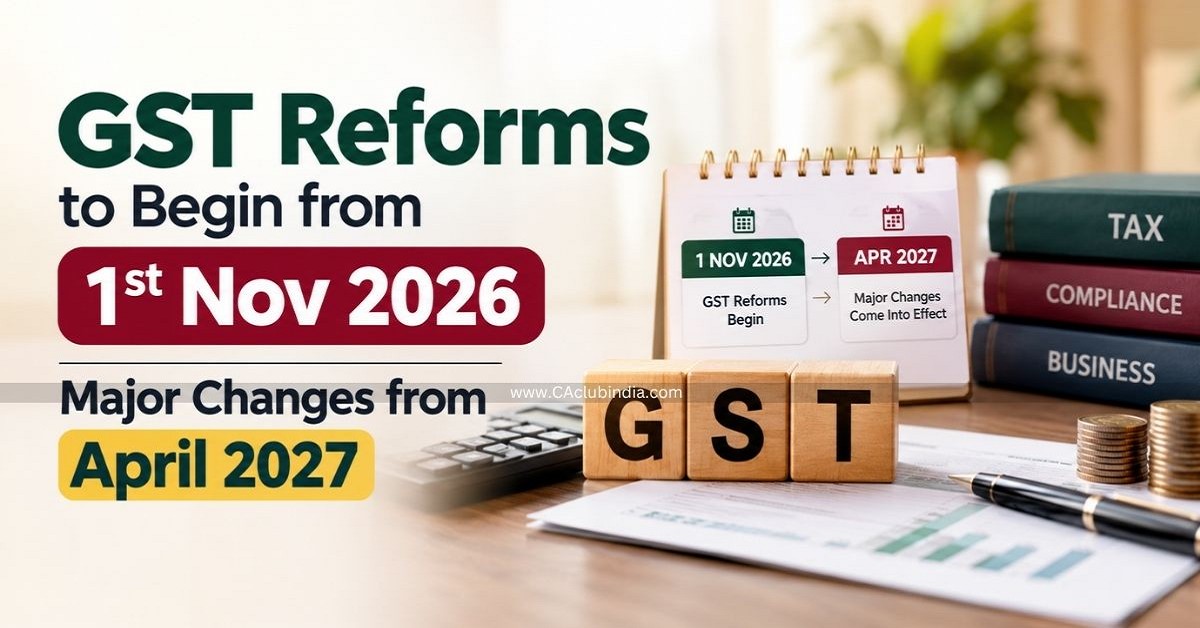
The Central Board of Indirect Taxes and Customs (CBIC) has indicated that GST reforms aimed at simplifying tax compliance, improving Input Tax Credit (ITC) flow and speeding up refunds will be implemented in phases from November 1, 2026. Measures requiring amendments to the Central and State GST laws are expected to be rolled out from April 1, 2027, subject to the necessary legislative changes.
Sanjay Mangal, Member (GST) at the CBIC, shared the implementation timeline during a media interaction in on October 22, 2026. He said the reforms recommended at the 57th GST Council meeting are primarily focused on reducing the compliance burden on businesses and addressing operational challenges faced by taxpayers.
The GST Council meeting was held on October 8, 2026, under the chairpersonship of Union Finance Minister Nirmala Sitharaman.
GST Reforms to Be Implemented in Two Phases
The government plans to introduce the approved measures in phases, depending on the system changes and legal amendments required.
Reforms that do not require amendments to the GST law are tentatively scheduled to begin from November 1, 2026. Measures requiring changes to the Central and State GST legislation are targeted for implementation from April 1, 2027.
The proposed changes cover several areas, including return filing, ITC verification, refund processing, prosecution provisions, arrest-related provisions and e-way bill compliance.
1. GST Compliance Relief for Small Traders
One of the key proposals is a simplified return filing mechanism for small businesses exclusively making business-to-consumer (B2C) supplies and having an annual turnover of less than ₹5 crore.
Under the proposed mechanism, eligible businesses would be permitted to file GST returns annually while paying their tax liability quarterly. The move is intended to reduce the frequency of return filing and ease compliance for smaller traders.
The GST Council has also approved, in principle, relief from late fees for small taxpayers with turnover of up to ₹5 crore who file their returns within the same calendar month in which the returns were originally due, even if the filing takes place after the prescribed due date.
These measures are expected to reduce routine compliance pressure on eligible businesses. Taxpayers should, however, check the applicable notifications and implementation instructions before changing their existing filing schedules.
2. Automated GST Refund Processing from November 2026
The CBIC has indicated that automated refund sanctioning will begin after November 1, 2026, wherever applicable.
The initiative is intended to simplify refund processing and improve the availability of funds for businesses. Faster refunds can be particularly important for taxpayers facing working-capital constraints because of blocked funds or delays in receiving eligible GST refunds.
However, the proposed automated mechanism will apply to future refund claims and will not cover the accumulated refund claims that are already pending.
Businesses should continue monitoring their existing refund applications separately and follow the applicable procedures for pending claims.
3. Technology-Based Checks to Prevent Fake ITC Claims
The government is placing greater emphasis on technology-driven compliance checks to prevent fake invoices and fraudulent Input Tax Credit claims at the source.
According to Sanjay Mangal, the proposed changes to the GST return filing mechanism will seek to ensure that tax declared as payable by a supplier and passed on as ITC to the recipient is actually paid.
The objective is to strengthen the link between the supplier's tax liability and the recipient's ITC claim, helping prevent fraudulent credit generation before it leads to further proceedings.
This approach reflects a shift towards preventive compliance mechanisms rather than relying primarily on investigations and enforcement action after fraudulent transactions have occurred.
Businesses should continue reconciling their purchase records, supplier invoices, GST returns and eligible ITC to minimise the risk of credit mismatches and disputes.
4. Changes to GST Arrest and Prosecution Provisions from April 1, 2027
Certain major reforms will require amendments to the GST legislation and are therefore targeted for implementation from April 1, 2027.
These include proposed changes to arrest-related provisions, rationalisation of prosecution thresholds, modifications to e-way bill provisions and the introduction of a minimum threshold of ₹10,000 for issuing show-cause notices.
The proposed changes are intended to streamline enforcement and compliance procedures while addressing concerns surrounding GST proceedings.
Mangal clarified that arrests already made would not be affected by the proposed changes. The new provisions relating to arrests, including the proposed removal of arrest provisions from the law as decided by the GST Council, are expected to take effect from April 1, 2027.
The CBIC and the tax administration are also examining whether instructions or guidelines could address the issue during the transition period. However, no decision had been taken on this matter as of October 22, 2026.
Taxpayers should distinguish between recommendations announced by the GST Council and changes that become legally effective through the required amendments and notifications.
5. No GST Rate Changes Announced at the 57th GST Council Meeting
Unlike the earlier rate-rationalisation exercise, the 57th GST Council meeting focused primarily on process and structural reforms.
No GST rate revisions were considered at the meeting. The Council decided that rate-related matters would be taken up separately at a future meeting, the date of which had not been finalised as of October 22, 2026.
The latest proposals are mainly intended to benefit businesses by simplifying compliance, addressing ITC-related issues and facilitating refunds. Any benefit to consumers is expected to be indirect, depending on how improvements in business operations and compliance costs are passed on.
Key GST Reform Dates at a Glance
| Particulars | Expected timeline |
|---|---|
| Initial rollout of reforms not requiring legislative amendments | November 1, 2026, tentatively |
| Automated refund sanctioning, wherever applicable | After November 1, 2026 |
| New return mechanism for eligible small B2C businesses | Subject to implementation arrangements |
| Changes requiring amendments to GST laws | Targeted from April 1, 2027 |
| Proposed changes to arrest and prosecution provisions | Targeted from April 1, 2027 |
| GST rate-related discussions | At a future GST Council meeting; date not finalised |
What GST Taxpayers and Businesses Should Do
Businesses, tax professionals and GST practitioners should keep track of the notifications, circulars and system-level changes issued by the CBIC and GST authorities as the reforms are implemented.
Small traders should check their eligibility for the proposed simplified return mechanism and late-fee relief. Businesses claiming ITC should continue to maintain proper documentation and reconcile supplier-related tax information. Taxpayers awaiting refunds should also distinguish between existing pending claims and new claims covered by the proposed automated process.












 CAclubindia
