The Central Board of Indirect Taxes and Customs (CBIC) has issued Instruction No. 02/2026-GST dated October 30, 2026, introducing immediate trade-facilitation measures based on recommendations made during the 57th GST Council meeting held on October 8, 2026.
The instruction brings significant relief to GST taxpayers by directing field formations to stop arrests under GST, restrict unnecessary interception of vehicles carrying goods and avoid issuing show cause notices (SCNs) involving amounts below ₹10,000.
These measures are intended to reduce compliance-related hardships, minimise low-value litigation and promote a more taxpayer-friendly GST administration. Importantly, the directions will remain applicable until the corresponding amendments to the CGST Act, 2017, and relevant State GST laws come into force.
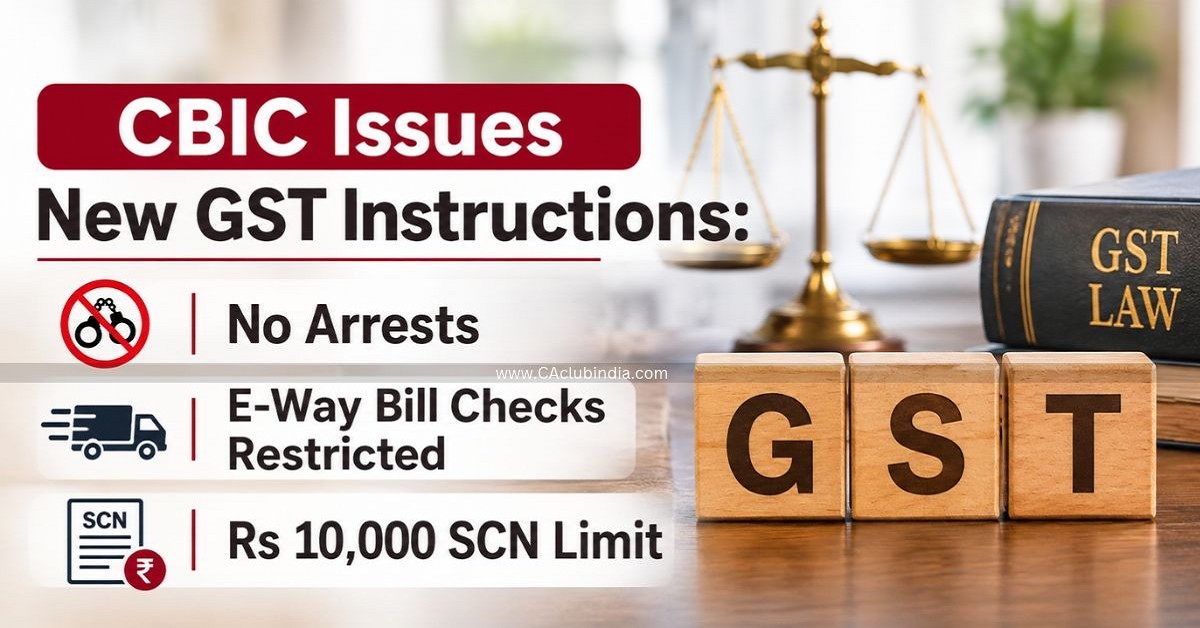
Key GST Reforms Announced Under CBIC Instruction No. 02/2026
The instruction covers three major areas of GST administration:
- Withdrawal of GST arrest action.
- Rationalisation of e-way bill interception and verification procedures.
- Introduction of a minimum ₹10,000 threshold for issuing GST show cause notices.
1. No Further Arrests Under GST
One of the most significant directions concerns the withdrawal of arrest powers under GST.
The 57th GST Council meeting recommended omitting Section 69 of the CGST Act, 2017, which deals with the power to arrest. Pending the necessary legislative amendments, CBIC has directed all CGST field formations that no further arrests may be carried out under GST.
This interim direction is expected to provide substantial relief to businesses and taxpayers who have faced concerns regarding arrest-related proceedings under GST.
The move also reflects the government's intention to make GST administration more trust-based and reduce the hardships faced by taxpayers.
2. Strict Restrictions on E-Way Bill Interception and Vehicle Inspection
CBIC has also introduced detailed instructions to rationalise the interception and verification of goods and conveyances in transit.
The objective is to prevent unnecessary vehicle checks and ensure that interception takes place only where there is a valid reason.
The key directions are as follows:
Interception Based on Specific Intelligence
- A conveyance can be intercepted only on the basis of specific intelligence.
- Such intelligence must be duly authorised by an officer not below the rank of Joint Commissioner.
- The authorising officer must record written reasons to believe that the goods are being transported in violation of the CGST Act or the rules made thereunder.
Inspection Within Jurisdictional Limits
The officer intercepting the conveyance can inspect the vehicle and goods only if the supplier or recipient is registered or located within the State or Union Territory falling under the officer's jurisdiction.
If the inspection establishes a contravention of GST provisions, the proper officer may detain or seize the goods in accordance with Section 129 of the CGST Act, 2017.
Goods Must Be Allowed to Pass When They Fall Outside Jurisdiction
Where neither the supplier nor the recipient is registered or located within the jurisdiction of the authorising officer, the intercepting officer must follow a different procedure.
If the officer forms a prima facie opinion that the goods are being transported in violation of GST provisions, the information must be forwarded to the jurisdictional proper officer.
In such cases, the conveyance and goods must be allowed to pass through without obstruction. The jurisdictional authority receiving the information will examine the matter and take appropriate action.
Exception Where E-Way Bill and Supporting Documents Are Missing
An important exception has been provided.
If an e-way bill has not been generated for the goods being transported and no document establishing the origin or destination of the goods is produced, the intercepting officer can inspect, detain or seize the goods or conveyance irrespective of the jurisdiction of the supplier or recipient.
No Detention or Confiscation Beyond Prescribed Conditions
The instruction further clarifies that:
- Goods and conveyances in transit cannot be detained or seized for reasons other than those specified in the instruction.
- Goods or conveyances in transit shall not be confiscated under Section 130 of the CGST Act, 2017.
These directions are expected to reduce unnecessary interruptions in the movement of goods and provide greater certainty to businesses involved in interstate transportation.
3. No GST Show Cause Notices Below ₹10,000
Another important relief relates to the issuance of show cause notices involving small tax amounts.
The GST Council recommended amendments to Sections 73, 74 and 74A of the CGST Act, 2017, to introduce a minimum monetary threshold of ₹10,000 for issuing show cause notices.
Pending the required legislative amendments, CBIC has directed that show cause notices should not be issued where the amount involved is below ₹10,000.
The ₹10,000 threshold will be calculated by considering the combined amount under:
- Central Goods and Services Tax (CGST)
- State Goods and Services Tax (SGST)
- Integrated Goods and Services Tax (IGST)
- Union Territory Goods and Services Tax (UTGST)
- GST Compensation Cess
This means the threshold is not to be considered separately for each tax component. The combined amount of the applicable taxes and cess must be considered.
The measure is aimed at reducing low-value GST disputes, unnecessary litigation and the administrative burden on both taxpayers and tax authorities.
When Will These GST Instructions Become Applicable?
Although the GST Council recommended that the corresponding legislative amendments should come into force from April 1, 2027, CBIC has decided to implement the reforms as an interim trade-facilitation measure.
Accordingly, the directions under Instruction No. 02/2026-GST dated October 30, 2026, are to be followed by CBIC field formations immediately and will remain in force until the recommended amendments to the CGST Act, 2017, come into effect.
The instruction also requests Principal Chief Commissioners and Chief Commissioners to monitor its implementation.
Further, the GST Council Secretariat has been requested to circulate the instruction to State GST formations, which may issue similar directions within their respective jurisdictions to ensure uniformity and effective implementation.
What Does This Mean for GST Taxpayers and Businesses?
The latest CBIC instruction represents an important step towards reducing procedural difficulties under GST.
For businesses, transporters and GST practitioners, the changes have several practical implications:
- Reduced arrest-related concerns: CGST field formations have been directed not to carry out further arrests under GST.
- Fewer unnecessary vehicle checks: Interception must be supported by specific intelligence and proper authorisation.
- Greater jurisdictional clarity: Officers must follow prescribed jurisdictional conditions while inspecting goods in transit.
- Protection against low-value litigation: SCNs should not be issued where the combined amount involved is below ₹10,000.
- Improved ease of doing business: Reduced compliance-related disruptions may help businesses manage transportation and GST proceedings more efficiently.
However, businesses must continue to comply with applicable GST provisions, including proper documentation and e-way bill requirements. The relaxation in interception procedures does not remove the underlying compliance obligations.
Conclusion
CBIC Instruction No. 02/2026-GST is a significant development for India's GST framework. By directing field formations to stop further GST arrests, limiting e-way bill-related interception and introducing a ₹10,000 minimum threshold for show cause notices, the government has taken steps to reduce unnecessary taxpayer hardships.
The key point is that these measures are being implemented through administrative instructions pending the formal legislative amendments. GST taxpayers, transporters and professionals should take note of the directions and their applicability while monitoring subsequent amendments to the CGST Act and corresponding State GST laws.












 CAclubindia
