
Tax deduction at the source (TDS) is one of the ways to collect taxes based on certain percentages on the amount to be paid by the recipient for goods/services. The tax collected is an income for the government.
- A department or institution of central government or state government; or local authority;
- Government agencies; or
- The people or categories of people that can be notified by the government.
In accordance with the last notification of September 13, 2018, the following entities must also deduct TDS:-
- An authority or council or other body created by the Parliament or by a state legislature or government, with a 51% (controlling) shareholding held by the government.
- A company constituted by the central government or by a state government or by a local authority and the company is registered under the Companies Registration Act 1860.
- Public sector companies.
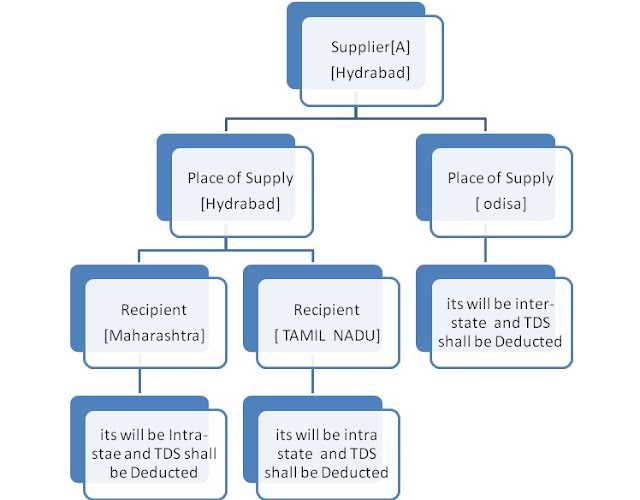
The TDS must be deducted at the rate of 2% on payments made to the supplier of taxable goods and/or services, in which the total value of this supply, on the basis of an individual contract, exceeds Rs 2,50,000. No tax deduction is required where the supplier's position and place of supply are different from those of the recipient.
https://www.corporateslaw.com/2018/09/tds-2-levied-on-payment-above-250-lakhs.H T M L
A man who is obligated to deduct TDS needs to necessarily enlist and there is no edge restrict for this. The enlistment under GST can be acquired without PAN and by utilizing the current Tax Deduction and Collection Account Number (TAN) issued under the Income Tax Act. In this manner it tends to be said having TAN is required
TDS shall be paid within 10 days from the end of the month in which TDS is deducted. The payment shall be made to the appropriate government :
- The Central Government in case of the IGST and the CGST
- The State government in case of the SGST
As in Income Tax Law, here also the person deducting tax has to issue the TDS certificate in form GSTR-7A to the concerned person within 5 days of depositing the tax to the government. Failure to do so will make the person liable to pay a late fee of Rs. 100 per day up to a maximum of Rs. 5000.
As in Income Tax Law, here additionally the individual deducting charge needs to issue the TDS testament in shape GSTR-7A to the concerned individual inside 5 long periods of keeping the assessment to the administration. Inability to do as such will make the individual subject to pay a late expense of Rs. 100 every day up to a most extreme of Rs. 5000.
For purpose of deduction of TDS, the value of supply is to be taken as the amount excluding the tax on the invoice. This means TDS shall not be deducted on the GST component of invoice.
Example:- Supplier RAM makes a supply worth Rs. 5000 to RAMA. The rate of GST is 18%. When RAMA pays A, She will pay Rs. 5000 (worth of Supply) + Rs 900 (GST) to RAM and Rs. 100 (RS. 5000*2%) as TDS to the government. So it show that TDS is not deducted on the tax(GST) of a transaction.
The person deducting tax is required to file a TDS return in form GSTR-7 within 10 days from the end of the month. When GSTIN of the unregistered supplier is not available in this case name can be mentioned on it.system reflects these filled-in details in the electronic ledger of the supplier.
The deductee can claim credit in his electronic cash ledger of this tax deducted and use it for payments of other taxes.
As in Income Tax Law, here additionally the individual deducting charge needs to issue the TDS testament in shape GSTR-7A to the concerned individual inside 5 long periods of keeping the assessment to the administration. Inability to do as such will make the individual subject to pay a late expense of Rs. 100 every day up to a most extreme of Rs. 5000
https://www.corporateslaw.com/2018/09/tds-2-levied-on-payment-above-250-lakhs.H T M L




 CAclubindia
